

College athletics have become the Wild West, with so many new factors and unclear guidelines schools, athletes, and athletic directors are all trying to figure it out day by day. For many athletic directors, the landscape of college sports throughout the last few years has made their jobs and what they have to balance to shift to a professional and business mindset. Bradley Davis, the athletic director at NCAA Division I Mount St. Mary’s University in Emmitsburg, Maryland, expressed how he thinks college athletics have shifted.
“It’s changed a ton. It’s more transactional now. You know, for years it was always about the student-athlete experience and we’re here for them and whatever that takes, we’re going to help them get through this but, it’s not like that at all anymore. It’s a business” Davis said.
The issue that Davis is talking about is how the student-athlete experience and how athletic departments have to support these athletes has changed. The whole recruitment has become about other factors, like money, deals, and opportunities, and less about fit. This is just one of many things athletic departments and athletic directors have to adapt to because of the major factors that exist in college athletics.
The state of college athletics has never been more chaotic. With the new proposed NCAA vs. House settlement, NIL, the transfer portal, and conference realignments. College athletics and student-athletes at the Division I level are faced with more on their plate than ever before. The student-athletes are just one facet of the changing landscape of college sports. All of the factors that are changing college sports are having a direct impact on many different conferences, universities, athletic directors, coaches, and players. Diving into the changes in college athletics helps to highlight how it is getting increasingly more difficult for certain colleges and conferences to keep up with the top dogs and revenue drivers in the new age of college athletics.
The new landscape of college athletics tailors to schools with larger funding and donor bases and the Power 4 conferences with the largest television contracts and media rights.
NIL: Money, Money, Money
NIL has changed the landscape of college sports forever. NIL, which was introduced into college sports in 2021, showed how college athletics can be heavily tied to money. After all, it is a business.
Now that student-athletes can earn money through their name, image, and likeness it has changed how the recruiting process and how student-athletes operate. It has also changed how athletic directors have to approach recruiting, especially in smaller conferences where they do not have the NIL funds to match other schools’ offers.
Davis has experienced just what the new environment means to mid-major schools such as Mount Saint Mary’s. After the school’s men’s basketball team won the Metro Atlantic Athletic Conference title in 2025 to earn an automatic bid to the NCAA Tournament, the team advanced to the field of 64 after winning its First Four game over American University. That meant the team’s star players would become attractive to bigger, more tradition-rich programs that could lure them to transfer and earn NIL dollars that Mount St. Mary’s could not match.
“Most of our players in men’s basketball are transferring, right now. They think they can get paid more elsewhere and great. Good luck to them. But that’s not our problem anymore. So, some of it is making sure that we are investing in the right things within our school and our athletic department” Davis said when asked about recruiting.
NIL has made athletes able to negotiate different deals from different schools, changing how recruiting is done. Schools now have to compete with other schools who are offering recruits more money and if they want the players, they will probably have to up their offer or match it. NIL is broadcasted to be an unlimited money pit, and for some sports like college football it is, but for a lot of the other sports on average people are not making much from NIL. The average NIL deal across college athletics is $62.
Some athletes at Power Four Conferences – the Big Ten, the Big 12, ACC and SEC – can earn millions of dollars from NIL deals. NIL can be looked at in comparison of different sports from different conferences. It is also necessary to look at the NIL collectives from different schools, which is the money that the school raises for paying their athletes through NIL.
The rise of NIL collectives has been one of the most controversial developments in college athletics since NIL was passed in 2021. While NIL was initially thought to allow student-athletes to profit from their personal brands through endorsements and partnerships, the donor-driven collectives have rapidly transformed the landscape and it does not come without concerns.
A 2022 survey was conducted by the LEAD1 Association, which represents athletic directors from (FBS) programs. The results highlight fears that NIL has shifted from a personal branding tool to a recruiting loophole, threatening the integrity of college athletics. The chart below highlights the key findings from that survey.
| College leaders NIL Survey | % Agreeing |
| Athletic Directors concerned about NIL collectives’ direction | 90% |
| Athletic Directors “extremely concerned” | 73% |
| Believe unregulated NIL market will lead to more scandals | 77% |
| Disagree with NIL payments solely for being rostered | 87% |
| Believe NIL payments should reflect fair market value | 72% |
Not only is NIL and the transfer portal changing the way athletes are recruited and the way they choose a school it is also widening the gap between Power 4 schools and smaller programs, reshaping the way NCAA athletics and tournaments operate.
Money Gap: Power 4 vs. everyone else
The gap between the Power Four conferences to the mid-majors to all of the Division I programs has only grown with NIL and the creation of the House settlement. The smaller conferences that do not generate the same revenue through donations, funding, TV rights deals, and other forms have to compete for the same talent.
Judy Olian, the outgoing president of NCAA Division I Quinnipiac University in Hamden, Connecticut, expressed her concerns over the trendlines in college sports in a written statement. Quinnipiac is considered a mid-major team and competes in the Metro Atlantic Athletic Conference alongside Mount St. Mary’s
“We can already see that an inevitable divide is emerging between the handful of big-time, revenue-generating programs participating at the top of Division I, and the vast majority of schools who self-fund their athletic programs,” Olian wrote.
What Olian is describing is how there is a growing gap between the top schools and conferences in college spots between the smaller conferences that will likely only continue to increase with the way NIL is going and the NCAA vs. House settlement.
The disparities between Power Four, Group of Five ( American Athletic Conference (AAC), Conference USA (CUSA), Mid-American Conference (MAC), Mountain West Conference (MW), and Sun Belt Conference) and other Division I teams in terms of NIL can be seen when looking at the data. Below is a graph showing on average how much the NIL collectives spend which is the amount of money that these schools spend on NIL.
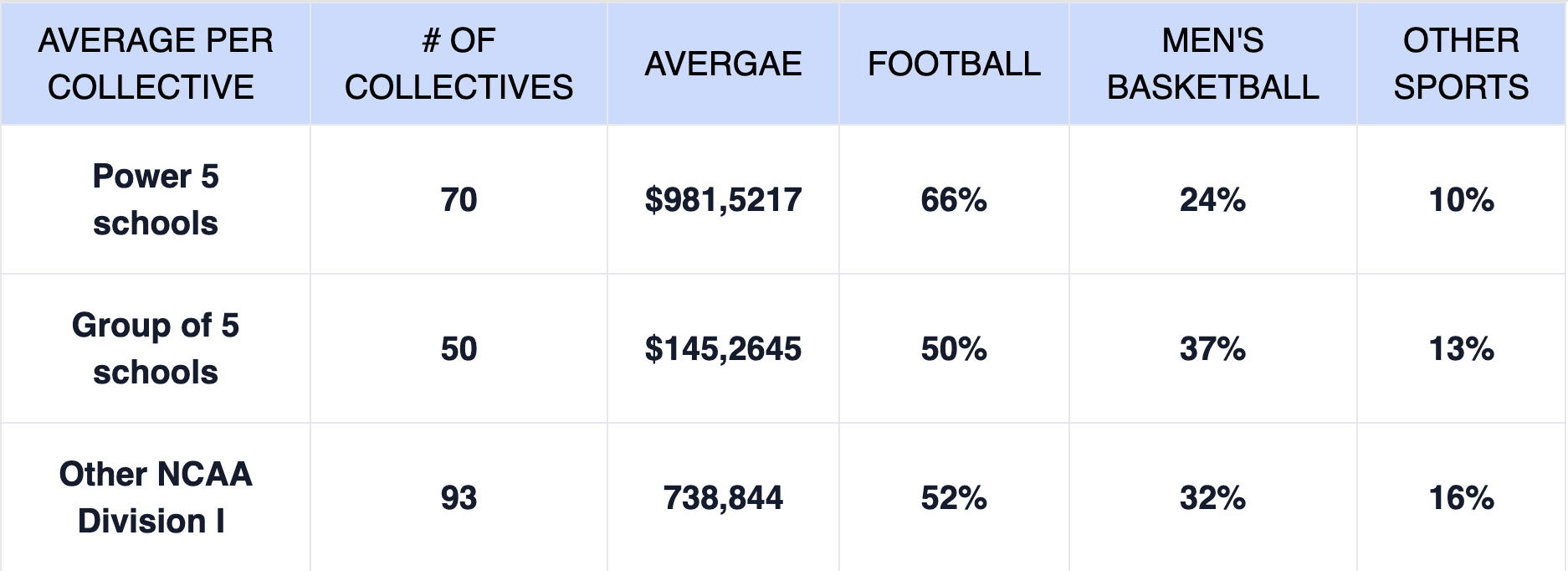
The data highlights how Power 4 schools have a massive NIL funding advantage, averaging $9.8 million per collective, compared to $1.45 million for Group of five schools and only $738,844 for other Division I programs. This significant advantage allows for these Power four schools to spend way more money throughout their rosters and the ability to use this money to recruit the top athletes and transfers. There are other takeaways when looking at the financials of these NIL collectives, like which sports are receiving the most NIL funding.
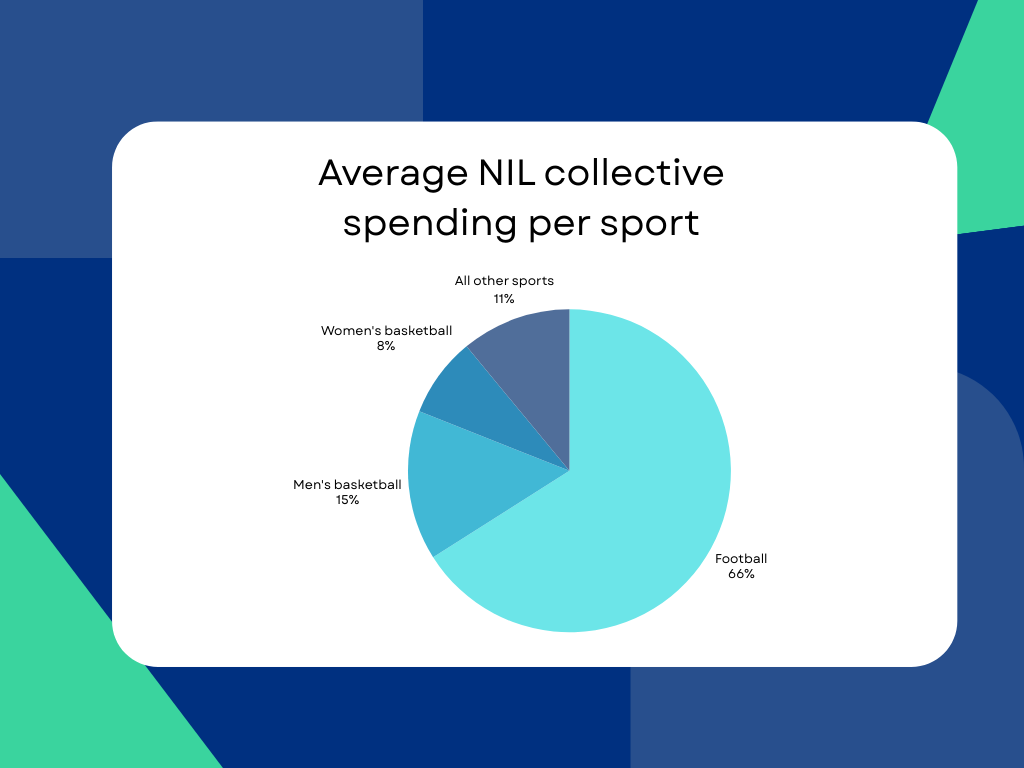
Power four collectives allocate 66% of funds to football, further widening the talent gap. While mid-majors devote higher percentages to basketball and other sports, their overall funding is too limited to attract the top talent consistently. This makes it difficult for smaller programs to retain or recruit top athletes, maintaining a competitive disadvantage.
NIL has made it increasingly more difficult for schools with smaller funding, donors, and NIL collectives to compete with the big schools of the SEC or BIG 10. These smaller schools cannot offer the amount of money for recruits, but the larger issue for schools like Quinnipiac or Mount St. Mary’s is that it is hard to retain their own talent. When athletes perform really well, they will have bigger power conferences reaching out and offering them large NIL deals to transfer. This problem for nonpower conferences and competing with the deep pockets of the SEC might only increase with the upcoming NCAA vs. House Settlement.
NCAA vs. House Settlement
The NCAA v. House settlement is a class-action lawsuit where former college athletes claimed the NCAA unlawfully restricted compensation, particularly through NIL opportunities. The settlement includes $2.7 billion in back pay for past NIL earnings and introduces a revenue-sharing model allowing schools to allocate up to $20 million annually to athletes. The power conferences are already locked into the settlement but the nonpower schools have the option to either opt in or out of the settlement.
If they opt in they have to spend up to that $20 million cap, which would be a lot harder for those smaller schools to be able to front those costs without the same donors and television contracts that the power schools have. This puts these mid-major schools in a tough position because on one hand that is a lot of money to come up with every year but if they aren’t offering direct payments to their players, it becomes harder and harder to be competitive.
“The end goal of this is if we’re going to opt in so we can potentially pay our players. We should pay our players or we’re not going to be good. So like basketball, for example, if we don’t start investing in our student-athletes in basketball, we’re gonna be anywhere from 8th to 13th place every year in the MAAC. That’s just what’s going to happen.” Davis said when talking about why Mount St. Mary’s opted into the settlement.
While this settlement may reduce reliance on NIL collectives, it benefits Power four schools that generate higher revenues, leaving smaller programs at a disadvantage in recruiting and competing for top athletes and championships. This allows for a tough scenario for athletic directors to weigh when deciding if they should opt into the settlement. They have to look at the school as a whole, the whole athletic department, and how the settlement would be financially doable.
“Small schools are very tuition-driven, through enrollment, and if schools feel like they have to cut students, it’s a tough sell on campus,” Davis said.
Davis is describing a scenario that many athletic directors are currently faced with. The new house settlement presents a shift from scholarship limits to roster limits. Traditionally, the NCAA has put a cap on the number of scholarships per sport, but not the total number of athletes on a team. Many smaller nonpower four schools have had larger rosters in sports like track, swimming, and baseball with minimal scholarships to help drive enrollment and tuition revenue.
These new financial pressures from revenue sharing push the NCAA or individual schools to cap roster sizes rather than just scholarship limits, which could lead to fewer opportunities for walk-ons or non-scholarship athletes, many of whom are paying tuition and helping sustain smaller athletic departments. The concern over the gap within college athletics extends across many different conferences and athletic leaders.
Mack Brown, the former head football coach at the University of North Carolina, emphasized at ACC media day the gap in college athletics is widening among schools.
“There’s the SEC, there’s the Big Ten, and then there’s everybody else,” Brown said.
The house settlement only widens the gap between the top and the bottom because the smaller schools can’t keep up with the spending required for the settlement.
There’s always been inequity in college sports. Not just in college football, but throughout college sports. There’s always been a lopsided piggy bank when it comes to the top versus the bottom. This settlement just exacerbates it.
This growing financial divide isn’t new, but the NCAA v. House settlement threatens to turn a long-standing imbalance into a divide. While the settlement may offer some relief, it also places additional pressure on schools that are already struggling to keep up. The reality is that only a select group of institutions have the resources to fully embrace the new compensation model without sacrificing other areas of their athletic programs.
Cutting rosters might reduce costs, but it also reduces headcount, hurting enrollment and eliminating a key part of the athletic and academic missions at many schools. Moving toward roster caps to manage athlete pay may solve one financial problem while creating another for schools already operating on thin margins.
The Transfer Portal and NIL Connection
Since the introduction of NIL in 2021, the NCAA’s transfer portal is becoming clogged with players seeking to move from one school to another. Between 2021 and 2023, Division I student-athlete transfers increased by about 75%, growing from 17,781 to 31,000 entries.
There is a direct correlation between NIL and the transfer portal. Fewer athletes transferred before NIL, with transfer rates around 9-10% annually with the transfers primarily being driven by playing time, coaching changes, or the academic fit. However, with NIL the transfer portal activity surged, with 15-20% of athletes transferring annually. Although the reasons above for transferring can still be true many athletes entered the transfer portal for NIL opportunities and higher financial compensation.
Smaller schools often develop talented athletes, only to see them transfer to larger programs that offer better NIL deals. This creates constant turnover, making it difficult to maintain a stable roster and build long-term success.
Once again, the mid-major schools are left at a disadvantage. Oftentimes when they have winning seasons and win conference tournaments and play in NCAA tournaments their players get more attention and exposure. This increase in visibility leads to many of these players entering the transfer portal to see what their ceiling is and what offers they can generate from bigger programs.
Greg Amodio, Quinnipiac’s athletic director, tries to avoid panic over losing top talent to bigger schools. His focus is on players who choose to remain Bobcats.
“We have to worry about the players who want to be here. We encourage our athletes to do what’s best for them and oftentimes players leave to get more opportunities but have ended up transferring back the year later because they miss the family aspect that we have at Quinnipiac” Amodio said.
Amodio knows that they cannot always match the price tags that a lot of other programs have to offer, but he thinks the smaller nurturing environment at Quinnipiac is invaluable for some student-athletes. Quinnipiac Men’s and Women’s Basketball both had the MAAC Player of the Year on their team in 2025. After each of their seasons concluded both Amari Monroe on the Men’s side and Gal Raviv on the women’s side entered the transfer portal.
Raviv has committed to the University of Miami, which has a large NIL backing and plays in the ACC. Raviv proved that having success at a smaller school can get you the attention and opportunities to transfer to a bigger program. However, Monroe took a different path deciding to come back to Quinnipiac and withdraw his name from the portal.
The transfer portal offers a different path for athletes feeling like they can get more out of college athletics than what their current situation provides. However, with limited restrictions, players can transfer as much as they want. It becomes increasingly difficult for coaches and athletic directors to maintain their rosters from year to year. The connection between NIL and the portal will only continue without firm regulations on both and college sports will continue to be the Wild West and continue to be harder for mid-majors to compete.
Athlete Experience: Opportunity vs. Burden.
The state of college athletics presents a lot of opportunities for student-athletes, but that is also coupled with a lot of large responsibilities and expectations. For some student-athletes managing these tasks is no problem and they can take care of the NIL obligations and they see the current layout of college athletics as a positive.
Quinnipiac men’s basketball sophomore Akintola Akinniyi sees NIL as an opportunity to become more than just an athlete.
“ I love NIL. I mean, I think I literally lead Quinnipiac in independent NIL funds.
So I have made the most of it. I think it’s great for athletes to be able to profit off the name that they have” Akinniyi said.
He also acknowledges that being a student-athlete who takes advantage of NIL opportunities is time-consuming and it is a commitment that not every student-athlete wants to pursue.
“It’s difficult, but it’s just kind of just like, how bad do you want it? I guess I do get paid to play basketball, but if they compensate me enough, then I’ll do it. It’s worth it if they compensate me enough. It’s a lot to balance, so it has to be worth my while. So it’s kind of just all dependent on you” Akinniyi said when asked about the balance of being a student-athlete who takes advantage of NIL.
However, there have been many instances where NIL has gotten in the way of student-athletes, and they have received lots of backlash. Recently the quarterback at Tennessee Nico Iamaleava was rumored to have been talking to other schools about getting a larger NIL deal behind Tennessee’s back. Tennessee then cut Iamaleava, and he transferred to UCLA. Iamaleava faced a lot of backlash on social media for his decision saying that he had already been treated quite well at Tennessee and that he was greedy and treating college football like the pros. He is not the first player who has transferred this year alone because of NIL, but it brings up the point that maybe NIL isn’t always such a good thing. The lack of limitations surrounding NIL and the other burdens and expectations that come with NIL can be too much for college athletes who still have to balance academics.
The President of the NCAA, Charlie Baker, has been outspoken about NIL. In a social media post he acknowledged that with the current state of NIL, it is hard to hold anyone accountable and can oftentimes lead to the student-athlete losing out.
“We continue to see evidence of dysfunction in today’s NIL environment, including examples of promises made but not kept to student-athletes,” Baker said.
The current landscape of NIL allows both opportunities for athletes but also a lot of responsibility and uncertainties.
Outlook Of College Athletics
College athletics has reached a crossroads. What was once a system rooted in development and opportunity is now a space that increasingly mirrors professional sports. Between NIL, the transfer portal, and the NCAA v. House settlement, the landscape of college sports has changed, and schools, athletes, and administrators are all learning to navigate this new game in real-time.
Athletic directors like Bradley Davis and Greg Amodio are currently caught in the middle. They are tasked with keeping programs competitive while managing spending, enrollment impacts, and athlete expectations. Meanwhile, athletes have more on their plates than ever. While this landscape has created new opportunities, especially for those with the deepest pockets, it has also widened the gap between Power 4 programs and the rest of Division I.
Mid-major schools currently face an uphill battle to recruit, retain, and invest at the level now expected in this new era. For programs like Mount St. Mary’s and Quinnipiac, one good season often becomes a launching pad for players to move on, not build long-term success. The transfer portal, and NIL, have turned college rosters into revolving doors, forcing the smaller schools to rebuild year after year while competing against offers they can’t match.
Aside from competitive imbalance, these issues raise questions about the direction of college athletics. What does it mean to be a student-athlete in 2025? Where is the line between opportunity and burden?
While athletes now have more opportunities and financial upside, the burden of managing it all on top of performing athletically and academically is substantial.
The NCAA has acknowledged these issues. As Charlie Baker noted, today’s NIL landscape is filled with broken promises, unregulated deals, and student-athletes who often don’t have the support they need to succeed off the field. Without clearer guidelines, the chaos will only continue, leaving smaller schools further behind and more student-athletes stuck navigating a system that isn’t working for them.
College athletics has become professionalized. However, it lives in a gray area where money drives decisions, but guidelines haven’t been clear. If nothing changes, college athletics risk becoming unsustainable for all but the top revenue generators. But with clearer guidelines, there’s still room to preserve what’s best about college sports while embracing the future it’s already stepped into.