
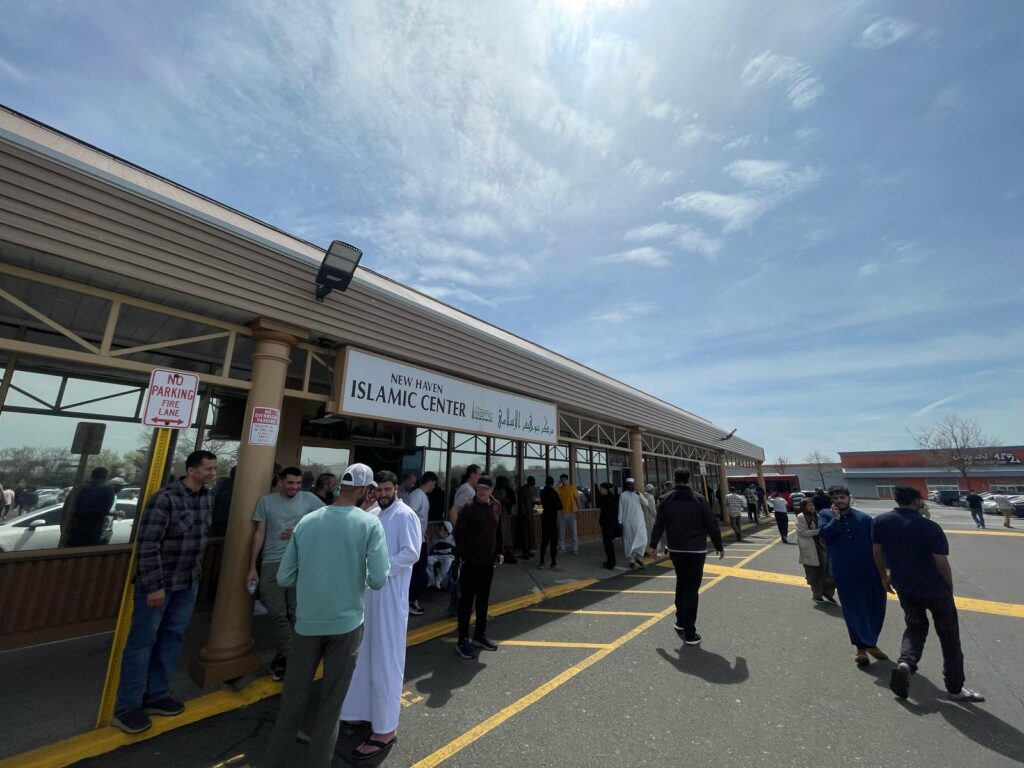
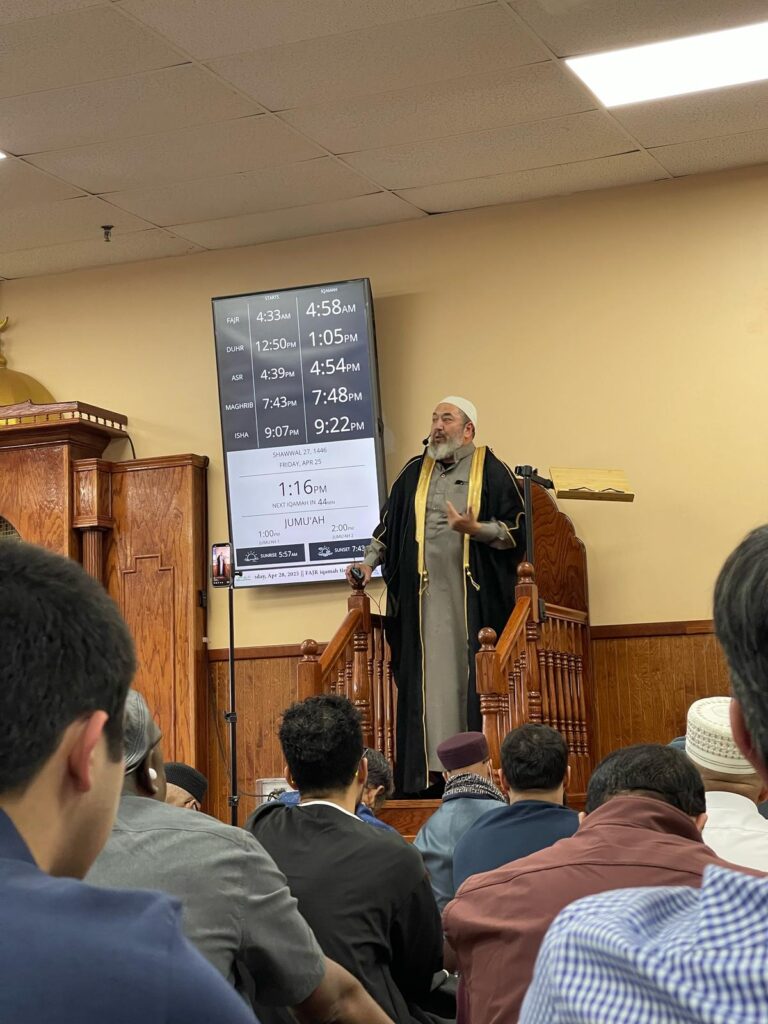
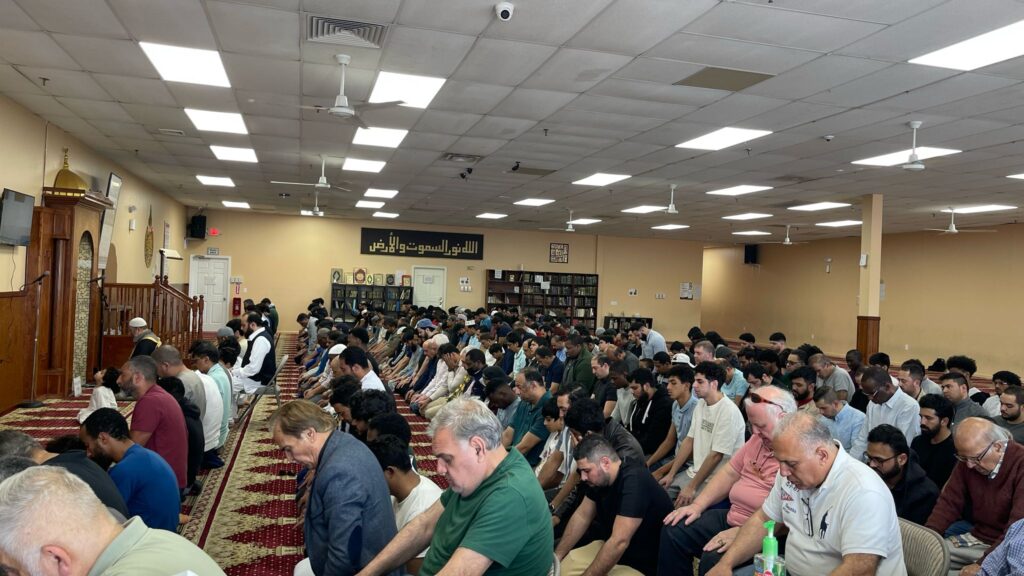
As the Iqama call begins softly through the main prayer hall of the New Haven Islamic Center (NHIC), hundreds of worshippers quickly become quiet. It is a calm moment. Shoes left neatly in rows, voices hushed, hearts aligned. The scent of worn rugs and spices from the neighboring halal restaurant lingers in the air. Men and women, shoulder to shoulder, move forward.
Some wear flowing thobes or brightly colored salwar kameez. Others wear jeans and hoodies. There are elders from West Africa with prayer beads in hand, university students from the Middle East scrolling through Qur’an apps, and young boys whispering in Albanian, Arabic, Urdu, and English. Here, language does not matter. Neither do the dozens of homelands. At NHIC, this diversity is not something they manage — it’s something they embrace.
On Fridays, the hall fills beyond capacity. During Ramadan, it overflows. On Eid, the parking lot transforms into a sea of prayer mats and bowed heads, with more than 5,000 people gathered beneath the open sky. This place in Orange, Connecticut, is more than a mosque.
It’s a community, a safe space, and a home built by people from many backgrounds. This is a story of how a humble prayer room became a beacon of unity — and how one Islamic center redefined what it means to be American.
From humble beginnings to a beacon of belonging
The story of NHIC does not begin with grandeur. It starts in the 1980s with a few Saudi students at the University of New Haven searching for a place to pray. They pooled resources, rented a modest house in West Haven, and turned it into a quiet corner for faith.
“It was just a prayer room back then, but it was enough to gather us,” recalls Abdul Rahman Nached, a Syrian-American who has lived in New Haven for more than 30 years. “As the Muslim population grew, we realized we needed more than just walls — we needed a community.”
And that community grew fast. Soon, Sudanese families arrived. Next came Pakistanis, Albanians, Moroccans, and Egyptian immigrants. Converts, refugees, and professionals were all drawn to the idea of building something lasting.
In 2013, the community made a bold decision by purchasing the entire Bull Hill Plaza in Orange. It was not just about space; it was a bold vision. The plaza, once half-vacant and rundown, would become NHIC’s new home. It would serve not only as a mosque, but also as a school, a marketplace, and a hub for interfaith dialogue and youth programming.
“I have seen this place rise with my own eyes,” says Nached. “My wife, my son, and my daughter — all of us have served here. And when people convert to Islam, I have had the honor to guide them through the Shahada.”
For many like him, NHIC is more than a building — it’s a legacy of faith and family.
Muslims: A growing group
In the quiet suburbs of Connecticut, something quietly powerful has been happening. Over the past few decades, the Muslim population in the state has been steadily rising — not in loud declarations or headlines, but in family dinners, Friday prayers, and whispered du’as before school exams.
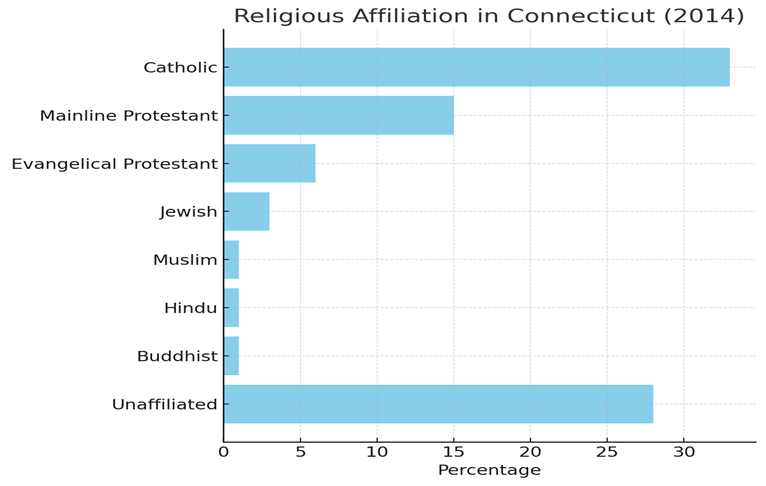
The Pew Research Center‘s 2014 Religious Landscape Study showed that Muslims formed 1% of Connecticut’s 3.59 million people. The largest religious group was Catholics at 33%, followed by Evangelical Protestants at 13%, and Mainline Protestants at 17%. The Jewish population constitutes 3%, Hindus make 1%, and Buddhists are also 1%. An additional 28% of the adults in Connecticut identify as religiously unaffiliated, including atheists, agnostics, or those who would simply say, “nothing in particular”.
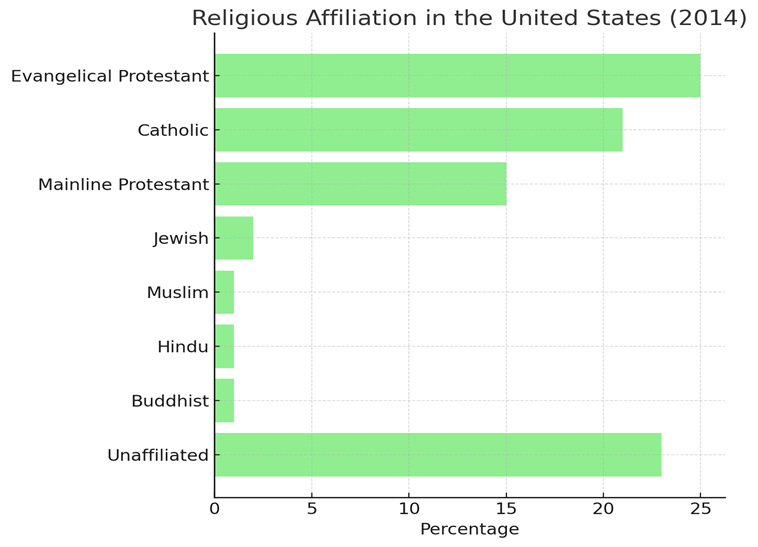
Muslims number a little over 1% nationally. In contrast, the bigger religious landscape of the U.S. varies widely. Evangelical Protestants make up 25% of the population, while Catholics comprise 21% and Mainline Protestants account for 15%. Jewish Americans make up 2%; Hindus and Buddhists make 1% each. Larger nationally are the religiously unaffiliated at 23%, although it is not higher than Connecticut’s 28%.
These comparisons bring out how Connecticut approaches particularities on the regional scale and generalities pertaining to religious diversity.
Behind the numbers, there are families like those of NHIC—immigrants, converts, and second-generation Americans. Their experiences are not just about religion. They are also about identity, balance, and belonging. They are students, business owners, educators, engineers, and parents—and more and more.
A mosque unlike any other
In Connecticut, no other mosque operates quite like NHIC. With soaring operating expenses and fluctuating donations, most Islamic centers rely on regular fundraising to stay afloat. NHIC, however, chose a different path: financial independence.
“We wanted stability, not just for us, but for generations to come,” says Khalid Mohamed, president of the NHIC Board of Trustees. “So, we bought the plaza and began leasing retail units.”
Today, those businesses — including halal markets, clothing boutiques, and restaurants — support the mosque’s core functions. The model is part faith, part finance, and wholly community-driven. NHIC uses the rent to pay for educational programs, maintenance, and charitable services.
“It’s about long-term sustainability,” NHIC board member M. Asaf Sheikh explains. “If we become financially independent, we can do more to help the community.”
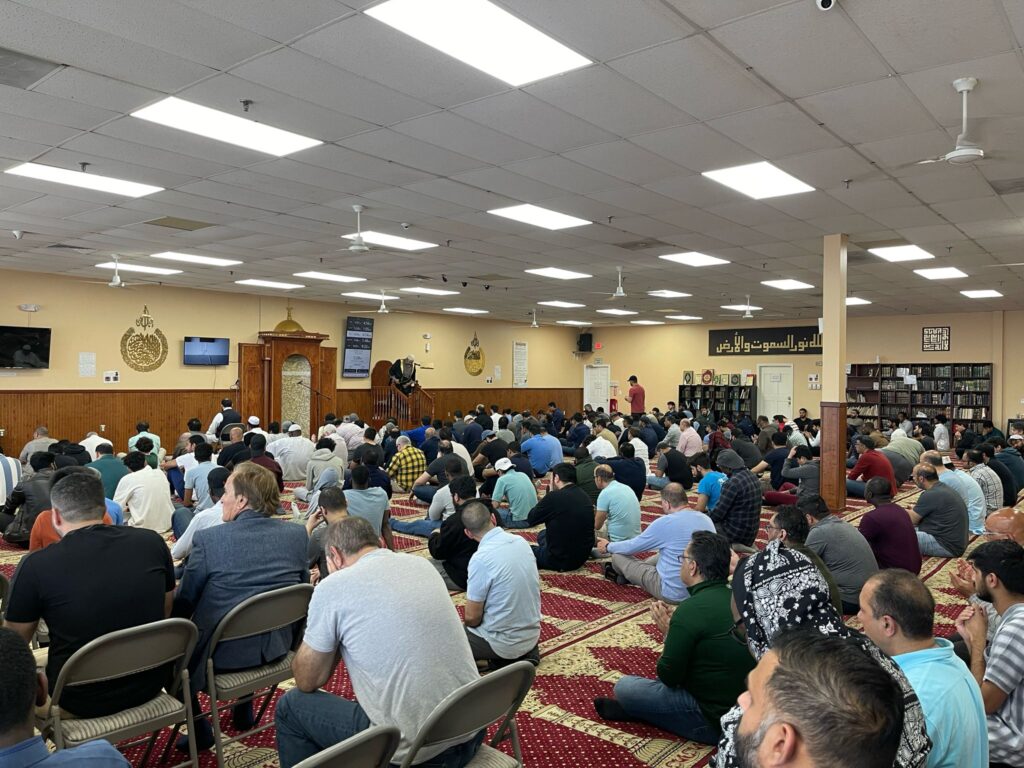
And help, they have. The center now hosts over 1,500 worshippers each Friday, with special events drawing thousands more. NHIC’s registered membership has also grown significantly.
In 2023, the mosque had about 635 members; by 2024, that number had risen to nearly 1,000, according to Jamal Shreiteh, a member of the Board of Trustees. This steady increase reflects the community’s growing trust in NHIC’s services and leadership.
The center becomes unrecognizable on Eid. There are food booths, kids playing, families sharing sweets, and volunteers directing traffic in the lot-turned-prayer-field.
“This was never just about real estate,” says Sheikh. “It’s about dignity — about creating a space where we don’t have to beg to exist.”
The ripple effects go beyond the Muslim community. Local businesses benefit from foot traffic. Non-Muslim neighbors are welcome for open houses and interfaith dinners. Even tenants who aren’t part of the faith praise the NHIC for their generosity and flexibility.
“That does not happen. Not in the United States,” said Ali Hasan, local shop owner. “But they aren’t just landlords. They’re neighbors.”
For NHIC, that’s the whole point. They are not simply serving Muslims—they are nurturing a community, one prayer, one dollar, and one handshake at a time.
Tapestry of cultures
If you walk through the New Haven Islamic Center on a Friday afternoon, the first thing you will notice is not the size of the crowd—it’s the blend of languages and colors. English, Arabic, Urdu, Albanian, Somali, and Bangla mix in the air like the scent of cinnamon tea and warm samosas after prayer. A Sudanese man greets a Pakistani teenager with a fist bump. A hijabi from Bosnia chats with a convert from New Haven about upcoming events. It’s not just a congregation—it’s a patchwork of continents stitched together by faith.
“Being part of this community, the first thing that you experience is that there is no racial profiling,” says Luan Klobucishta, an Albanian-American who lives nearby. “Everyone worships together, eats together, and celebrates together. We are such a diversified community, and somehow, we always find a way to communicate.”
Klobucishta’s experience speaks to the very heart of what NHIC has become: a living model of inclusivity. His mother’s side is Roman Catholic, but he says being part of NHIC has never made him feel “other.” Instead, he describes his journey in Islam — and in this community — as “nothing but awesome.”
In his words, “It is like being part of one big family.” And that family, it turns out, is remarkably resilient. Language barriers? They exist but rarely limit interaction. People adapt, using whatever language they share—English, gestures, or a smile.
“We always find a way to understand each other,” Klobucishta says. “And that creates something special, especially for our kids. They learn early how to belong to more than one world.”
That sense of belonging is echoed by Elsadiq Eltijin, a Sudanese community member. He admits that at first, he was nervous.
“I only speak Arabic, and I imagined that I would not be able to blend in,” he says. “But this center was created to meet the needs of everyone. It embraces you, no matter where you’re from.”
This cultural inclusivity is not just accidental. It’s deliberate. The mosque offers multilingual programming and encourages cultural celebrations. Events are not only designed to educate but to unify—whether through food fairs, heritage nights, or youth events where children learn Qur’an side by side with peers from different continents.
Akbar Dar, the NHIC Executive Committee’s Secretary, originally from Pakistan, sees this diversity as both a strength and a responsibility.
“I’ve been coming to this center since the 1980s — first with my children, and now with my grandson. We all learned Arabic and the Qur’an here. And now, watching my grandson learning in the same space is incredibly fulfilling,” he says. “Everyone who lives in America should consider this country their own. We preserve our values and culture, but we also develop together as one community.”
NHIC’s diversity is not just about where people come from. It’s about how they come together—how they listen, adapt, and build something that transcends ethnicity. In a world often fractured by difference, the center stands as a reminder: unity does not require uniformity.
Leadership and vision
This remarkable sense of unity did not appear overnight. Leadership patiently and intentionally cultivated it, understanding one fundamental truth: diversity does not mean being the same. That phrase — spoken often by Imam Mahmoud Kamal, who led NHIC for two and a half years transformative years — still echoes through the community.
“Unity here is built through shared values, not identical backgrounds,” Kamal once said during a sermon. That principle defined his leadership. Instead of asking people to erase their cultural differences, Kamal encouraged them to lean into them — and to find strength in common ground. Under his guidance, NHIC launched new programs designed to encourage dialogue and mutual respect.
He opened space for women’s voices, advocated for youth inclusion, and clarified that everyone — whether a new convert or a lifelong Muslim — deserved to be heard.
“Nobody should be discriminated against,” he once told the community, “No matter if they practice a lot or a little.”
Kamal’s progressive stance wasn’t without its critics. Some community members, particularly those from more conservative backgrounds, struggled with the mosque’s increasingly inclusive approach.
Debates emerged over issues like gender roles, interfaith outreach, and public responses to global conflicts. But Kamal didn’t shy away from difficult conversations. Instead, he modeled the kind of compassionate leadership that demanded more listening than lecturing.
During a heated debate on women’s access to programming space, Kamal invited sisters to speak openly during Friday announcements.
“If we listen more,” he told the board, “We will lead better.”
That culture of listening outlasted his tenure. Today, NHIC’s leadership team includes Sister Fatima Lemfadel, the Sisters’ Liaison, ensuring that women’s voices are part of every decision. The Executive Committee—led by President Suleman Babatunde Lawal and supported by figures like Usman Shaaba, Akbar Dar, and Nadeem Sayyed — continues Kamal’s mission of service-based leadership.
The Board of Trustees, chaired by Khalid Mohamed, brings long-term vision and investment oversight, balancing the day-to-day needs with strategic growth.
NHIC is a dual structure, one that combines spirituality with sustainability. And at the heart of both branches is a leadership model based on respect, not rank.
“Even if we have opposing opinions, here we listen,” says Elsadiq Eltijin. “And that’s why we’re strong.”
Teaching the next generation
If the prayer hall is NHIC’s spiritual heart, its classrooms are its future. Tucked behind the main sanctuary is a small educational wing, where over 110 students gather three times a week to study the Qur’an, Arabic language, and foundational Islamic teachings. They sit cross-legged on rugs, reciting verses, asking questions, and building friendships that bridge national and linguistic borders.
“We don’t have statistics on where all these students come from,” admits Mohamed. “But they come from all over the world. And they come together — week after week — to learn.”
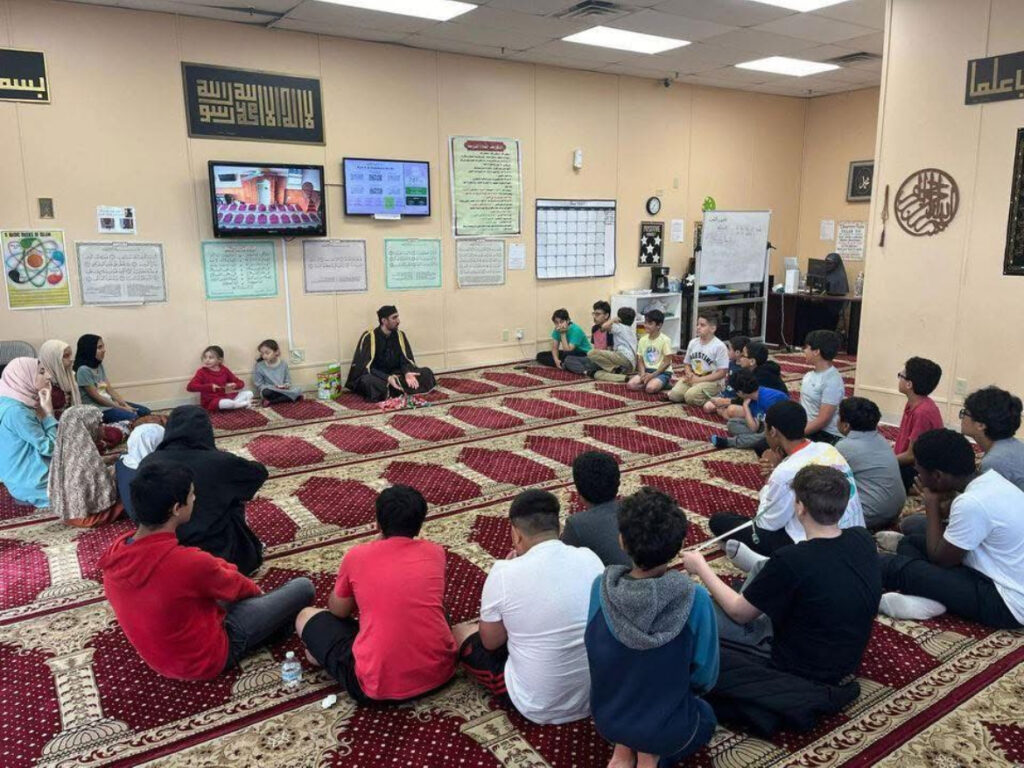
It’s not just religious education. The school teaches discipline, empathy, and identity. The goal is not to enforce one version of Islam but to offer a foundation strong enough to support each student’s unique journey.
“We hold a Qur’an memorization competition every Ramadan,” says Khalid Mohamed, who oversees both spiritual and investment activities. “It’s wonderful to see the confidence and pride these children show. They represent the future of our community.”
But education at NHIC extends beyond the classroom. Clubs like the Girls Club and Boys Club organize activities ranging from hiking in Sleeping Giant State Park to canoeing and Ramadan crafts.
The goal is simple: keep children connected, engaged, and rooted in a positive sense of Muslim identity.
“The classroom is where they learn the faith,” says Maya Zaher, a teacher at the center. “But it’s in those adventures and conversations that they learn how to live it.”
Importantly, NHIC maintains a strong code of conduct. Children are not allowed to bring electronic devices to class, and programs emphasize values like respect, humility, and cooperation. For families struggling with financial hardship, fee waivers or installment plans are available.
The educational wing mirrors the larger NHIC mission: blending tradition with relevance and building bridges rather than barriers.
One of the mosque’s dreams is to establish an Islamic elementary and high school.
“My goal is to build an Islamic school for our children, but we are currently facing financial issues,” says Shreiteh. “It’s better for our children to grow up and learn in Islamic schools so they can develop Islamic values and morals. That will be their foundation.”
Despite challenges, Shreiteh remains committed.
“I will do my best to achieve this goal for all our Muslim sons and daughters living here,” he said.
Behind the scenes, two wings of administration ensure smooth operations: one focuses on the day-to-day needs of worshippers—cleanliness, prayer schedules and event setup.
The other, a supervisory department, oversees the mosque’s financial investments, ensuring sustainability for future generations. For many, this dual structure feels like divine design — faith and function working side by side.
A joyful faith: Where identity meets play
At the New Haven Islamic Center, joy isn’t an afterthought — it’s part of the curriculum. On a sunny weekend in early spring, laughter spills from a group of children darting between balloons, picnic blankets, and activity stations just outside the mosque’s main building.
The Girl’s Club is hosting a Ramadan challenge day — complete with drawing competitions, face painting, a cake contest, and a surprise scavenger hunt. About 30 girls, ages 5 to 12, move from station to station.
Unsurprisingly, the Boys Club is preparing for a canoeing excursion the upcoming week. Past outings have included hiking through Sleeping Giant State Park, team-building workshops, and winter coat drives.
These aren’t just recreational events —they’re designed to foster confidence, leadership, and a deep-rooted sense of belonging in a world where many Muslim kids are often made to feel “other.”
“We are raising kids who know who they are,” says youth coordinator Ahmad Nasir. “Not just in the masjid, but outside in the world. These programs help individuals embrace their Muslim identity. And nowhere is that love more visible than during Ramadan.
Every evening during the holy month, NHIC transforms into a festival of faith and food. Families gather long before Maghrib. Volunteers rush to stack dates and water bottles. Children set out colorful mats while aunties stir giant pots of Somali rice or Pakistani curries in the kitchen.
“We serve food from everywhere,” says Lemfadel, the Sisters’ Liaison. “You can’t tell if you’re in Fez, Karachi, or Bridgeport.”
After prayers, people sit together — elders and children, immigrants and locals, converts and lifelong Muslims. Iftars at NHIC are not just about breaking fast. They’re about breaking walls.
During Eid, that spirit of joy crescendos. The plaza bursts into color. Inflatable slides go up. Food vendors circle the parking lot. Henna stations and games line the walkways.
Klobucishta, the Albanian community member, says, “Eid here is magical. It feels like the whole world came together just to celebrate love.”
These moments of shared happiness matter deeply. For children navigating hyphenated identities — Muslim and American, Arab and Black, Bangladeshi and Connecticut-born — NHIC offers something rare: a space where all their parts are welcomed.
Facing global tensions with unity
NHIC does not exist in a vacuum. The mosque’s doors open into a world often marked by division — political, religious, and cultural. And recently, the strain has deepened. As the Palestine-Israel conflict re-erupted in global headlines, many Muslim communities in the U.S. found themselves navigating fear, grief, and growing tension.
NHIC was no exception.
“People came to the mosque not just to pray, but to process,” says President Khalid Mohamed. “There was so much pain in the room.”
Instead of retreating into silence, NHIC responded with clarity and care. The leadership organized community-wide du’a nights and offered space for grief circles.
Volunteers created resource packets with mental health support and safety guidance for those feeling vulnerable. Friday sermons began to address the complexities gently — not to take political sides, but to center compassion, justice, and spiritual resilience.
Klobucishta noticed the shift.
“We did not avoid the topic. We confronted it with love,” he says. “We talked to each other, not just about our pain, but about how we could support each other — even our non-Muslim neighbors.”
The NHIC leaned into its long-standing interfaith work. Within days, the mosque hosted a dialogue night with members from local churches and synagogues. The goal wasn’t debate — it was empathy.
“We wanted to model what it means to disagree without dehumanizing,” said Usman Shaaba, Vice President of the Executive Committee. “And that starts by breaking bread, not pointing fingers.”
Social media also became a lifeline. The mosque’s Instagram and Facebook pages posted Qur’anic reminders about mercy and unity, along with updates about prayer times, community resources, and safety information.
Messages were translated into multiple languages to ensure accessibility for all members. Behind the scenes, NHIC leadership quietly coordinated with local law enforcement to ensure security while avoiding panic.
“We would rather not scare people,” said Shaaba. “We want them to feel protected and empowered.”
Islamophobia is not a new challenge. According to the Institute for Social Policy and Understanding’s 2022 American Muslim Poll, Muslims in the U.S. scored the third highest on the Islamophobia Index — meaning they are not just the targets of bias but also internalize it.
NHIC counters such prejudice with community strength. Through charity drives, youth empowerment, and constant education, the mosque teaches its members to hold their heads high.
A model mosque in a modern world
The NHIC has built a self-sustaining spiritual center, a multicultural haven, an educational institution, and a community wrapped into one address. That shopping plaza that funds its programs is a blend of retail and religious revival. It’s a place that offers Qur’an classes and canoeing trips. That’s why NHIC is drawing attention beyond Connecticut.
“They’re not just landlords,” said Ali Hasan, a small business owner who rents space in the plaza. “They’re neighbors.” It’s a phrase repeated often here — neighbors, not just worshippers.
NHIC doesn’t want to exist behind a fence. It wants to exist within a community. Its leaders partner with local schools, meet regularly with town officials, and invite non-Muslim guests to Friday prayers, Ramadan Iftars, and interfaith roundtables. These aren’t publicity stunts —they are part of NHIC’s foundational values of openness and compassion.
That intentional openness may be NHIC’s greatest lesson to others. “Unity is not about pretending we are the same,” says Mohamed. “It’s about building something strong enough to hold all of our differences.”
And those differences — in language, culture, religious interpretation, or even politics — are not obstacles here. They are fuel. They lead to better conversations, more activities, and a stronger community. NHIC is proof that pluralism and piety are not mutually exclusive.
Other mosques and Muslim organizations across the region have begun reaching out to NHIC’s leadership for guidance on adopting similar financial and administrative models. Some are exploring leasing commercial spaces.
Others are keen to learn how to structure youth clubs, design Ramadan events, or engage with the non-Muslim public without diluting their religious values.
“We are not perfect,” Mohamed adds, “but we are trying to leave something behind that others can build on.”