
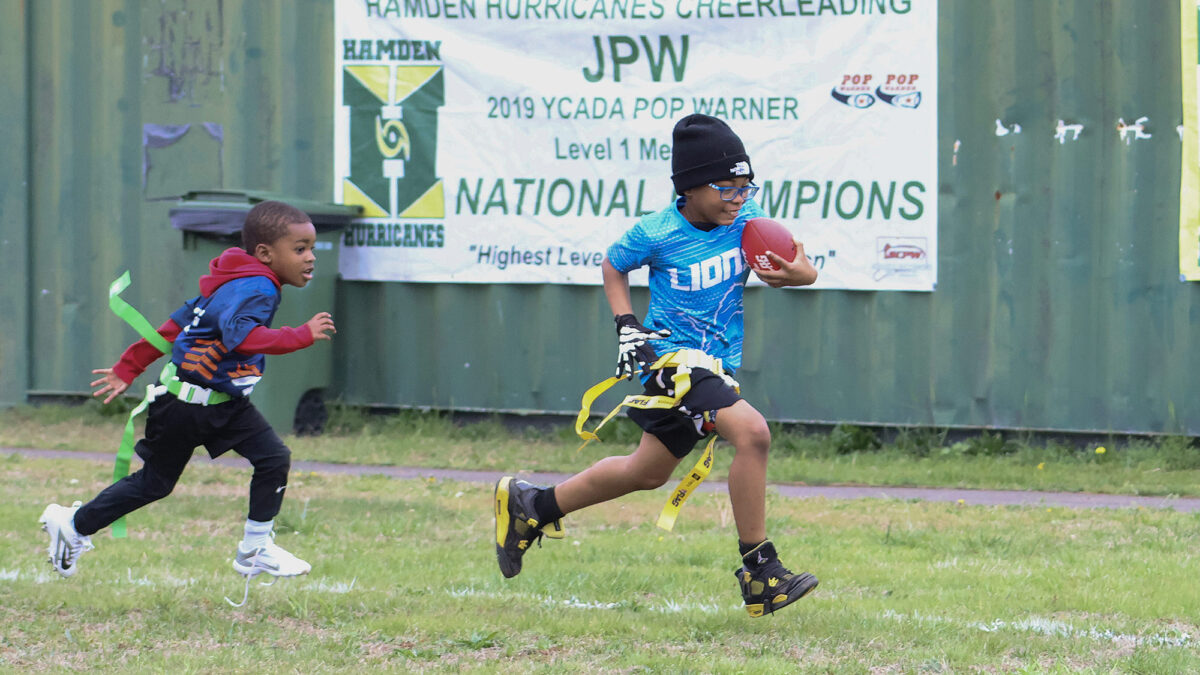
Youth tackle football is not dead. It certainly is not what it once was either.
As concerns continue to rise surrounding the safety of tackle football, specifically regarding player brian-related injuries, engagement has largely decreased since 2013 — a time period associated with the start of football’s ‘concussion crisis.’
As of 2023, the Washington Post reported participation is down 17% since 2006.
There is also an inaccessibility that inhibits tackle football — at both the economic and gender level. While young boys flock to the sport in droves, tackle football tends to leave young girls and children of lower economic status off the field. Not-so-suddenly, the downfall of a sport so beloved by Americans becomes understandable.
And if youth tackle football is not already dead, then flag football will almost certainly kill it.
‘Pop warner is like a dinosaur right now’
Matthew Kennedy props himself up in a booth in the back of Hamden’s Glenwood Drive-In, ignoring his lobster roll. In over an hour, he’s taken one bite. He pulls his Hamden Hurricanes football hat down further on his head.
“Pop warner is like a dinosaur right now,” he said. “It is huge if your kids are into it, but it’s very hard in Hamden to really get an age-based tackle program from ages six to 14 because of all the different things kids do in our town.”
Pop Warner Little Scholars is the largest youth football, cheerleading and dance organization in the nation. Think the football equivalent of little league baseball. Over seven years ago, Kennedy, 58, felt the program, the Hamden Fathers Football and Cheerleading Association (HFFCA), known more colloquially around town as Hamden Hurricanes pop warner, needed a boost. As he and HFFCA president Calvin McGee rode home from an indoor football game in Middletown, they saw signs advertising the local flag league.
And there it was. An answer.

Kennedy and McGee’s realization was not a one-off experience. Hundreds, if not thousands, of local towns have ushered in flag football for all that it offers. Hamden’s operation has grown into a respectably-sized organization in the time it has existed. Last year, 120 local kids participated in co-ed flag football on 18 teams across three divisions, the largest registration class Kennedy has seen in his 15 years with the HFFCA. The A Division accounts for children aged 5-7, while the B Division suits kids 8-10 and the C Division houses kids 11 and up, though the age cuts off at 15. Last year, there was one 16-year-old player. Kennedy and his wife Jennifer put the younger of their two sons, now aged 26 and 21, through the program.
But it is hard to get 14 and 15 year olds to want to play flag football, Kennedy said. By the time adolescents reach high school, they want to play for the high school program or spend their summers on the baseball or basketball circuit. Those who do play flag usually stick around for tackle, with Kennedy stating about 65% of his flag players also participate in tackle.
With all that flag offers, that is likely to change.
Safety first
Flag football’s upswing in popularity is a three-pronged approach: Safety, accessibility and cost-efficiency. Flag football is objectively safer to play than tackle football because it is a non-contact sport. Defensive players must pull a flag off of a belt tied around an offensive player’s hip to perform a tackle. Each belt has two sides, one on each hip. There is no hitting, there is no blocking and there is no contact, aside from the occasional trip in the younger divisions.
“The best thing about it is the league is non-contact,” Kennedy said.
Concussions and other brain-related injuries have always existed in football, but the gravity in which their effects are being validated has only increased in the last decade. The Athletic reported that NFL players suffered 432 concussions combined in preseason and regular season games as well as practices between 2022 and 2023. A September 2023 study performed by Mass General Brigham in Boston, one of the largest hospital-based research enterprises in the country, found that, out of a poll of nearly 2,000 former NFL players, 35% felt they would be diagnosed with chronic traumatic encephalopathy (CTE) upon their death. Twenty-five percent reported having frequent suicidal thoughts.
It is not uncommon to come across parents who may forbid their child from playing tackle football for these very reasons. Flag football provides a much safer alternative.
“There’s a lot of parents saying … And I’m not saying it will happen, but there’s a potential that, by the time my child is 55 he’s drooling and can’t remember where he parked his car because he’s suffering from CTE.”
Meghan Lewis,
Quinnipiac clinical professor and lab coordinator of athletic training and sports medicine.
Concussions are the most common type of head injury seen in tackle football players, Lewis said. As an athletic trainer, Lewis worked with the University of Connecticut’s football team during her undergraduate career before transitioning to the University of North Carolina in pursuit of her graduate degree. Part of the reason why Lewis gravitated to Chapel Hill was for her admiration for the work that researchers at the college were doing on concussions and other brain-related injuries. She venerated Kevin Guskiewicz, current president of Michigan State University and formerly of UNC Chapel Hill, where he first worked as a professor of athletic training. The injury has always fascinated and intrigued Lewis, she said. Since her time on the sidelines to her job now instructing the next generation of athletic trainers, she has seen the perception around concussions shift to be much more sympathetic toward those who suffer them.
“We’ve kind of seen the pendulum swing from one end to the other. I always tell my students, early on in the late 90s and early 2000s we were really for so long acknowledging concussions but in a way that it was this right of passage. Like, ‘Oh look at him. He definitely got his bell rung but he’s getting back on the line of scrimmage,’” Lewis said. “We didn’t value the gravity of a concussion. As time progressed, we started to have more respect for just how significant a concussion can be.”
Repeated head traumas — like concussions — can significantly affect an athlete’s health, both physically and mentally. One manifestation of that is CTE.
“It’s this cumulative effect of someone who’s sustaining repetitive hits to the head that might seem pretty benign because that person doesn’t necessarily have a concussion after that contact,” Lewis said. “But over time, when that’s happening hundreds and hundreds of times over the course of a week, and over the course of a 20-year playing period between youth football and the end of a collegiate career or a professional career. What is the toll ultimately that that takes?”
In defense of tackle football’s safety, there are two arguments. Kennedy presented one, while Lewis the other.
Kennedy said tackle football is not as dangerous if it is coached correctly. With proper technique and guidance, an athlete can limit his or her own physical damage by performing the correct maneuvers securely.
“The sad part is, (when) coached correctly tackle football… It’s actually more dangerous to play soccer,” he said. “You have no padding. Any hard hit in soccer produces a serious injury: fracture, twisted ankle, broken ankle, concussion. Football is more physical, yes, but NFL Football and NFL Flag does its best to make sure there’s no contact.”
The HFFCA has not reported a ‘serious concussion’ in four years, Kennedy said, and the ‘false narrative’ surrounding concussions and traumatic brain injuries has seriously deterred parents from enrolling their children in local pop warner leagues. Of the coaches who volunteer their time captaining flag teams for the HFFCA, about 90% also coach tackle football, either in Hamden or elsewhere, Kennedy said. They’re USA Football certified, meaning coaches learn the core concepts of the game, ranging from principles of safer contact to abuse prevention through a certification that costs $15 on the USA Football website. Flag now has its own certification assessment. Kennedy said coaches learn to apply their tackle coaching techniques in flag, where there is much correlation.
The second defense highlights the equipment used during play. New innovations like the guardian cap and the Q-Collar have been rolled out in professional leagues in the past few years, giving players an opportunity to test the products to their liking. In the NFL, the caps debuted in training camps starting in 2022, first appearing in regular season games in 2024. The guardian cap, consisting of an additional layer of padding draped over a player’s helmet, is meant to act as one final line of defense between two colliding players. It’s goal is to limit and neutralize any impact to the head area.
The Q-Collar, worn around a player’s neck, applies a light pressure to the neck area, specifically where the jugular vein runs alongside the carotid artery. That pressure is meant to slightly increase the volume of blood in a player’s head, which in turn would limit any excess brain movement on impact.

“The helmet was never designed to prevent concussions,” Lewis said. “The helmet was designed to prevent skull fractures, which, way back when football started, we were seeing people suffer skull fractures, and those can lead to death. That’s what the helmet was intended to do. It doesn’t stop the biomechanics, that motion, of what’s happening with the head. That comes more from the tackling techniques in the physical context.”
Research suggests these products promote increased safety at the highest level of play, but Lewis questions the objectivity of its origins.
“I think there’s a lot of controversy over some of these products,” she said. “The guardian cap, the Q-Collar… I think there’s more research that needs to be done. More unbiased research. A lot of the research early on that we’ve seen from these products is funded by the company that’s developed them.
Lewis has this to say about such technological innovations.
“It goes back to the preventative piece, right? These increases in technology and these neat gadgets… ultimately they’re not going to necessarily prevent a concussion,” she said.
Bridging the gap
Tackle football is a male-dominant sport.
The NFL reported in 2018 that 2,404 girls participated in tackle football leagues across the country. In 2023, the NFL detailed that nearly 500,000 girls aged 6-17 played flag football — a 63% increase from 2019. If tackle football shared the same 63% increase from 2018-2023, the roughly 2,500 participants would go up to just 3,900, a minute differential compared to flag.
Flag football is a sport that accommodates both boys and girls. Higher education would agree, given colleges all over the U.S. have begun rolling out flag football programs for collegiate student athletes. Sixty-five NCAA schools currently sponsor flag football at the club or varsity level. As of December 2024, 24 National Association of Intercollegiate Athletics (NAIA) schools offer the sport at the Division II level, where student athletes can be recruited to play on scholarship.
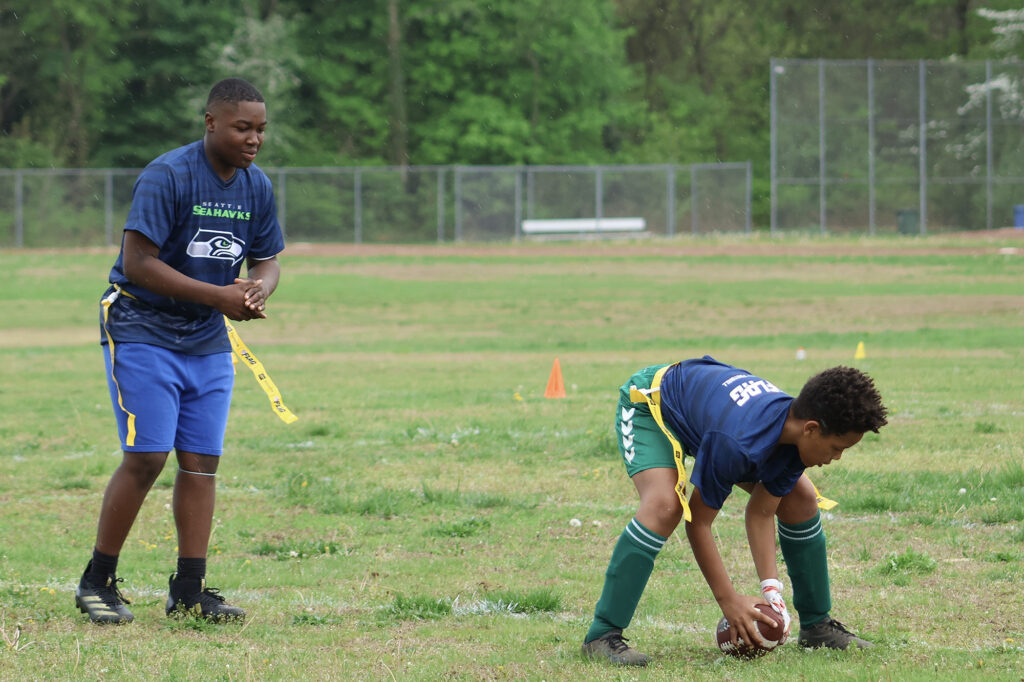
Janet Eaton-Smith, director of athletics at Ottawa University in Kansas, oversees one of those 24 programs. She did not start the program, given she is about to complete just her second full year in the role, but she could not imagine where Ottawa would be without it.
“We only have women flag football, and so promoting and giving a space for our female athletes to flourish, it’s been very, very instrumental for our female athletes to flourish,” she said. “It’s been very instrumental and strategic for us. I’m really big on making sure our female athletes are preserved, and our female sports are preserved. The fact that (flag football) is considered emerging in the world of NAIA has given us the opportunity to take hold of that and promote it.”
The sport is not just emerging in collegiate athletics but everywhere. In 2028, it will appear at the Los Angeles Olympic Games. In Hamden, Kennedy said the Hamden High School club team has petitioned to upgrade the club to a varsity sport — something 15 states‘ high school athletic associations have already sanctioned. Connecticut is among nearly 20 other states running pilot programs, trialing the sport in a select number of schools to evaluate if it has the foundation and growth potential to run full-time.
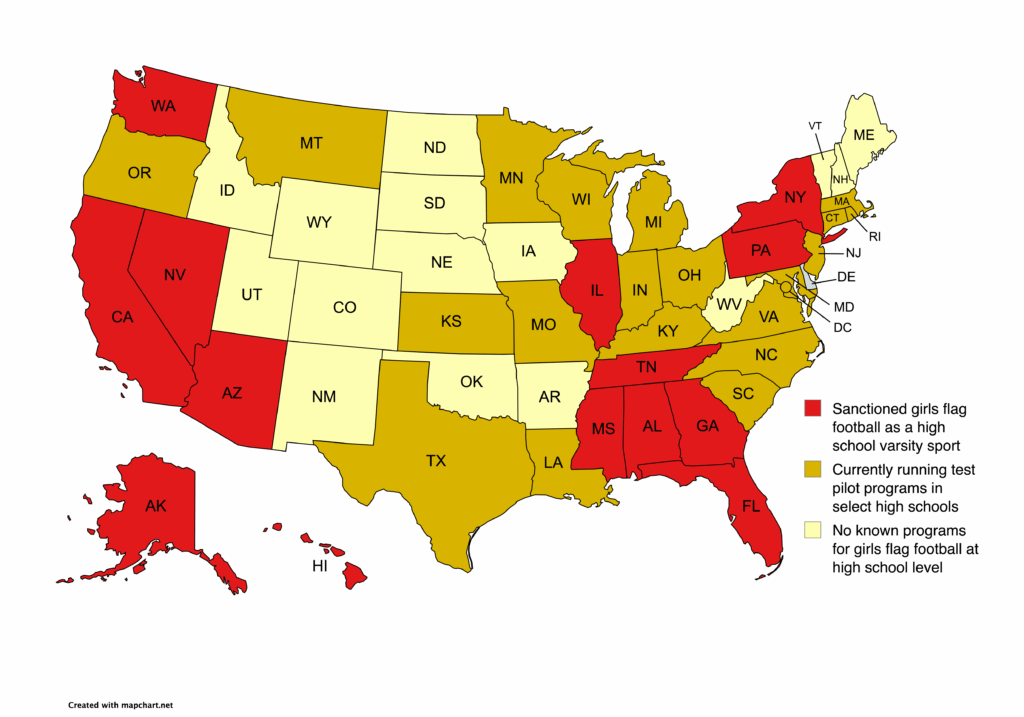
Many southern states — Alabama, Florida, Georgia, Mississippi and Tennessee — are among the 15 states that fully recognize flag football as a varsity sport by the state’s high school athletic association. Kansas, not too far away, is emerging in that hotspot. Eaton-Smith said that at any point, her program could play 12 different teams in a roughly 50-150 mile radius.
But with the sport’s sporadic nature at the high school level, how do these programs recruit players?
Eaton-Smith identified flag football as a crossover sport. Meaning, if an athlete does not receive a scholarship for their main sport in high school — be it basketball, soccer, etc. — the skills needed to play flag football are easily transferable, thus that any athlete with natural athleticism can pick it up. With a short buffer period baked in to learn the game’s mechanics and study its rules, an athlete can earn a scholarship playing flag.
“Our coach is going to high schools and doing a pitch on, ‘If you are not being targeted for an athletic scholarship in your current sport … Consider looking at flag and coming out and participating and still pursuing your athletic dreams,’” Eaton-Smith said.
It is a win on both sides, Eaton-Smith said. If an athlete crosses over from their original sport to flag, they can earn an athletic scholarship after all, simultaneously knocking off some of the out-of-pocket costs required to attend college. In return, her program receives a talented athlete who can make an immediate impact on the field.
And the recipe seems to be working, considering Ottawa flag is a combined 83-8 with five-straight conference championships dating back to the program’s inception in 2021. In 2025, the Braves are 18-0 and set to compete in the NAIA Flag Football Finals in early May.
It begs the question: How long until the sport breaks into the NCAA at the varsity level?
Eaton-Smith guessed it won’t be long. Within five years, she said if she had to estimate, 50% of the NCAA population — meaning at the Division I, II and III levels, will offer the sport to its student-athletes.
Greg Ammodio, Quinnipiac University’s athletic director, has his reservations. He knows the sport is booming with popularity. After all, the NCAA recommended the sport to be added to its Emerging Sports for Women program in February, joining the likes of acrobatics and tumbling as well as rugby — two sports Quinnipiac already offers.
It is not the upwardly exponential participation numbers that Ammodio is concerned with. He is, however, wary of the overall state of collegiate athletics. The impending House vs. NCAA settlement has cast a blanket of unease over the world of college sports. The settlement, among other things, would pay out over $2.8 billion in back payments to athletes for their name, image and likeness and also permit colleges to compensate their students directly, but until there is resolution — which could take months given the many delays the settlement has already encountered, Ammodio does not anticipate adding any new sports any time soon.
“I think we have to continue to keep on eye on what makes sense and what’s emerging, where there’s value (and) where there’s connectivity,” he said.
Ammodio is in the same boat as many athletic directors around the nation, looking to balance the murky future of college athletics with emerging sports in its landscape. He noted Mount St. Mary’s University in Maryland, which became the first NCAA Division I program to endorse flag football at the varsity level on November 7, 2024. On April 2, 2025 the Mount announced its decision to join Conference Carolinas, the first Division I or II league to sponsor the sport. Mount St. Mary’s joined as associate members alongside Mars Hill University and Wingate University, bringing the conference’s member pool to 11 ahead of its inaugural season in 2026-27.
In real time, flag football is reaching the Division I level. With all it has to offer for its athletes and the athletic programs that institute them — Ammodio citing enrollment management as one draw for his peers — it won’t be long before more schools follow suit.
The bottom line
There are always concerns, as well, financially. The addition of a new sport in any athletics department would theoretically pull money away from other programs that are reliant on the funding that they receive. Eaton-Smith quelled her own worry about that.
“Everybody’s looking for that sweet spot,” she said. “I do believe that your return on investment, when you talk about the student athletes and how much their out-of-pocket cost is that goes back to the school. That is the actual return. So when you have the correct formula, I do believe it can be beneficial and can be profitable. I don’t believe the statement of, ‘If we added a new sport it drains from another sport.’”
In a world where everything is money, sports are not exempt. Balancing budgets and allocating assets are not tasks Eaton-Smith, Ammodio or any athletic director takes lightly. Not every sport can be funded as well as it would like to be, though flag football’s cost-efficient nature is appealing on that front.
“It’s cost effective because (of) shorts and t-shirts, or yoga pants and t-shirts, and the belts and bands. We’re not paying for the helmets, we’re not paying for the shoulder pads,” Eaton-Smith said. “We’re not paying for that equipment that has to be customized to meet our female athletes like it does our male athletes. So you’re saving a large chunk of money on that side.”
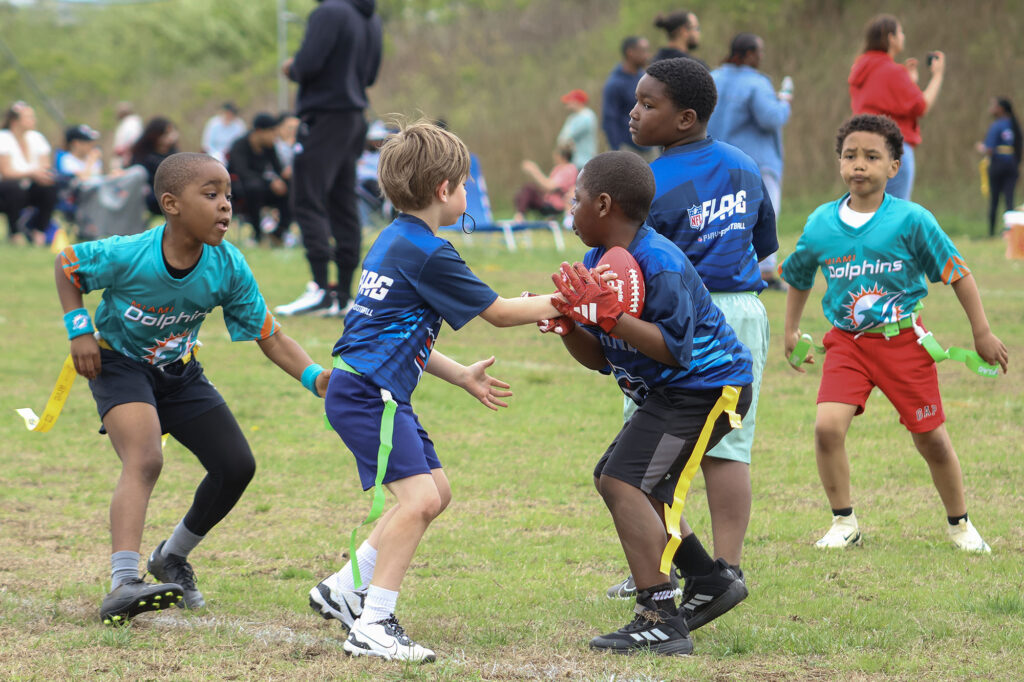
At the local level, Kennedy and the HFFCA charge $225 per child to register to play flag football. That upfront payment covers the league’s insurance premiums as well as uniforms. The league provides all the necessary equipment, which comprises just two things: a flag, and a football. Parents can forget the headache of buying shoulder pads and girdles. Where there is no contact, there is no need for protective wear.
Beyond the flags
Jordan Ashley Sr. has coached flag football in Hamden for two years now. When he signed his 7-year-old son up to play two years ago, he simultaneously volunteered to coach. For eight years Ashley was a tackle football coach in North Carolina, where he finished his college career some years ago wrestling for UNC Greensboro.
As a coach, Ashley has the experience Kennedy reveres. The former college wrestler and baseball standout played football for a long time, going as far as to take some snaps with the University of Connecticut. He coaches the game properly, teaching kids how to play the right way.
But as a parent, he is giving his kid more of a reason to get out of the house. Many parents like Ashley enjoy flag football because of its timing. As spring begins to take shape, the flag season begins its first weekend around the end of April, when the HFFCA hosts its combine and evaluation day to properly weigh each player’s skill set ahead of the coaches’ draft. Ashley is not worried as much about his team’s performance, but rather how the game will benefit his players.
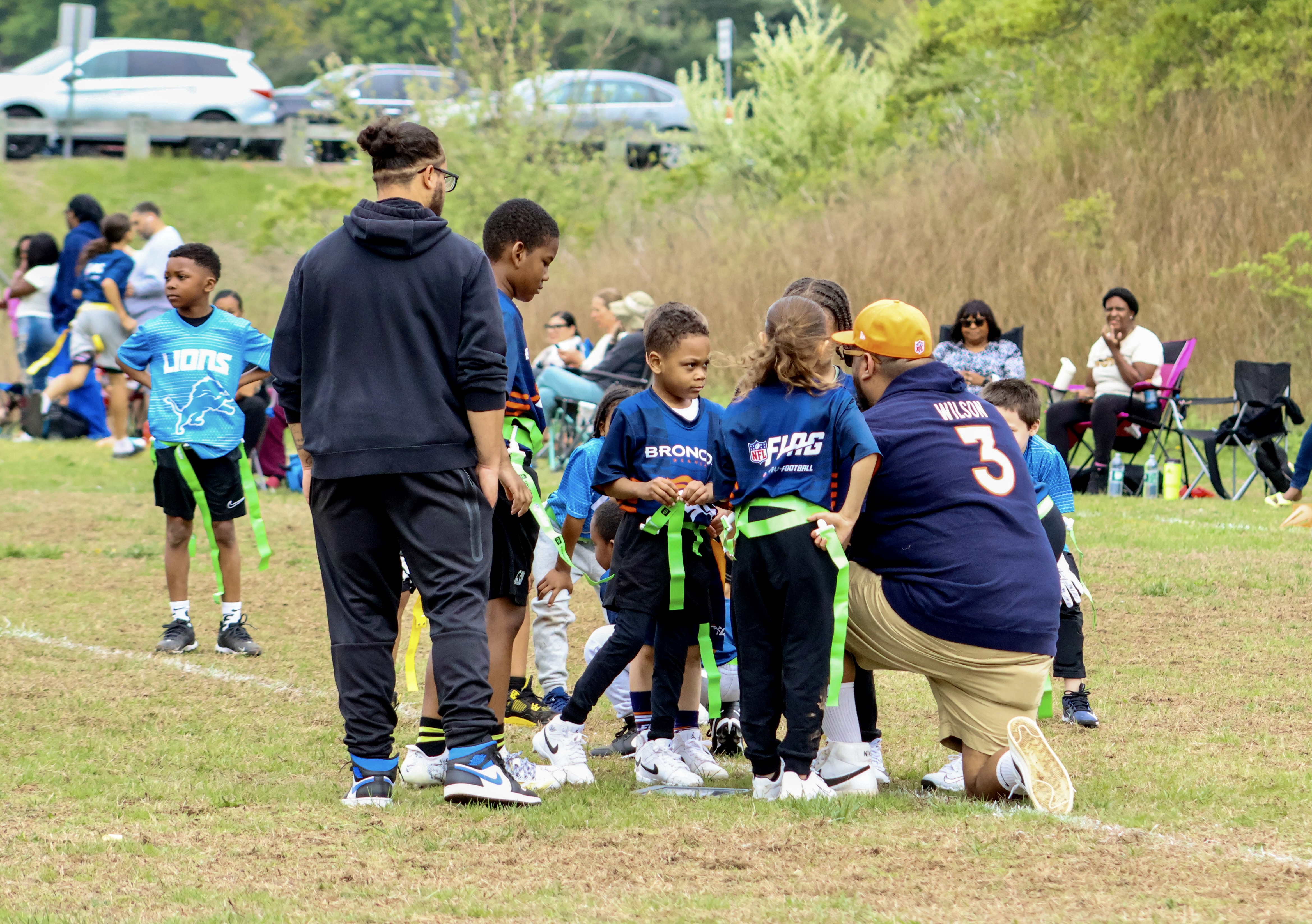
“I’m big on coaching young kids. Growing up it was something I didn’t really get to have,” Ashley said. “I kind of developed on my own. I also commission baseball and coach wrestling. So I like getting kids ready, make them fall in love with the sport before it gets kind of crazy competitive. At this point you want the kid to love the sport.”
At such a young age — Hamden’s A Division allows children as young as 5 to participate — children are still learning much about the world. Ashley sees the sport as an opportunity to educate. Above all, he wants them to have fun.
“I like seeing kids develop over time. It’s good to see, (if) you get a kid who’s never learned something and when they finally get it, even if it’s something very simple (like) making a catch on the ball,” he said. “It’s nice to see them get that development and get that experience, you see the smiles on them.”
At the collegiate level, Eaton-Smith agreed sports brings something more to the table that many other things cannot. Be it flag or something else, sports are more than a game. They foster an environment of growth.
“Sports in general is just like when we were kids. It teaches teamwork. It teaches camaraderie and it helps you manage self-discipline. It helps you understand how to control and work your emotions, but it also teaches you diversity,” she said. “Accepting and working with people that don’t normally look like you (and) you normally would not interact with. And I’m a firm believer that when you have a mixture of things and a different variety, it opens up your perspective on how you look at things.”
Kennedy understands this, too. Flag football accomplishes a slew of things, he said. It keeps young, impressionable kids busy, putting them on the field instead of somewhere they shouldn’t be, teaching them important skills while keeping them healthy and in shape.
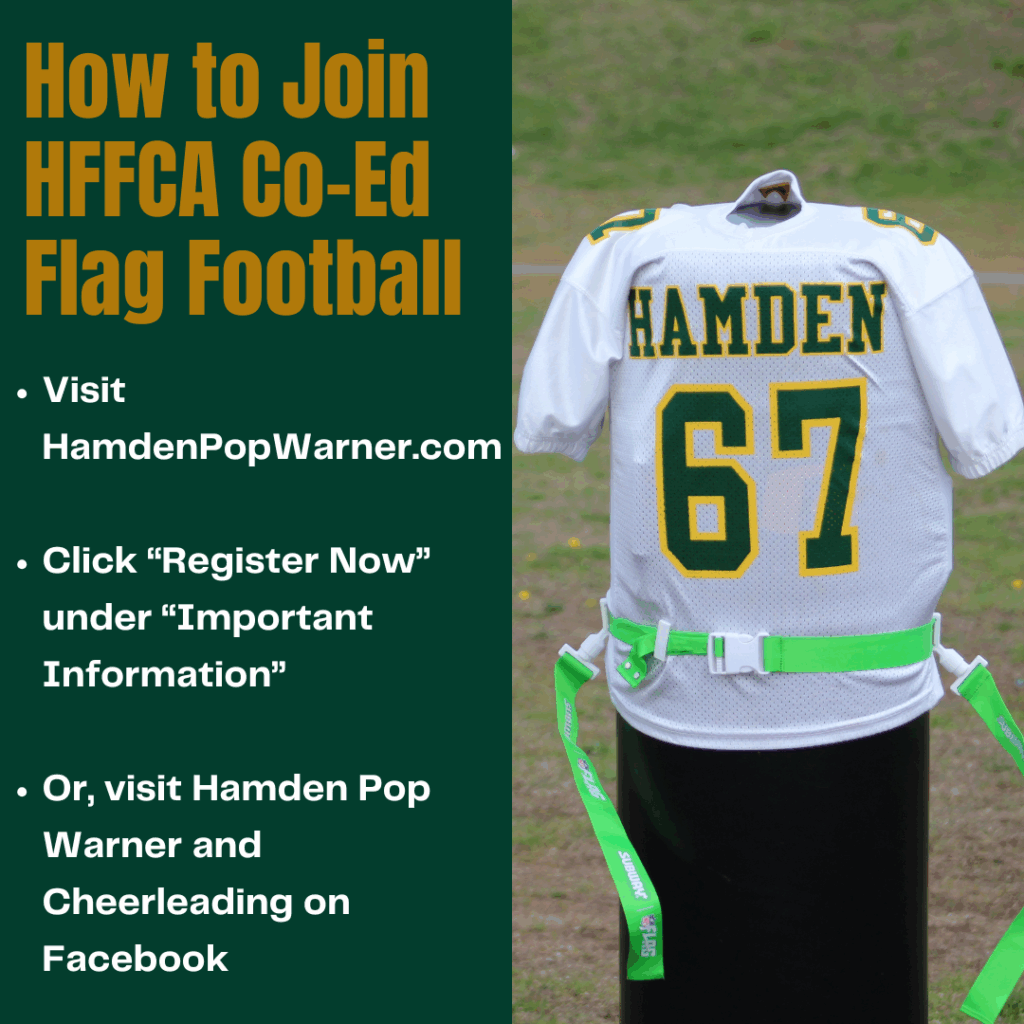
Regarding the future of the HFFCA, Kennedy has two dreams. One is to, eventually, implement an all-girls league.
“Sometimes the girls are better,” he said, smiling.
The other is to at some point recruit more than double the count from the HFFCA’s enrollment of 120 players last year. He hopes to see the sport grow enough at the local level to where 320 kids sign up one year.
Why that specific number?
He wants to have representation for all 32 NFL teams, with 10 players per team. That dream could be realized sooner than the he and the nation might think.
“Flag isn’t just big,” he said. “It’s huge.”