
When you enter the front doors of Quinnipiac’s North Haven campus, you see a two-story staircase to your right, a public safety booth straight ahead and an entrance to the Frank H. Netter School of Medicine to your left.
However, if you go straight past the public safety booth, past the auditorium, a left and then a sharp right, you’ll find nestled away in the campus is MNH-139. It’s a square room with a blue placard outside that reads “CHESHIRE QUINNIPIAC TRANSITION COLLABORATIVE.”
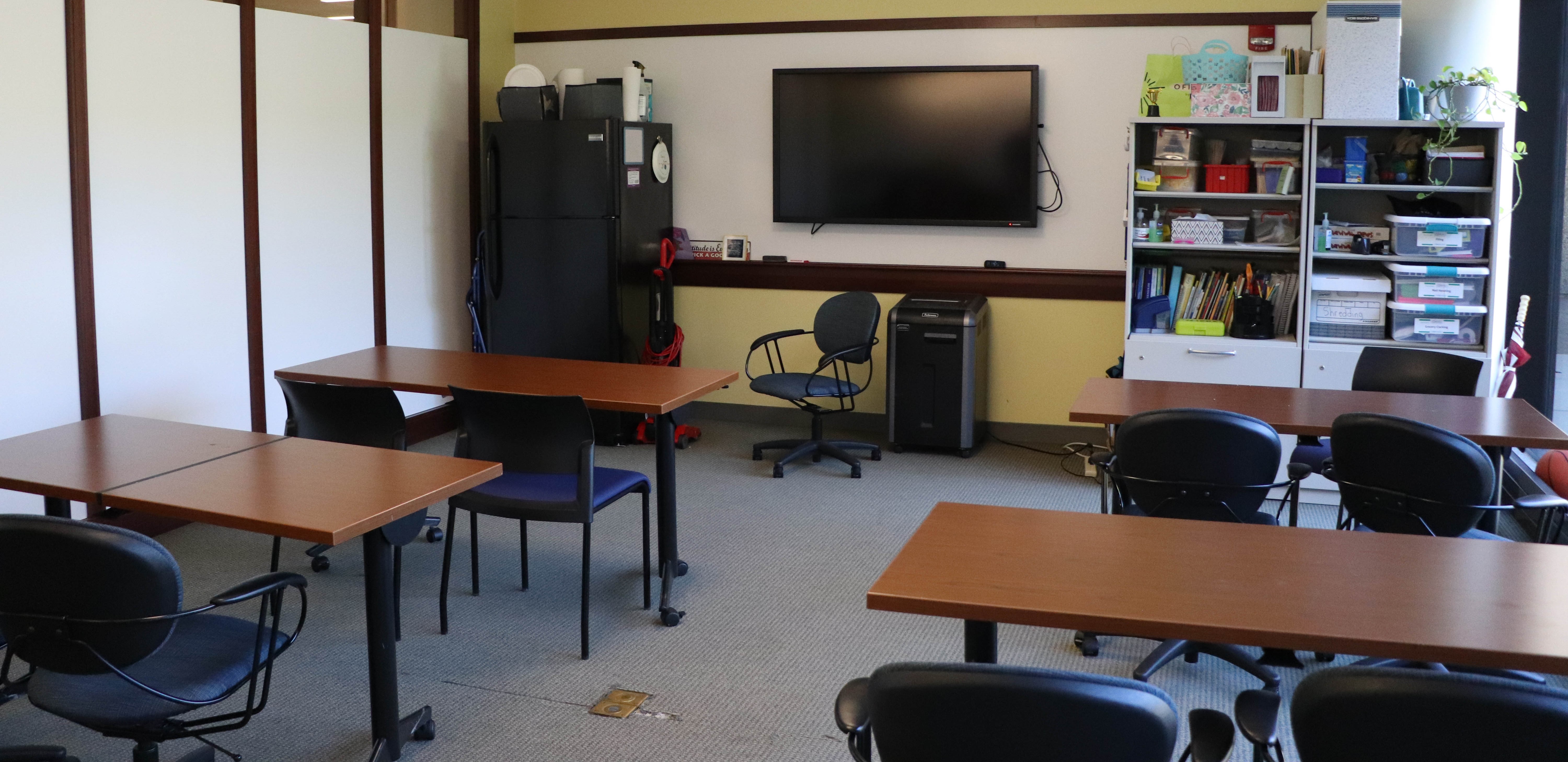
MNH-139 is more like a high school classroom rather than a lecture hall. There are four wooden tables with two chairs each, two white shelves filled with supplies, a refrigerator in the back left corner and a TV mounted on a whiteboard at the front of the room.
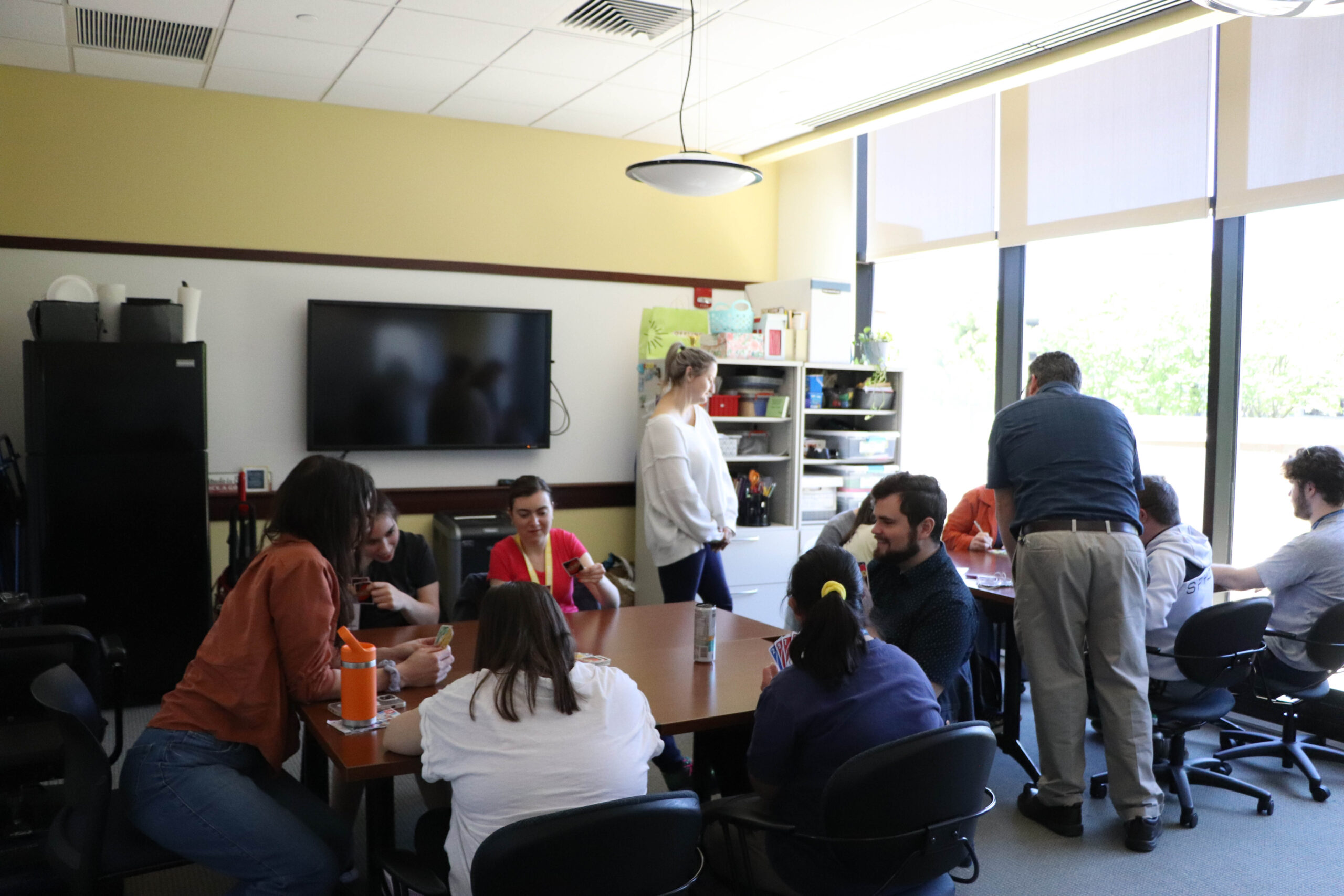
But Monday-Friday from 8 a.m. to 2 p.m., nine students fill the classroom. These nine students graduated from Cheshire High School, all are 18-22 years old and all have some kind of disability, ranging from Autism spectrum disorder to down syndrome to cerebral palsy. All of them are now part of a transition program to get them acclimated to life after a postsecondary education. The students transition services through the public schools system end through the end of a school year in which a student turns 22.
“It’s funny, parents of our kids who have siblings, they always say that ‘we thought looking for a college was hard’ for their typical siblings, but for [students with special needs] it’s harder trying to find what they’re going to do when they’re 22 and moving on from school,” Russ Hinckley said.
Hinckley and Deb Taylor run the program, which is also called “Bridge to Life.” Both are special education teachers employed by the Cheshire School District, but work at the collaborative.
Quinnipiac University has a partnership with Cheshire Public Schools to allow the program to use the North Haven campus. It’s mutually beneficial, Quinnipiac extends its community outreach and the Bridge to Life students get to use the campus’ resources. They eat lunch in the cafeteria, they can sit in on some classes and they use the model apartment located on the third floor to practice life skills.
All of those activities are to build toward two goals — a better quality of life or, in some cases, full independence. But not too long ago, transition programs weren’t even a thought.
How did transition programs and the Quinnipiac-Cheshire collaborative begin?
In 1975, U.S. Congress enacted the Education of All Handicapped Children Act to help meet the needs of children with disabilities. It’s required to be reauthorized every five years. In 1990, the reauthorization included the name change to the Individuals with Disabilities Education Act (IDEA) which guarantees a “ … free appropriate public education,” for students with a disability.
Former U.S. president George H.W. Bush signed the reauthorization into law.
The law was last majorly reauthorized in 2004 and signed by former U.S. president George W. Bush to include “highly qualified” special education teachers and also, detailed the requirements for transition programs.
The law states that by the time a student turns 16, they need to have in their Individualized Education Plans (IEP’s) appropriate postsecondary goals, which include areas to improve in an individual’s educational skills, employment skills and for some, independent living skills. The IEPs must also detail the services needed to achieve said goals. Additionally, the goals need to be updated annually with the IEP.
A planning and placement team (PPT) which comprises the student, their parents, at least one regular and special education teacher from the public school district and other school representatives determines those goals.
Now, Connecticut state law requires transition services for students starting when they turn 14, which the state changed in 2020, and in some cases even younger. Those same goals are discussed and the transition services they receive are planned out in the yearly PPT meetings.
CT law defines transition services as “ … a coordinated set of activities for a child with a disability,” that is results-oriented and focuses on improving the “ … academic and functional achievement of the child with a disability to facilitate the child’s movement from school to post-school activities.”
“It’s harder trying to find what they’re going to do when they’re 22 and moving on from school.” – Russ Hinckley
The aforementioned “coordinated set of activities,” include instruction from a teacher, community experiences (going out to a local grocery store and shopping, for example), and learning daily living skills.
This was only possible for Cheshire Public Schools students 15 years ago. The collaborative began in 2010 when Karen Majeski, an associate professor of occupational therapy at Quinnipiac and one of the co-founders of the collaborative, saw the limits of holding a postsecondary transition program in a high school.
“It’s always tricky to manage how do these kids, who are 19 to 22, continue to receive services even though they are done with their high school years,” Majeski, who also taught in the Cheshire Public Schools system for 21 years, said. “There’s nothing wrong with the high school environment, it just doesn’t mimic true postsecondary transition services.”
With the North Haven campus growing, and there being a need for a transition program beyond the walls of a high school, Majeski brought forth an idea to then-interim dean of the School of Health Sciences Edward O’Connor and the then-head of the occupational therapy program, Kim Hartmann. The idea was to allow Cheshire Public Schools to use the North Haven campus as a space for a transition program. They agreed and the program started on August 30, 2010.
How is the Quinnipiac-Cheshire Transition Collaborative funded?
Money from both the Cheshire School District and the state of Connecticut funds the transition collaborative. However, the costs to fund special education have steadily grown for the Cheshire School District.
In 2023-24, Cheshire spent over $22.1 million on special education. Compare that with 2017-18, the cost was $17.3 million. What that money goes toward are largely salaries, benefits and special education tuition.
The district also receives a state IDEA grant, which goes toward “ … salaries of special education staff and para[educator]s,” Robin-Anne Carey, Cheshire Public Schools district of pupil personnel services said. The Cheshire Board of Education approved the total salaries of paraeducators to be more than $3.8 million for the 2024-25 school year.
In 2023-24, the Cheshire School District estimated that it would receive a little over $1 million in the IDEA Section 611 (for school-aged children three to 21 years old) grant. The 2022-23 total was the same amount. The rest of the money for salaries comes from taxpayer dollars.
A day at the collaborative
Once you enter MNH-139, in blue marker on the whiteboard at the back of the room is the day’s schedule.
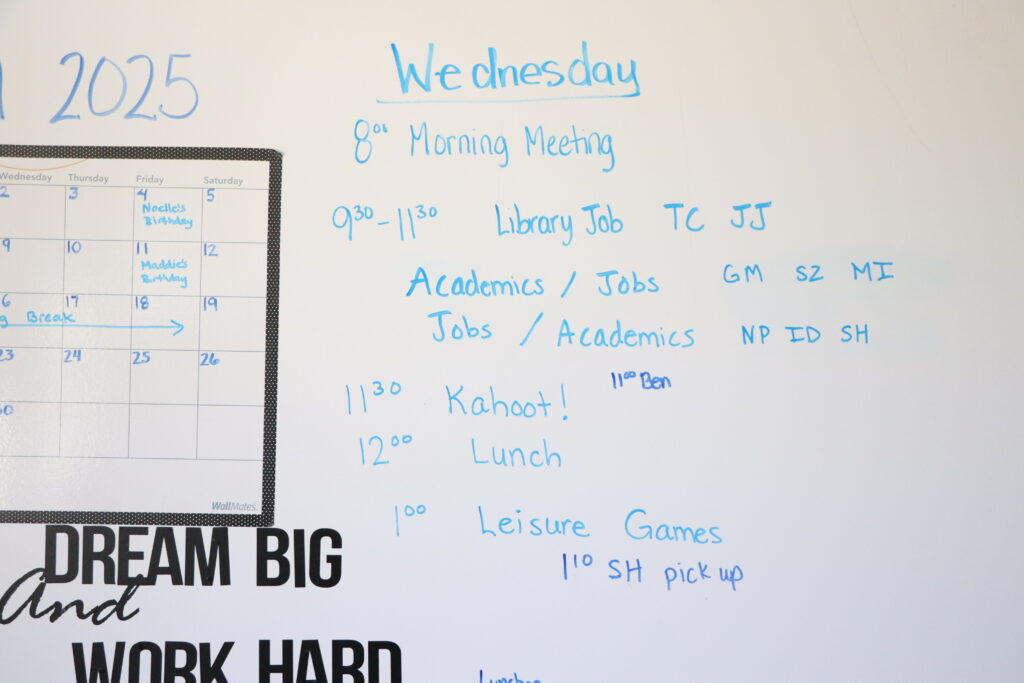
“8:00 Morning Meeting.” The group gets together to discuss the upcoming day, current events, the weather and about how members of the group are doing. They usually include a riddle in there too, to help with problem solving.
Here’s April 29th: “What’s Harry Potter’s way to get to the bottom of a hill?” The answer is “Running … JK! Rolling.”
“9:30-11:30 Library Job, Academics/Jobs, Jobs/Academics.” After the morning meeting, the students in the program split off. Some go and do jobs out in Cheshire — some of the businesses that the students work at are Goodwill, the YMCA, Elim Park and Reread Books. They usually work until lunch.
Others stay back and focus on academics or jobs on the North Haven campus. Today, Tim Considine and Justine Jewitt, two students in the program, are sorting and cleaning books in the Edward and Barbara Netter Library.
Other jobs the students do include sweeping and organizing the cafeteria, cleaning the bookstore, laundry for the medical departments and restocking and distributing the Quinnipiac Chronicles, Quinnipiac’s student newspaper, around the campus.
Then it’s normally lunch time, but on April 30, the students are playing a Kahoot about Patrick Rainey, a graduate student in the master of social work program and an intern at the collaborative. Today was Rainey’s last day. No surprise, he won.
“12:00 Lunch.” The students head to the North Haven campus cafeteria. All of them brought their lunch from home. Isaac Dubb, another student in the program, has a turkey sandwich. Considine has a bowl of pork and vegetables with a yogurt and fruit bar.
Considine is wearing a Hartford Whalers t-shirt his Dad handed down to him. He talks about his favorite band, The Beatles, and favorite guitarist, Jose Feliciano. His phone wallpaper is a photo of him with Feliciano, both are smiling.
Considine can play four instruments: the guitar, piano, accordion and drums. He has perfect pitch too. You can hum him a note, and he’ll hum it back and tell you what it is. He knows the pitch of the elevator ding on the North Haven campus. It’s an F.
Near the end of lunch, Maddie Innaimo, another student in the program, comes around and distributes an oatmeal raisin cookie to all of her peers, for Rainey’s last day. His favorite cookie is oatmeal raisin.
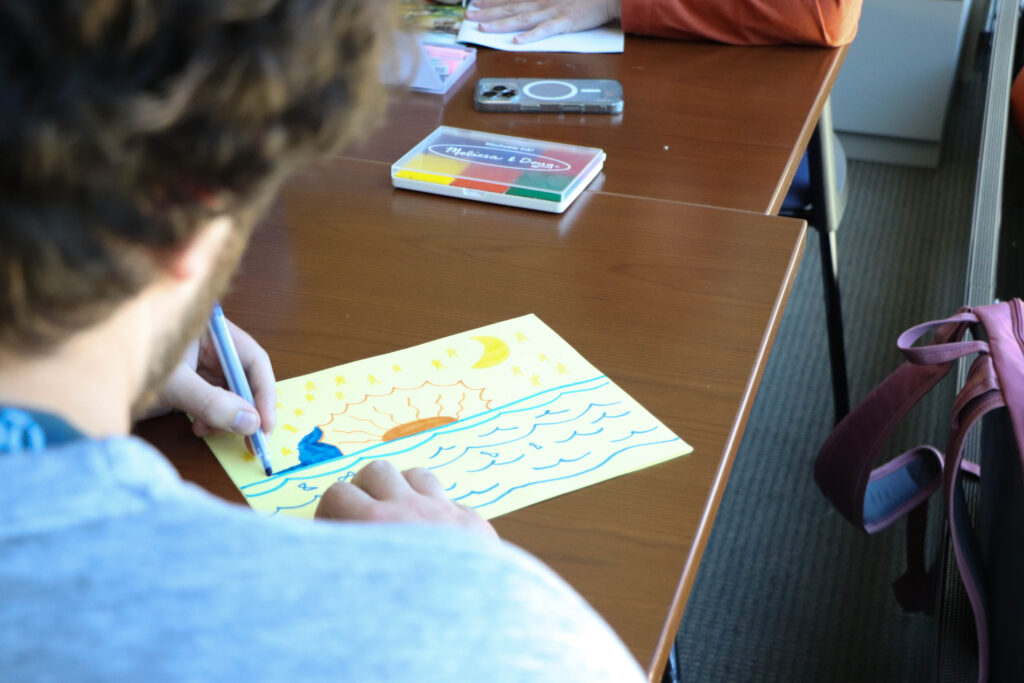
“1:00 Leisure Games.” The four tables in the room are pushed together to become two big ones. On the left side of the room is a six-person UNO game, Rainey bluffs often and grabs a couple wins, on the other, more mellow side, a group of students are drawing.
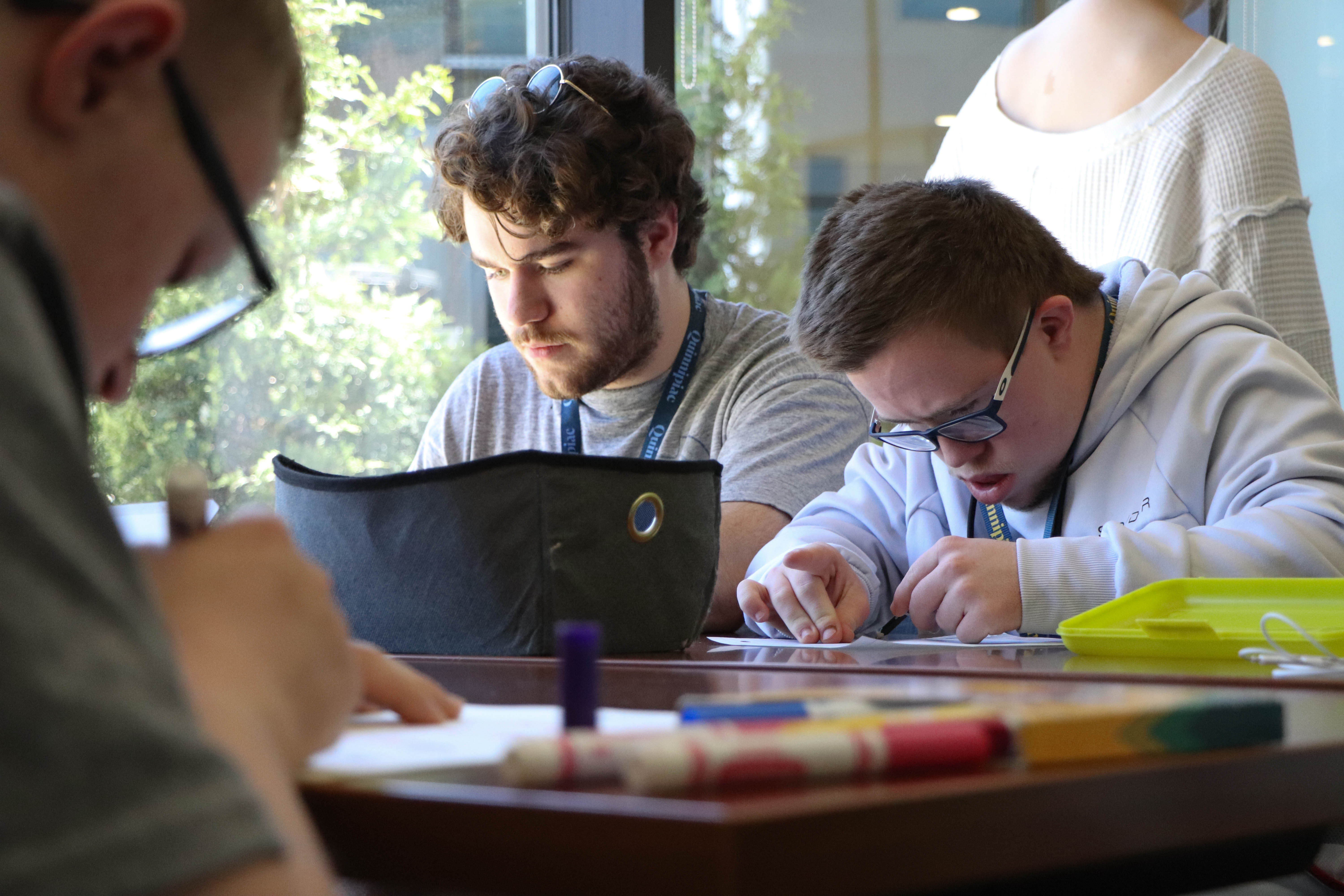
Considine is drawing a sunset on a beach. There’s a crescent moon in the top-right corner, stars in the sky and waves on the water. Dubb is writing out what’s on the top of his paper: “Quinnipiac University.” Taylor is at the back of the room writing out the May 2025 calendar. May 17 is Considine’s birthday
The future’s uncertain for all of the students in the program. They could go onto an adult program, or enter the workforce. They’ll face challenges a neurotypical, or able bodied person could never imagine.
The special part of the current group of students in the collaborative, though, is that Hinckley and Taylor have known the students since middle school. Hinckley recalls that when Considine was in first grade, he barely spoke, he only whispered to a teacher. Now, Considine can talk about anything and for any amount of time, sometimes too much time.
It’s never a full goodbye, as Taylor was adamant about. Parents are frequently in contact with Taylor, and students still want Taylor and Hinckley in their lives.
“I’m just so proud of all the work they’ve put in,” Taylor said. “It’s amazing.”