
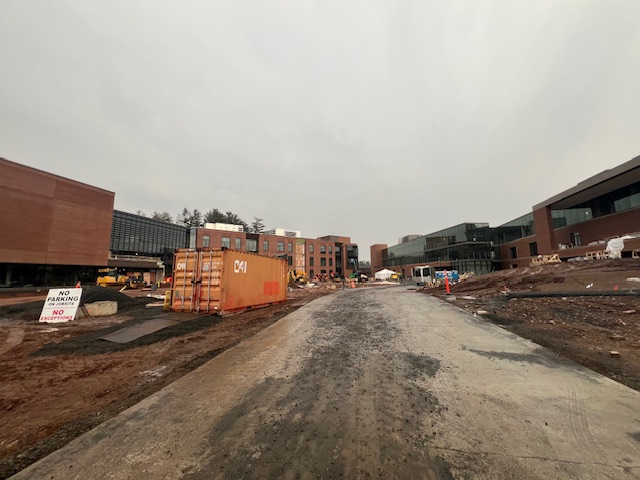
Anthony Maurice transferred to Quinnipiac University in January 2023 as a freshman. He wasn’t greeted by the familiar trees he had seen once before, which once dominated the campus. He was welcomed to construction fences and bulldozers, a common sight he and many others have dealt with for about three years.
“It was a dull feeling,” Maurice recalled. “You want the best experience when you go to college, and being a part of construction from beginning to end does not give you a full college experience, and I wish I could have been a part of a fully renovated college”.
The construction fences that have become a familiar scene for many Quinnipiac students have vanished, and the large number of construction trucks is disappearing. As tedious as the process has been, things are starting to take shape.
When university executives announced plans for the South Quad expansion a few years ago, they promised a future that would enhance academic and residential life. Now, that promise is becoming a reality right before the eyes of students, faculty, and the surrounding Hamden community.
As the finishing touches are being put on three major projects—the SITE (Science, Innovation, Technology, and Exploration) building, a new School of Business, and The Grove residential hall, which has already been completed, along with the renovated baseball field and new recreation center—anticipation mixes with reflections on the whole journey. The university has grown alongside the students, opening eyes.
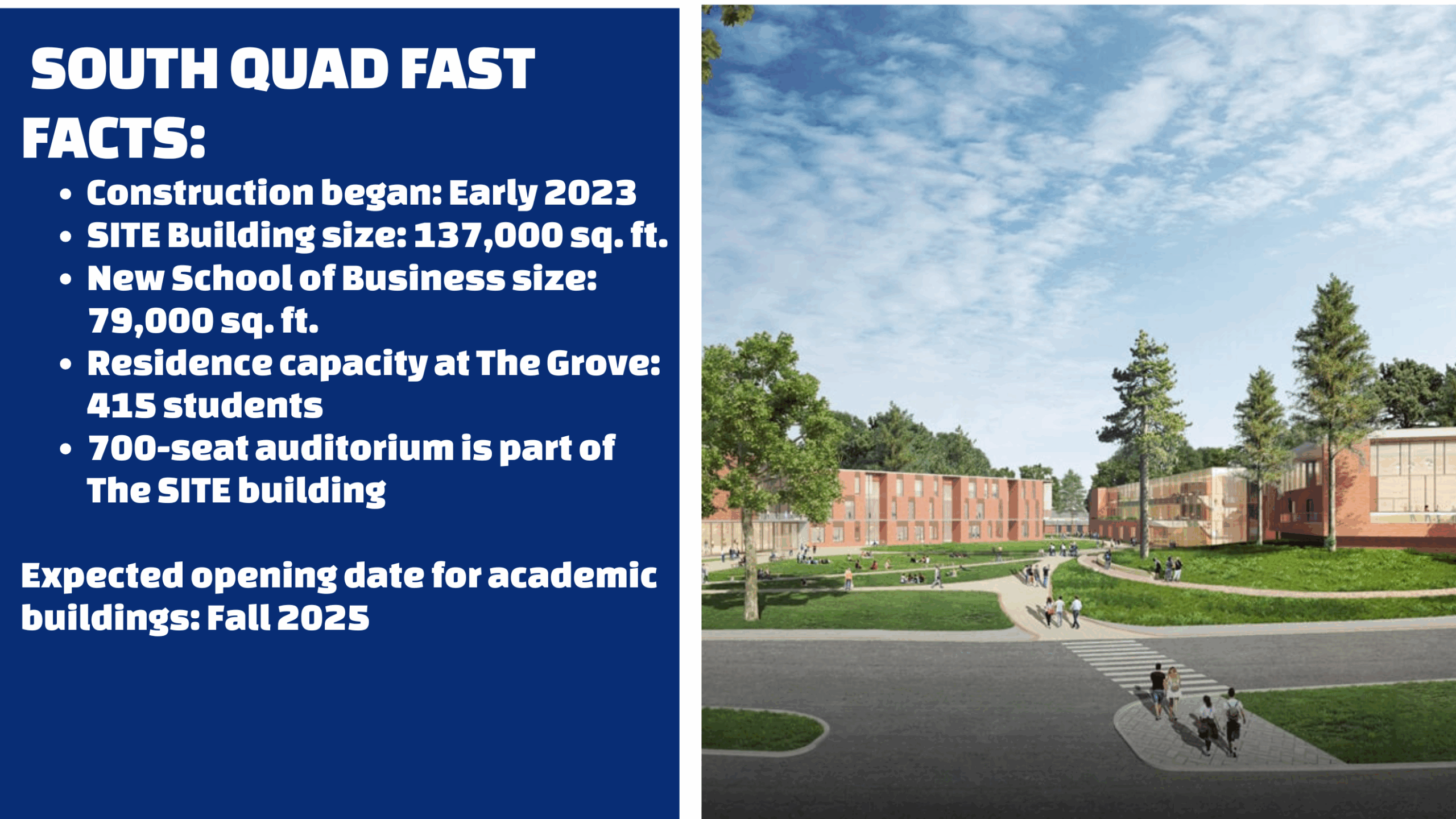
“The new advancements to the business school opened my eyes, and I was very excited to see what they would do. I feel amazing,” said Noah Salamanca, a freshman who changed his approach to college based on what he saw being constructed.
The new facility interested Salamanca, pushing him to try something in business.
“I came into Quinnipiac as a communication student, hoping to live my life as a broadcaster,” stated Salamanca.
Quinnipiac students have been sharing their reflections on the journey, which is just about complete. Now, how did we get here?
The Blueprint: What South Quad Means for Quinnipiac’s Future
The South Quad is about enhancing student experiences in modern times, while the university is experiencing a boom in applicants. The university has received 22,491 first-year applications for Fall 2024, up from 19,699 on the same date in 2023.
“It is important because the student experiences have been pretty limited, but I think the school is growing too fast, and it is great that they are enhancing living and academics because the school must hit some new heights,” noted Jason O’Hagan, a junior studying physical therapy.
“When the hockey team won the National Championship, it intrigued and brought people here. They don’t have enough living halls for the students, so they badly need the growth,” O’Hagan added.
Listed below are the buildings a part of the South Quad project, according to QU.edu.
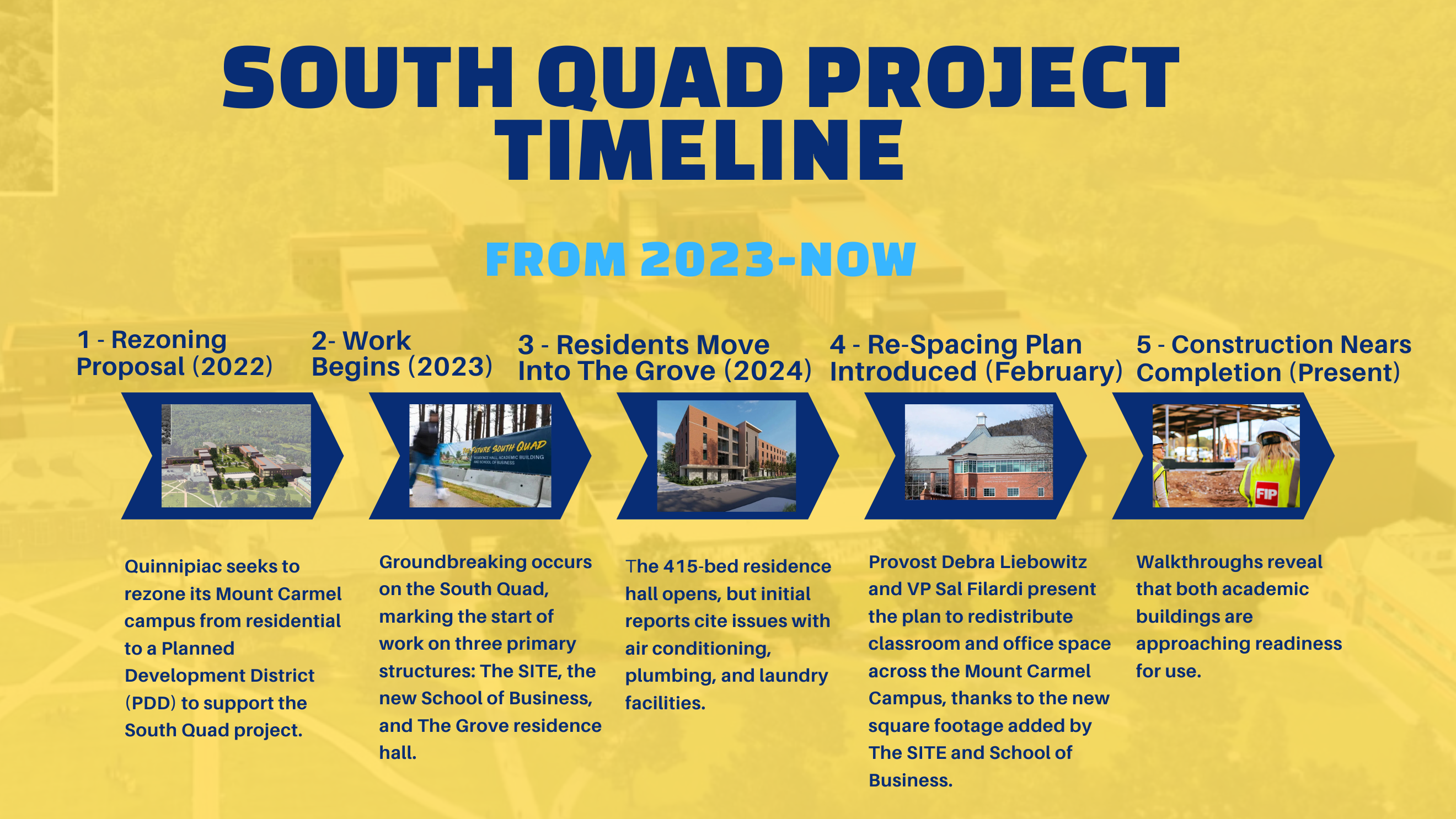
- The SITE: A 137,000-square-foot academic center designed to foster interdisciplinary study. It boasts advanced labs, modern classrooms, expanded computing spaces, and a versatile 700-seat auditorium.
- The School of Business: A 79,000-square-foot hub with a Business Innovation Center, financial technology labs, flexible lecture halls, and green energy solutions.
- The Grove: Opened at the beginning of the 2024-25 academic year, and is a 415-bed residence hall crafted to strengthen the living-learning community through lounge spaces, outdoor courtyards, and group study areas.
These structures signal a new era, and the first buildings on Quinnipiac’s campus since the 1990s.
Students hope the South Quad will bring more life to campus and people outside.
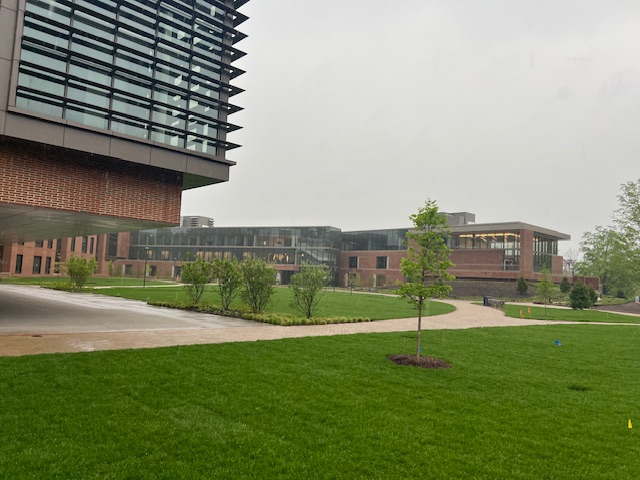
“I think the new spaces are going to improve the vibes on campus,” Maurice stated. “Without all the noise and construction, we can spread around and not be clustered on one quad and in one setting for 9 months”.
Quinnipiac aims to provide more space and opportunities for students to improve their academics and enhance their quality of life, with new social spaces and outdoor areas.
“People can explore the new buildings and the new quad, and I think it will increase the number of people you see hanging outside and doing work and such,” Maurice added.
Growing Pains: Construction Challenges and Community Concerns
The road to realizing South Quad was far from smooth, as residents pushed back against the plan.
In late 2022, Quinnipiac proposed rezoning its Mount Carmel campus to a Planned Development District (PDD) to accommodate the ambitious construction. The move met with significant resistance, as Hamden residents raised concerns about the size of the development, its potential traffic impact, and potential environmental degradation.
Numerous residents were concerned about the construction and the somewhat sour relationship between Quinnipiac and Hamden.
“As an undergraduate student, I remember stories about Hamden residents not getting along with Quinnipiac students, and they changed the housing rules because of it,” remarked Gavin Merrill, a graduate student who lives in the community.
Other community members were more worried about the traffic and environmental impacts.
“It was concerning, especially because of the environmental impacts it had and possible traffic issues that thankfully have not arisen,” said Hamden resident Lauren Williams. “Bringing in more students was the plan here.”
The Hamden Planning and Zoning Commission delayed votes multiple times. In September 2023, Joe McDonagh, a commissioner, recused himself from voting after claiming he was involved in some public issues relating to the university. The commission approved Quinnipiac’s plan on November 15, 2023, and the final green light eventually came exactly a month later
Hamden Mayor Lauren Garrett supported the PDD and Quinnipiac throughout the process. Garrett was very open to collaborating with Quinnipiac since her election bid in 2021, saying she wanted to “establish a strong collaborative partnership based on mutual respect and common interests” with the university.
Shortly after that light turned green, campus life was turned upside down.
“It was a pretty rude awakening,” laughed Ian More. “I did not feel too prepared for it, or I just was not expecting it, one or the other”
As construction fences rose, so did student frustrations. Paths to the College of Arts and Sciences (CAS) were rerouted onto active roads, creating safety hazards. Parking lots disappeared, and walking to class became a calculated ordeal. The detour students had to take to the CAS caused numerous issues, including safety concerns and time management problems.
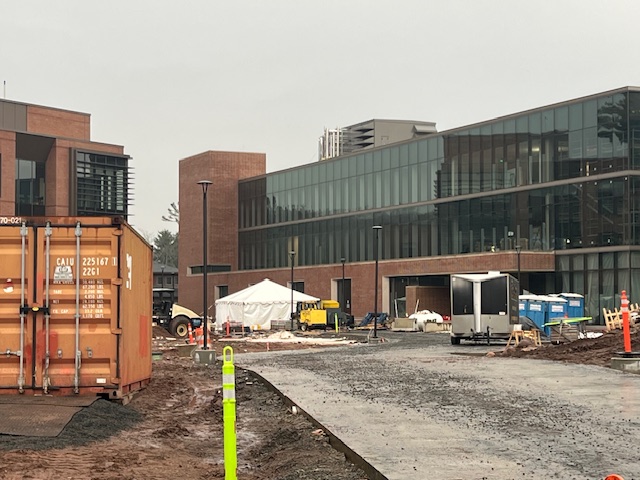
“I had to plan my day an extra 15-20 minutes ahead to make sure I got to class on time,” said Carter Thompson, a junior physical therapy major. “I had to make sure I had classes back to back instead of going to the CAS building consistently”.
The whole ordeal was rather unsafe. You could pick between risking getting nailed by reckless drivers while walking on the shoulder along the access road, or you could take an unofficial shortcut.
“I get they have the walking lane, but you can hardly fit two cars on that roadway, now plus people walking too. And I get we’re not one of those big schools, but if you spend all this money to make the campus bigger, why not make it look nicer with sidewalks?” Maurice.
Walking behind the Commons residence hall and underneath the Commons bridge was commonplace for many. Although walking on these uneven, bumpy, and muddy surfaces was often unsafe, it was a shorter route to class.
Many had trouble adjusting to the new normal, especially Maurice.
“As a business student I have no classes in the school of business, as a kid who lived on campus and going all the way to CAS from Larson it was a pain, dreading everyday wondering when I’d be able to walk across campus and see scenery instead of bulldozers and people drilling around me all day”
But Thompson enjoyed the construction at the time because it forced him to plan better and utilize his time.
“The construction made my life more convenient because I had my classes all back to back at the CAS and had the rest of my day easy and more productive with open time.”
Students have also been openly critical of the projects and the “new normal” across campus, as seen in the case of freshman student Jason Le.
Le feels that Quinnipiac is making these moves primarily out of panic.
“It just comes across as a bad look for the school. I feel that all the ongoing construction is just part of a larger problem at QU: that, as a university, we are still dealing with the consequences of becoming a prominent Division 1 school,” said Le.
Le also feels that the over-acceptance of students is related to the new changes.
“All of a sudden, the academic and residential buildings are no longer enough. It’s a bad look for the school and comes across as panic.”
These changes were only the beginning for everyone.
A Campus Transformed: Losses Along the Way
On their way to classes, students were no longer greeted with the Pine Grove. Instead, they were welcomed with scaffolding, construction fences, and bulldozers. The Pine Grove, a lush path of 65 trees connecting major campus hubs, met a bitter and discouraging fate.
“It added a natural look to the campus, sometimes at night I would walk to see the trees and whatnot,” said More. He often enjoyed the peacefulness the area provided, especially during hectic days.
“It was also a nice path that connected everything and made traveling around campus pretty easy,” More added.
Beyond emotional attachment, numerous other tangible concerns were on students’ minds.
- Disruption of local ecosystems—the removal of Pine Grove, a five-acre forested area on the south side of the Mount Carmel campus. At a May 2022 Hamden Inland Wetlands Commission meeting, Radhika Mahan, an architect, said that the construction would remove 257 trees from the campus.
- Increased air pollution—Trees are crucial in filtering air pollutants and providing oxygen; their absence may lead to poorer air quality. Additionally, ongoing construction activities, including the operation of heavy machinery and increased vehicular traffic, have likely introduced more dust and emissions into the campus environment.
- Loss of the campus’s aesthetic- The forested area offered scenic beauty, popular amongst students and visitors. Its removal has altered the visual landscape of the campus.
- Decreased accessibility- The closure of pathways, such as the one through Pine Grove, has forced students and faculty to take longer, less direct routes between buildings.
Students have also been openly critical of the projects, as seen in the case of freshman student Jason Le.
Le feels that Quinnipiac is making these moves primarily out of panic.
“It just comes across as a bad look for the school. I feel that all the ongoing construction is just part of a larger problem at QU: that, as a university, we are still dealing with the consequences of becoming a prominent Division 1 school,” explained Le.
Le also feels that the over-acceptance of students is related to the new changes.
“All of a sudden, the academic and residential buildings are no longer enough. It’s a bad look for the school and comes across as panic.”
Students Look Ahead
Despite the challenges and criticism, excitement is building amongst students.
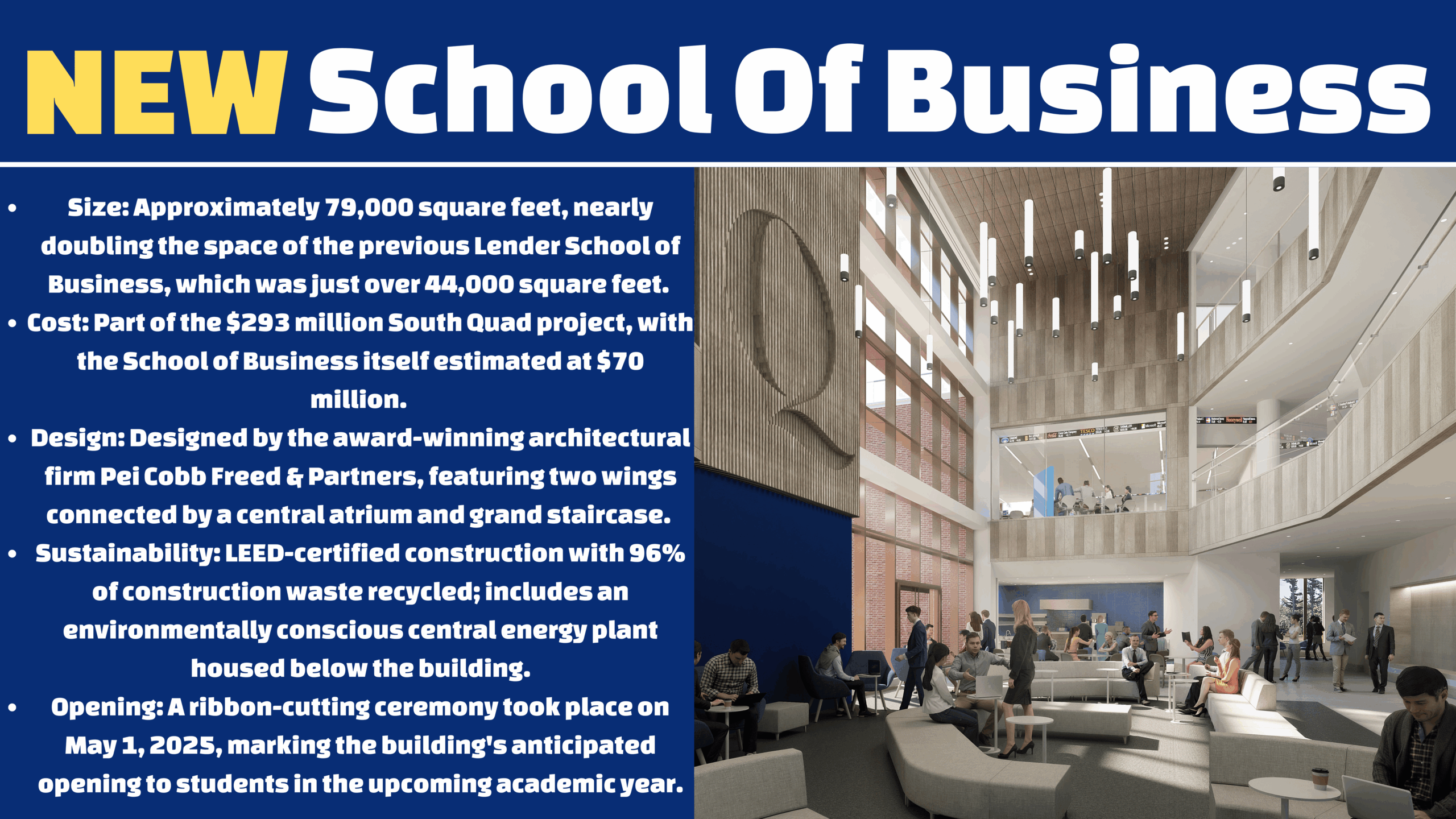
The new School of Business has been a primary factor behind student enthusiasm. It opened with a ribbon-cutting ceremony on May 1, much to the delight of many students, including Anthony Maurice, who received one of the first glimpses of the building.
“As a business student, I was blown away by the building and how modernized it is compared to the current School of Business,” said the junior applied business major. I wish I were a freshman so I had more time to utilize the space,” he laughed.
Similarly, despite early issues such as broken air conditioning units, plumbing leaks, and faulty laundry machines that have drawn the ire of students, The Grove remains a highly desirable residence option for incoming students due to its modern design and amenities. Its design emphasizes community, balancing social spaces and private living, and paying homage to Quinnipiac’s roots.
Athletic Upgrades
While the South Quad takes center stage, Quinnipiac’s commitment to upgrading facilities extends to athletic teams and everyday student life.
Quinnipiac’s baseball facility was ranked among the lowest in Division I baseball until the renovation. The field contained no side walls, an odd hill in the outfield, warning tracks or protective netting, small foul poles, and small dugouts.

After many years of criticism on the internet from college baseball fans, Quinnipiac finally broke through. In May 2023, the university initiated a major renovation of its baseball facility, marking a significant milestone for the baseball program. This $2 million project, known as “Project Omaha,” had been in development for nearly six years and was primarily funded through the efforts of alumni and the Baseball Booster Club. Renovations began last winter, and the field was ready for the beginning of the 2024 season. The upgrades included installing a modern turf playing surface, updating dugouts, and installing new fencing around the field.
Quinnipiac University’s Recreation and Wellness Center, a cornerstone of its 10-year master facilities plan, faced notable delays before opening in January 2023. Originally slated for completion by August 2022, the project experienced many disruptions.
The postponement elicited frustration among students, especially first-year attendees who had anticipated utilizing the facility, and were now crammed into the old gym for that time.
“I was looking for the gym to be back done then, it felt like a broken promise” More commented. “The gym we had before was tiny, and there was a giant amount of people who wanted to go to the gym, and it would have been nicer if we as juniors got to use the new stuff a little more.”
On the other hand, some students were encouraged by the new opportunities, such as classes being offered in the facility.
“I took a kickboxing class there last year, and I worked out there mostly everyday when I lived on main campus,” said O’Hagan.
Despite these initial setbacks, the center has since garnered acclaim, receiving the 2024 Outstanding Facilities Award from the National Intramural-Recreational Sports Association (NIRSA). It has also been a very popular spot for students on campus.
Beyond the Quad: A Campus-Wide Transformation
The South Quad expansion has been the primary catalyst behind a domino effect across Quinnipiac’s Mount Carmel campus, and it is only growing larger and more intriguing. In a February information session, Provost Debra Liebowitz and Vice President for Facilities and Capital Planning Sal Filardi unveiled a robust three-phase “re-spacing” plan, that was also briefly touched upon in the Spring 2025 Provost Update, to reallocate resources throughout campus starting in summer 2025.
Highlights of the plan include:
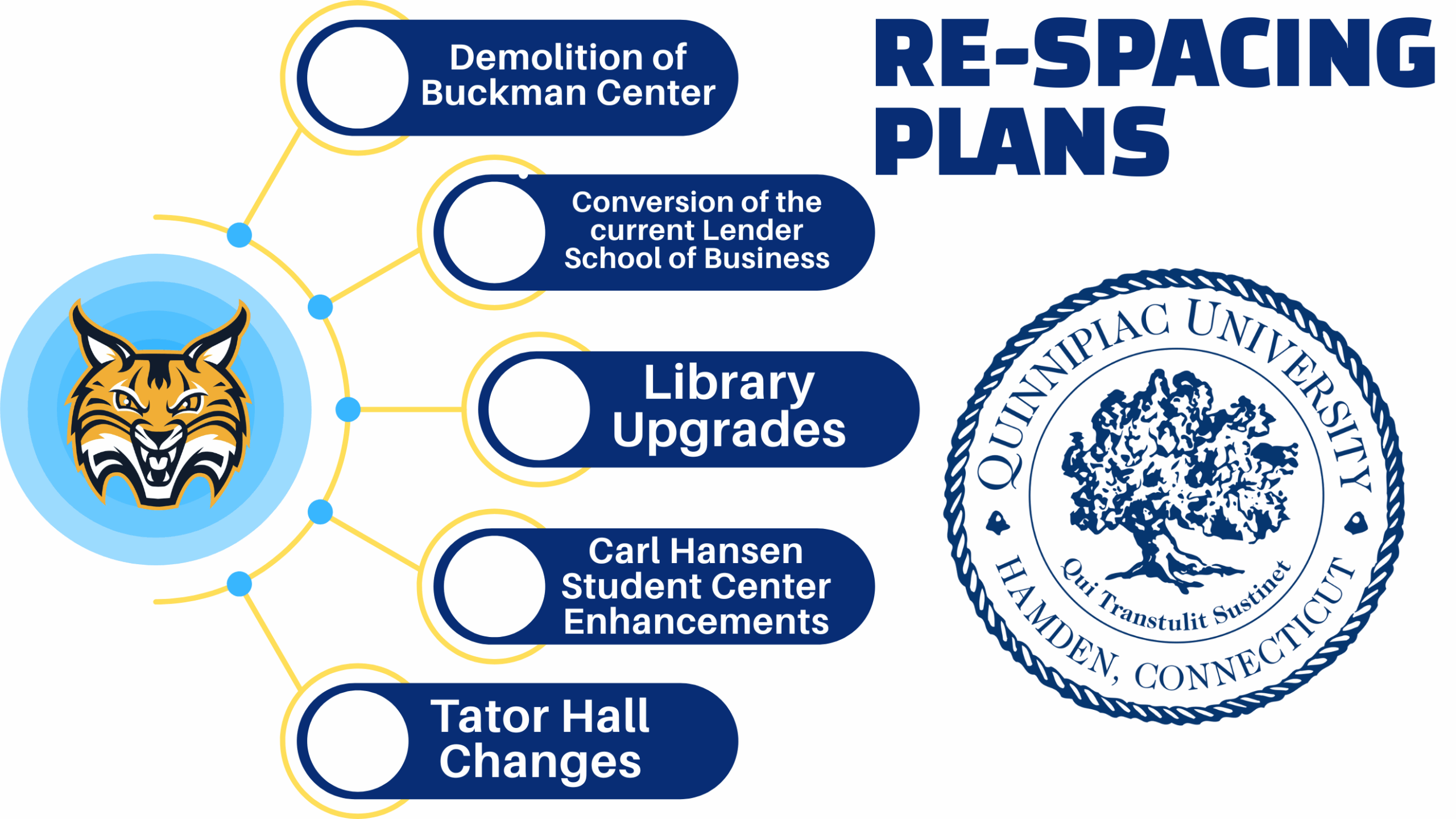
- Demolition of Buckman Center to make way for future expansion; many faculty offices will move into The SITE.
- The current Lender School of Business will be converted into administrative offices and an expanded School of Communications.
- Library Upgrades: Arnold Bernhard Library will expand its Learning Commons and consolidate registrar and career offices.
- Psychology Department Relocation: Moving to a more visible home in the College of Arts and Sciences.
- Carl Hansen Student Center Enhancements: The Multicultural Center will relocate, and dining services will expand into the space occupied by the old bookstore.
- Tator Hall: Testing centers will move here to free up more study space elsewhere.
- Center for Communications and Engineering: Rooms and workspaces will open for students.
Students React to Re-spacing Plans
Many students believe that some re-spacing plans are long overdue, and the reactions have been mostly positive.
“It is a long overdue improvement,” said Luke Overgaag, a sophomore criminal justice student. “Especially the planned upgrades to the food services”.
Some students are optimistic about the dining hall restructuring, mainly because the university seems committed to listening to student input.
“One of the biggest complaints is the lack of variety and food quality on campus,” said sophomore business student A.J. Russo. “I believe the school is trying to listen to its students and cater to these new changes, such as the expanded dining hall, to improve the student experience”.
However, Upperclassmen like Thompson are not all that moved by the plans, primarily because of spending less time on campus next year.
“Overall, now that I am a senior, it wouldn’t affect me as much as it did as an underclassman. Hopefully, they do something cool with the bookstore,” stated Thompson. “The office spaces being moved do not matter to me, and the same goes for Buckman.”
With the new South Quad opened for students to walk through, some Bobcats, like More, have been taking it in, reflecting on how much the school has changed alongside them.
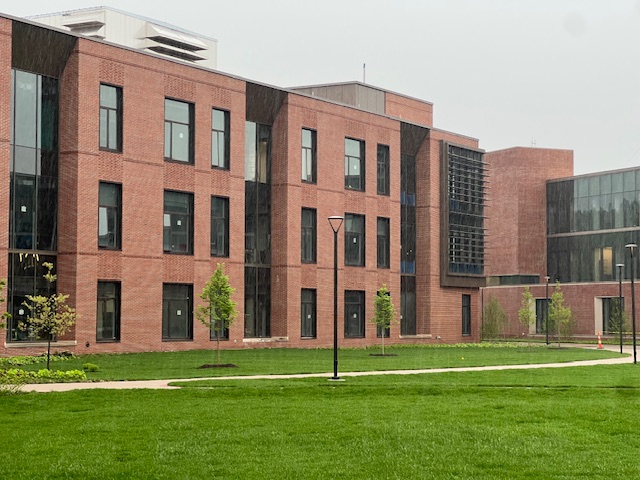
“What they did with the place is nice, it looks great with the new buildings, but I like how the current quad is because of the natural look it adds to the campus, it’s iconic. It also adds such nice scenery to the campus with the Sleeping Giant in the back”.
Some are just glad it’s finally over.
“Seeing construction got real old real fast, I’m happy it’s over,” said Thompson.
And others like Maurice? They’re excited to experience what they have wanted the whole time—the full college experience.
“As a student who won’t be on campus as much (next year), I’m gonna take it in and work out in the gym, do homework in the New School of Business, and utilize what I was given after barely utilizing the current School of Business throughout three years.”
“If I am going to pay to come here, I might as well utilize the materials offered to be the best version of myself and work hard,” he said with a smile.