

The standoff over Wallingford’s $400M potential new high school
By: Ben Busillo
To outsiders, Wallingford, Connecticut, looks like a typical New England town of 45,000 people. But for decades, it has been a town of two distinct identities, separated by a geographic divide and a fierce high school rivalry.
On the east side sits Lyman Hall High School, home of the Trojans, steeped in history and clad in orange and blue. On the west side lies Mark T. Sheehan High School, home of the Titans, and a product of the 1970s population boom, wearing burgundy and gold.
For 54 years, Wallingford high schoolers have been split apart, but now, the Wallingford Board of Education (BOE) wants to erase that dividing line.
Citing declining enrollment and aging infrastructure, the Board has proposed a massive, $411.6 million plan to close both schools and build one, unified, state-of-the-art high school on a new, undisclosed site by 2030.
The proposal has split the town. Proponents argue that consolidating into one building is a fiscal necessity that will save millions in maintenance and offer students modern career pathways that the current 1950s-era facilities cannot support. Opponents — a coalition of parents, teachers, and newly elected officials — fear the loss of community identity, the logistical nightmare of a “mega-school,” and a lack of transparency from the officials pushing the plan.
For years, the battle lines were clear: The Board of Education pushed forward, while skeptical residents demanded more transparency.
On the night of November 26, 2024, inside the Robert F. Parisi Council Chambers, the roles abruptly reversed.
Christine Tatta, councilwoman and a vocal skeptic of the consolidation plan, moved to take the Town Council into executive session — shutting the doors to the public and the press — to discuss the confidential details of the project’s status.
Councilman Sam Carmody, made a speech on the floor of the council, arguing that transparency is the only way to build public trust.
Transparency in this process is not optional. It is an obligation.
– Councilman Sam Carmody
In February, Carmody had penned an op-ed arguing that without open governance, the town would remain paralyzed by suspicion. Now, he watched as his colleagues voted to go dark.
“Public officials sometimes talk about transparency in the abstract, but when the rubber meets the road, they love executive sessions,” said Mike Brodinsky, Wallingford resident and former Town Council Chairman, criticizing the move. “The Board of Ed needs to make the parcel public before it goes to the council… Otherwise, it will be jammed through.”
Tatta defended the move as a fiscal necessity. She argued that discussing a new potential site for the consolidated school in open session would tip off the real estate market, inviting private developers to outbid the town and driving costs even higher. But for the residents left in the hallway, the optics were undeniable.
This meeting was a microcosm of a town in paralysis. Wallingford is attempting to build a single, unified high school to bring the community together. Yet, the political process of building it — marred by secrecy, dysfunction, and historic distrust — has exposed rifts in the community the project aims to unite.
The project is massive: a projected $411.6 million investment with a target opening date of 2030. But the governance is fractured. Education comprises roughly 60% of the town’s budget, yet according to Michael Votto, a 25-year veteran of the BOE, the Board and the Town Council have formally met only once regarding the project.
Now, a standoff looms. The Board of Education has voted to build the school, but the Town Council, dominated by skeptics of the plan, controls the checkbook.
WHY CONSOLIDATE?
Before politics took over, the plan was born from a simple reality: shrinking numbers and aging buildings.
Wallingford’s student population has been in a steady decline, leaving both Sheehan and Lyman Hall operating well below capacity. Running two half-empty schools, they argue, is fiscal malpractice.
“We have the statistics that show that [enrollment is going down],” Votto said. “You’ve got to have maintenance people at both schools. You have to plow the driveways of both schools… You have two kitchens with all the help… There’s more cost running two schools than there is one.”
Beyond the utility bills, proponents argue that consolidation is an academic necessity. In the current system, course offerings are diluted. If only a handful of students at Sheehan want to take AP Physics, the class might be cut. Combined, those numbers create a full section.
“If we have one high school… there might be two sections of it,” Votto explained. “So now a student would not have to choose between one course or another.”
Sheehan also offers a Certified Nursing Assistant program. Lyman Hall on the other hand doesn’t offer the program, so students who want to go into nursing on the east side of town, would have to make the commute during school over to Sheehan.
The vision is a state-of-the-art facility that offers career pathways — STEM, healthcare, technology — that these buildings simply can’t support.
“With a brand new school… you have more safety features and facilities than you can possibly build into one of these old schools,” Votto added. “Right now, we’re spending millions of dollars on elevators, on boilers.”
Despite the potential huge education benefits, the strongest argument for one school supporters like Votto — and perhaps the only reason the project is viable — is financial.
Lyman Hall, originally opened in the late 1950s, is old enough to qualify for the maximum state reimbursement rate — roughly 50% — if it is replaced by new construction.
Renovation is a different story.
Votto explains that the state formula “punishes” towns for underutilized square footage. Because Sheehan and Lyman Hall both have fewer students than they were built for, renovating them would only garner about 35% reimbursement.
“If we were to renovate Sheehan, we would only get 35% reimbursement from the state. That means the taxpayers would have to pay 65% of that renovation,” Votto said. “You don’t know what hidden things are there when you renovate. The cost to me is down the bottom of the list. But on the other hand, I still have to think of the taxpayer.”
Mayor Vincent Cervoni agrees, viewing the consolidation as a fiscal inevitability.
“Nobody can convince me that it’s going to be cheaper to build a new Lyman Hall and renovate to new Sheehan than it is to consolidate,” Cervoni said. “Consolidation has to be less expensive than continuing to run two high schools.”
JP Venoit, the CEO of Masonicare and Vice Chair of the Planning and Zoning Commission, looks at it through a workforce lens. He needs a town that attracts talent.
“I care more about having a town that attracts people… to get [a] better pipeline for staff for our organization,” Venoit said.
However, Venoit admits the rollout of the plan — specifically the early confusion that led people to believe the school would definitely be on the Lyman Hall site — was botched.
“Saying it was going to be on the Lyman Hall property probably was one of those where I think people… probably shouldn’t have got ahead of myself,” Venoit said.
THE GHOST OF ‘BOE’S’ PAST
This is not the first time there has been tension over which students go to which school.
In 2010, the Board of Education pushed through a controversial “reconfiguration” plan. For decades, Wallingford’s eight elementary schools operated on a K-5 model. The new plan split the district, forcing students to attend one school for grades K-2 and then switch to a “sister school” for grades 3-5, creating four pairs of two “sister schools.”
At the time, parents flooded meetings, skeptical of the disruption. As reported by the New Haven Register in 2010, parents were “wary” of the logistical nightmares and questioned the educational benefits. The administration, led by then-Superintendent Salvatore Menzo, cited that the plan would increase test scores and save budget dollars.
Fifteen years later, Melanie Rossacci, a BOE member who recently won a seat on the Town Council this past November, says the town is still waiting for those results.
“So plenty of people from the public came out and spoke and said they were against the reconfiguration. They didn’t listen,” Rossacci said. “Dr. Menzo said that it would increase test scores and reduce budget dollars. It did not… This K-2, 3-5 model has not shown anything beneficial. All it does is make things more complicated for families where they need to be in multiple places.”
The scars of that reconfiguration — a major change “jammed through” over public objection — have not healed. It created what critics call a precedent that still haunts the current debate: the Board of Education decides, and the public adjusts.
Votto, who has spent a quarter-century on the Board and one of the architects of one high school, admits the fallout lingers.
“It did leave a bad taste in some people’s mouths,” Votto said regarding the 2010 shift. “We did our best to explain it… economically and academically. But just because something happened 10 years ago, does that mean it’s going to happen again now?”
For many residents, the answer is yes. The skepticism facing the high school consolidation is not just about nostalgia for their own schools; it’s about a lack of faith in the body making the promise.
THE ‘TEACHER POD’ REBELLION
Despite the financial arguments, the educational benefits remain a point of fierce contention.
The disconnect between the planners and the public was made starkly visible during the community forums held back in the spring of 2024. Two sessions were scheduled to gather
feedback on the “Educational Specifications” for the new school. The result was anemic; 90 in-person attendees combined, and similarly low engagement on the archived YouTube streams.
But those who did show up expressed “great disapproval” of the proposed “Teacher Pod” model. In an effort to save space and costs, the new school design eliminated individual classrooms that teachers call their own. Instead, teachers would share communal workspaces and rotate through flexible classrooms.
The backlash was immediate.
Teachers and parents argued it would erode the stability of the learning environment. In this instance, the pressure worked.
By 2025, the Board of Education formally dropped the shared classroom model, adding 17 new classrooms to the design and expanding the project to over 344,000 square feet. Yet, for Rossacci, the fact that the idea survived as long as it did — narrowly passing earlier votes — is proof that the Board is out of touch.
She fears that as budgets tighten, bad ideas could return.
“I can’t guarantee that we’re not going to end up going back to those teacher pods that I fought so hard against,” Rossacci said.
For Rossacci, and for many parents, the loss of two schools means a loss of opportunity. One school means one set of varsity captains, one class president, and one drama club lead. It means fewer chances for students to find a mentor.
“You can’t have two presidents of the student council,” Rossacci said. “You can’t have four leads in the play… you’re cutting down every single opportunity in half.”
Mike Busillo, head coach of the Sheehan Girls Basketball team and fresh off a Class MM state championship victory, has the same concerns, but also thinks with more sports offered athletes will fill in the cracks.
Many parents also have issues with the student population of a giant high school, fearing that kids can tend to feel more isolated in a big crowd.
Votto dismisses this concern as an attack on the professionalism of Wallingford’s teachers.
“That’s an insult to the educators,” Votto said. “They know what they’re doing, and they can identify kids who are having issues. It doesn’t matter whether you have 25 kids in a class or 15.”
THE MANDATE
Despite the logic of reimbursement rates and course catalogs, the two school supporters remain unconvinced. And in the most recent election, they made that clear.
Rossacci sees the vote as a referendum. A BOE member who ran for Town Council on a “Two School” platform, she watched as candidates sharing her view swept the council seats.
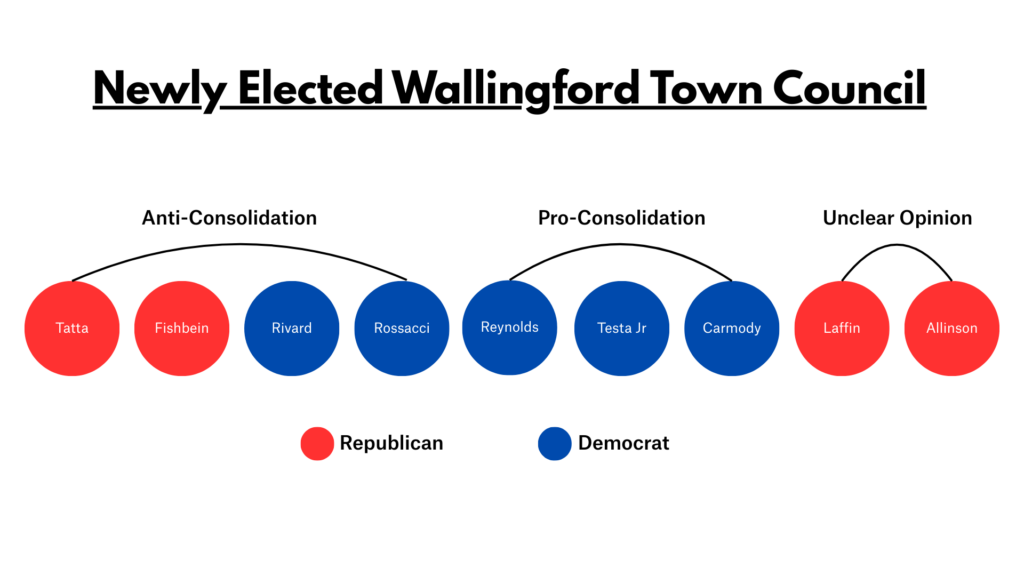
It wasn’t just Rossacci. Incumbents and challengers who voiced skepticism about the “One School” plan — including Craig Fishbein, Christine Tatta and Brian Rivard — secured decisive victories. Voters also elected Caroline Reyes and Ray Ross to the BOE, cementing a Town Council presence that is openly hostile to the current vision.
The results painted a stark picture of the town’s mood. While the Board of Education had spent years building the case for one school, the voters went to the ballot box and handed the reins of the Town Council — the body that controls the funding — to the people promising to stop it.
“Every candidate that was known for two schools won,” Rossacci noted. “People want a say, and people want to know who they’re putting in elected seats.”
Her concern isn’t just the cost of the new building; it is the future are we going to do with all these buildings?” Rossacci asked. “There’s been some conjecture that Sheehan would potentially be turned into a large sort of park and recreation facility… but there still would be a cost to that.”
She points to the town’s vacant police station as a cautionary tale of municipal waste.
“We have a vacant police station. We have a vacant Yalesville station… It is on the burden of the town,” Rossacci said.
THE TRANSPARENCY PARADOX
Derek Breuler, a 2005 graduate of Sheehan, lives on the west side of town. His 8-year-old daughter, Charlotte, is the face of the generation this project is built for — she will graduate in 2035.
Charlotte swims competitively, and Breuler worries about opportunities on sports teams, as well as the logistics of a single school in a town that spans a significant geographic footprint. But mostly, he worries about what he doesn’t know.
“I truly don’t know if one high school would benefit Wallingford, people forget It’s a pretty large town land wise,” Breuler said. “I don’t feel like they are being as open as they could be. I understand not publicizing a potential site, but I feel like many have gotten the impression that they just aren’t being told everything.
To the Board of Education, silence is a strategy, not a conspiracy.
Votto argues that revealing the location of a potential site prematurely invites a bidding war. If a seller is identified, a private developer could swoop in, outbid the town, and kill the project.
“We and the people who are selling it don’t want people to know they’re selling it,” Votto explained. “If it gets out there that Mike Votto is selling a 50-acre plot to the school system for $2 million, what’s going to stop someone from coming in saying… I’ll give you $5 million for it?”
Mayor Vincent Cervoni backs this play, noting that sellers often demand privacy until the ink is dry.
“Nobody is not being transparent,” Cervoni said. “The people who are dealing with this are dealing with it appropriately. So that being said, before anybody is going to vote on going forward or not, it absolutely will become public.”
But Rossacci argues that transparency is about more than just data dumps; it’s about accessibility.
“Government in general is not set up to be digestible to a regular person,” she said. “I have personally invited the mayor and… the chairman of Town Council to come to Board of Ed meetings, because education is 60% of the town’s budget, and they never come to our meetings ever. They have not shown their face in our meeting one time, so they don’t know how the community feels.”
IDENTITY
At the heart of the debate is the elusive concept of “town identity.”
For decades, the Powder Puff football game and the rivalry between the Titans and the Trojans have defined Wallingford’s autumns. Opponents of the plan fear that merging the schools will dilute the community’s spirit.
Mayor Cervoni dismisses the idea that the two schools are the sole keepers of the town’s identity.
“This town is 355 years old,” Cervoni said. “Having two high schools only represents the last 54 years. So what percentage of 355 is 54? It’s around 15%… Is it really the identity of this town?”
Votto goes a step further, arguing the two-school system has bred division rather than pride. He recounts hearing disturbing rhetoric regarding the geography of the town.
“I’ve had people call this side of town where Lyman Hall is ‘the ghetto’,” Votto said. “Now, do you think that’s right? This is not unity… We should be together as one town.”
He believes the rivalry goes too far, recalling games where he saw students fighting on the field. “You shouldn’t be fighting your kids in your own town,” Votto said.
PROCEED WITH CAUTION
While the Board of Education points to declining enrollment as the primary driver for consolidation, citizens at the forums raised a terrifying possibility: What if the projections are wrong?
Attendees pointed to the cautionary tale of Bassick High School in Bridgeport. There, a new school was built based on demographic projections, but upon opening, they discovered they did not have room for 75 of their students.
Rossacci argues that the enrollment drop in Wallingford is not a permanent condition, but a symptom of a housing crisis — one the town has failed to address.
“A teacher… cannot even afford to buy a house in Wallingford,” Rossacci said. “We’re not getting young families that move in because… the housing options are so, so small.”
Rossacci points to restrictive zoning laws that prevent multi-generational living, such as bans on detached in-law apartments.
“We are actually, based on our housing issues, we’re cutting down the ability for younger families to move in,” she said.
Venoit confirms that the power to change the rules exist, they just need the town to ask for it.
“We actually have workshops where we have the public work with us to make changes on the regulations,” Venoit said. “Some of those workshops really revolve around in-law apartments, about the number of units on a parcel of land, and affordability.”
He notes that regulations can evolve to meet “new demands,” but emphasized that the push often has to come from the residents themselves. “A lot of this will happen through… citizens of Wallingford that will ask for things like that to happen,” Venoit said.
The implication is clear: fix the housing, and the enrollment might stabilize. But if the town consolidates based on current lows, and then housing reform brings families back, Wallingford could find itself with a shiny new $411 million school that is already too small.
LIMBO
The clock is ticking toward a 2030 opening, but the path forward is mined with political obstacles.
The Board of Education can design the school. They can vote to build it. But they cannot pay for it.
That power lies with the Town Council — the same body that was just elected by a populace skeptical of the project.
Mayor Cervoni clarified a critical point: the public is waiting for a referendum, a chance to vote on the school themselves. But that vote only happens if the Town Council approves the funding first.
“The only way it gets to a referendum is if the council votes in favor of the expenditure,” Cervoni said. “If it dies at the council, there’s no opportunity for a referendum.”
So, the town sits in a stalemate. The “Two School” Council could kill the project before the public ever casts a ballot. The “One School” BOE continues to spend money on studies for a site they won’t name. And the residents, remembering the broken promises of the 2010 reconfiguration and the unanswered questions of the 2024 forums, watch with growing unease.
As Charlotte Breuler swims her laps and looks toward a graduation date a decade away, the adults in the room are locked in a battle of wills.
Many people in town want unity. The government is divided. Without a bridge between the abstract promises of transparency and the concrete reality of governance, the new high school risks being a monument to the friction that built it.
For Rossacci, establishing it correctly means more than just finding the right plot of land or the right reimbursement rate. It means fixing the broken trust that has come to define the project.
“It’s our town, it’s the people’s town, and it’s a lot of tax dollars,” Rossacci said. “The people’s voice needs to be very large in this.”