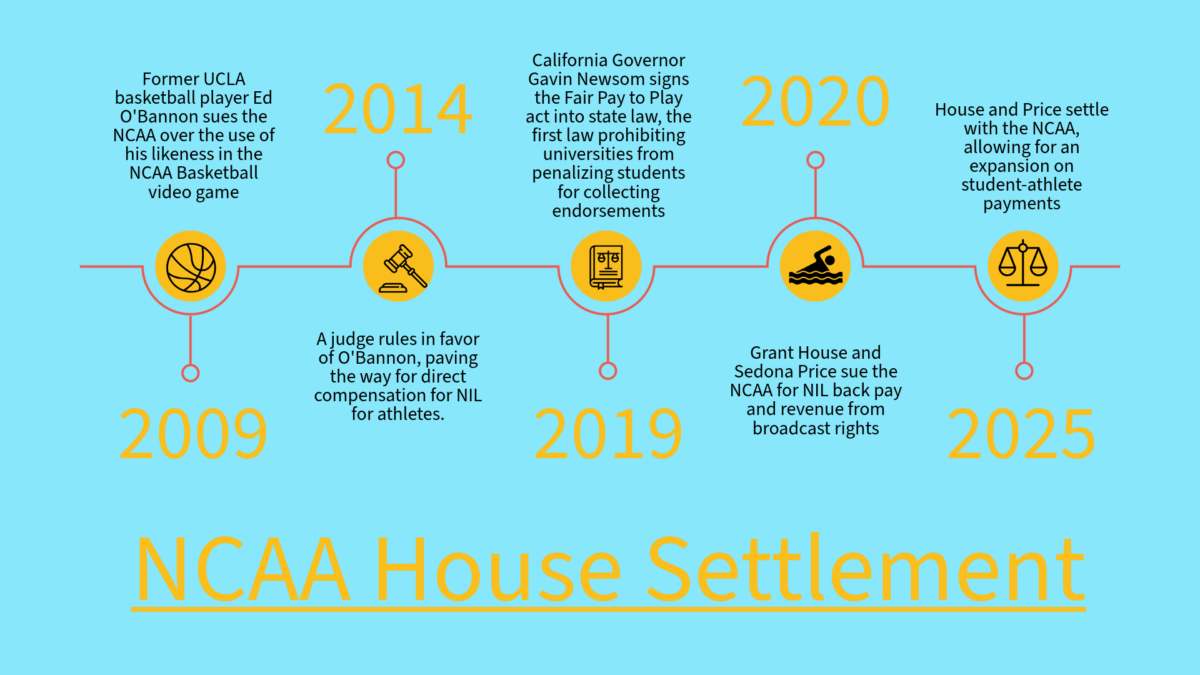
Over the summer, while college campuses lay dormant and students all went back to their hometowns, a legal agreement came down that cements a change that college sports have been undergoing for almost a decade. The NCAA v. House settlement, announced on June 6, 2025 mandated that institutions pay back athletes that were owed any money related to Name, Image, and Likeness (NIL) since 2016, as well as expand payment plans for current and future student athletes.
NIL refers to college athletes’ ability to make money from their personal brand — such as through endorsements, social media promotions, autograph signings, or other paid opportunities. It allows athletes to profit from who they are without affecting their NCAA eligibility. The lawsuit, brought against the NCAA and the “Power Five” conferences, the Big Ten, Big 12, Pacific 12 (Pac-12), Southeastern Conference (SEC) and Atlantic Coast Conference (ACC), was filed by former Arizona State University swimmer Grant House and Texas Christian University and University of Oregon women’s basketball player Sedona Price.
The Specifics:
The settlement allows for $2.8 billion over 10 years, about $280 million a year from the respective athletic departments to athletes who played from 2016 to 2024 who were not paid for NIL rights. This recognizes restrictions that prevent athletes from earning “fair market value” for their NIL.
The settlement then allows for schools to directly pay athletes beyond scholarships. A cap of
$20.5 million per school for all athletes began this academic year and which will grow over time.
Another notable detail is that the settlement removes limits on athletic scholarships that schools can give out. The schools will instead face roster caps according to sport, preventing an unlimited amount of players on a team.
“I figured I can help more athletes. I can advocate for them. I can help uplift them and give them new opportunities. Absolutely no question in my mind,” House said in an interview with Hoops HQ on why he wanted to be a named plaintiff in the case.
While many athletes and fans alike see this as an open door to new possibilities, others are more weary the change it will make in college sports.
“What I fear and what I think anyone should be concerned about is the unintended consequences… Like any legal decisions it sets precedents that sometimes lead into directions that people are not aware of,” said Dom Amore, a sports reporter with the Hartford Courant.
How did we get here?
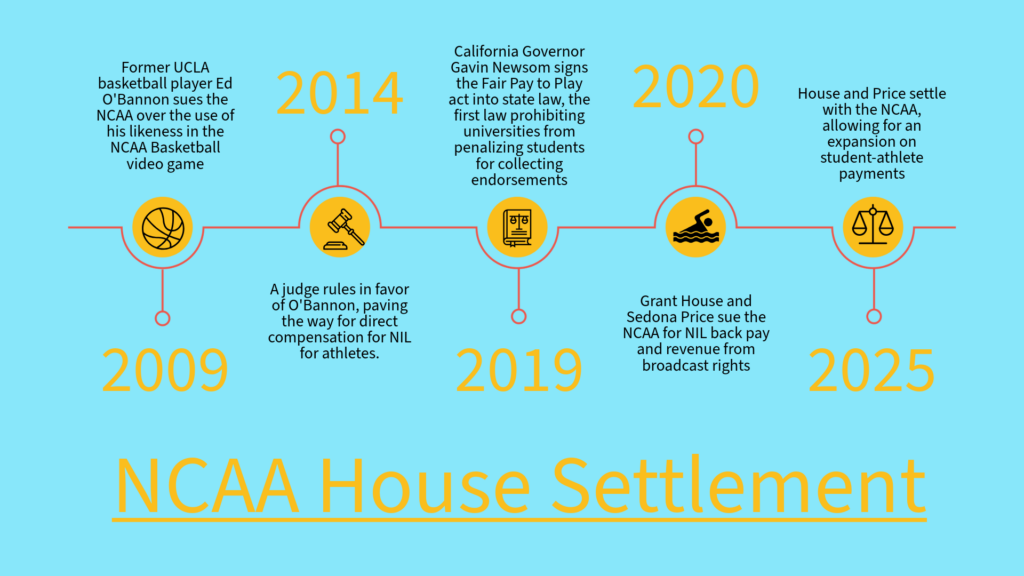
For most of its history, the NCAA strictly banned athletes from receiving compensation, considering them all “amateurs.” Many high profile athletes and coaches were not spared from these rules, like former Texas A&M quarterback Johnny Manziel, the first freshman in history to win the Heisman Trophy, who was suspended for signing autographs in exchange for compensation and head coach Rick Pitino, a member of the Basketball Hall of Fame, who was forced out of Louisville Cardinals because of payment an Adidas executive made to a family member of a high-rated recruit to play for the team and then endorse Adidas when he turned pro.
While all this was happening, the NCAA was raking in millions from TV deals and endorsements, while student athletes saw almost no profit. In 2019, California passed the Fair Pay to Play Act, becoming the first state to allow state schools to pay athletes.
In 2021 the NCAA adopted an interim policy in which athletes could profit off of brand sponsorships, social media, memorabilia and personal businesses. Many schools began forming NIL collectives to pool resources to draw in athletes. The settlement starts the construction of a standard model in which all athletes can profit.
“The NCAA has always been an organization known for paralysis of analysis; they accept change very slowly and deliberately… but change was forced on the NCAA by the courts and as a result. it became the wild west,” Amore said.
Here in Connecticut:
This settlement has the potential to not only increase payment of athletes, but also expand what athletes can do with NIL opportunities. Here in Connecticut the effect is being felt from a
mid-major school like Quinnipiac and a power-five school like UConn.
The settlement could also be seen as an example of the rich getting richer. Although they now have to pay more to athletes, schools in the Power Five conferences will have more resources to pull highly rated athletes to their schools. They can also expand their NIL capabilities, adding sponsors that will also help to pull in top talent.
One of these schools is the University of Connecticut, which has 26 NCAA championships across many sports. Fans everywhere are familiar witcourt and these new rules will help both of these programs exponentially.
The NIL operation in Storrs was big even before the settlement. The Huskies have their own website dedicated to advertising the school’s collective. One of the links leads to a NIL marketplace where athletes advertise themselves. An example of this is Alex Karaban, a star forward on the men’s basketball team and a two-time national champion. Fans can book private experiences with Karaban on the spot, like a personal video or appearance at an event.
Dominic Godi, UConn’s Associate Athletic Director for Strategic Initiatives, further explained NIL services that the Huskies provide to their athletes. “We do everything we can to find opportunities for other dollars for our athletes. We have a department called Championship Labs, which is an internal, like, content team that helps our athletes build their brands,” Godi said. “We also provide a service that if an athlete has a low-end photo shoot that a company wants to do, we’ll provide the support to make sure that they have a team reviewing and creating content for them in that company, to help them find
But even with the perceived advantage the Huskies have in NIL capabilities due to their size, Godi still worries about the ways the settlement will shake up the system.
“We’re hopeful that the structure being established will establish a market, and there’ll be some sort of ceiling or cap that will allow for student athletes to be appropriately paid, but also protect some parity in sport, which is no different than every other, major sport league where there’s some sort of parameters on overall spending,” Godi said.
The settlement may have the most effect on smaller yet still Division I school like Quinnipiac. Although the potential is there for wide recognition with D1 status, seen with the Bobcats 2023 men’s ice hockey championship win, the lack of state funding and large donors may impact the athletic department in many ways.
In a statement to Q30 before the school year started, Quinnipiac Athletic Director Greg Amodio said, “This decision reflects our institutional commitment to fully support our student athletes as they strive to achieve their competitive and academic goals.”
“The NCAA distributes a portion of their revenue to all of the member institutions every year, and the portion that Quinnipiac is getting to support our athletics department is less, moving forward because of the back payments. That impacts all of our teams,” said Alyssa Hyatt, Quinnipiac Athletics Associate Athletic Director for Business and Administration.
Hyatt added that the athletic department will have to find additional revenue to make up for the loss of revenue.
“You know, so with the roster limits, the scholarship limits are gone, and we could offer more scholarships,” Hyatt said. “If we had an unlimited pool of money, but we don’t. And we could often up to $20 million of revenue sharing, but we don’t have that.”
Kaitin Lewis, Quinnipiac’s Associate Athletic Director for Strategic Partnerships said the settlement will hit a mid-major school like QU more than it will hit a Power Five school like UConn.
“In the past, it was, you’ve got a full scholarship. You’ve got room and board, you’ve got all this stuff, but now, if you go to UConn, you get $700,000. If you come to Quinnipiac, you don’t,” Lewis said.
“Unfortunately, mid-major schools are destined to become bridge schools or stepping stone schools, almost like junior colleges. they are learning to recruit on that, promising ‘hey if you come here and establish yourself, then you could transfer to a power conference and make more money,” Amore said
Even with Quinnipiac being a mid-major school, that has not stopped some athletes from cashing in. Recently, star men’s basketball forward Amarri Monroe, who turned down numerous power four transfer portal opportunities to come back to Hamden, inked a deal with Farnam Reality, who also signed women’s basketball star Ava Sollenne.
“UConn gets a little complicated because it’s a state school and everything they do has to be transparent… Private schools on the other hand, are on their own and they have to live within their means… Quinnipiac seems to be very well resourced in their ability to provide a first-class athletic program.”
It is not just limited to basketball stars, however. Field Hockey defender Katie Shanahan has signed deals with the Kilogear Pro clothing brand has well as iHerb vitamins.
The settlement will also affect non-revenue sports such as tennis and cross-country due to the roster limits being imposed. “They might not be as competitive in the field events, or in the…distance, or that kind of stuff, because they’re limited on the number of student athletes they can bring in,” Lewis said.
“Star football players,” Amore said on who will benefit the most from the settlement, “It’s going to become a free agent bidding war instead of recruiting for those kinds of players”
No matter what, the settlement will change the landscape throughout college athletics. And while the effects are more widely covered in sports like football and basketball and in college towns in the Southeast and Midwest, it is important to keep your eyes on what happens to the places college sports seems to forget about sometimes like Connecticut.