
University originally nixed the group for its ties to Pro-Palestinian national organization
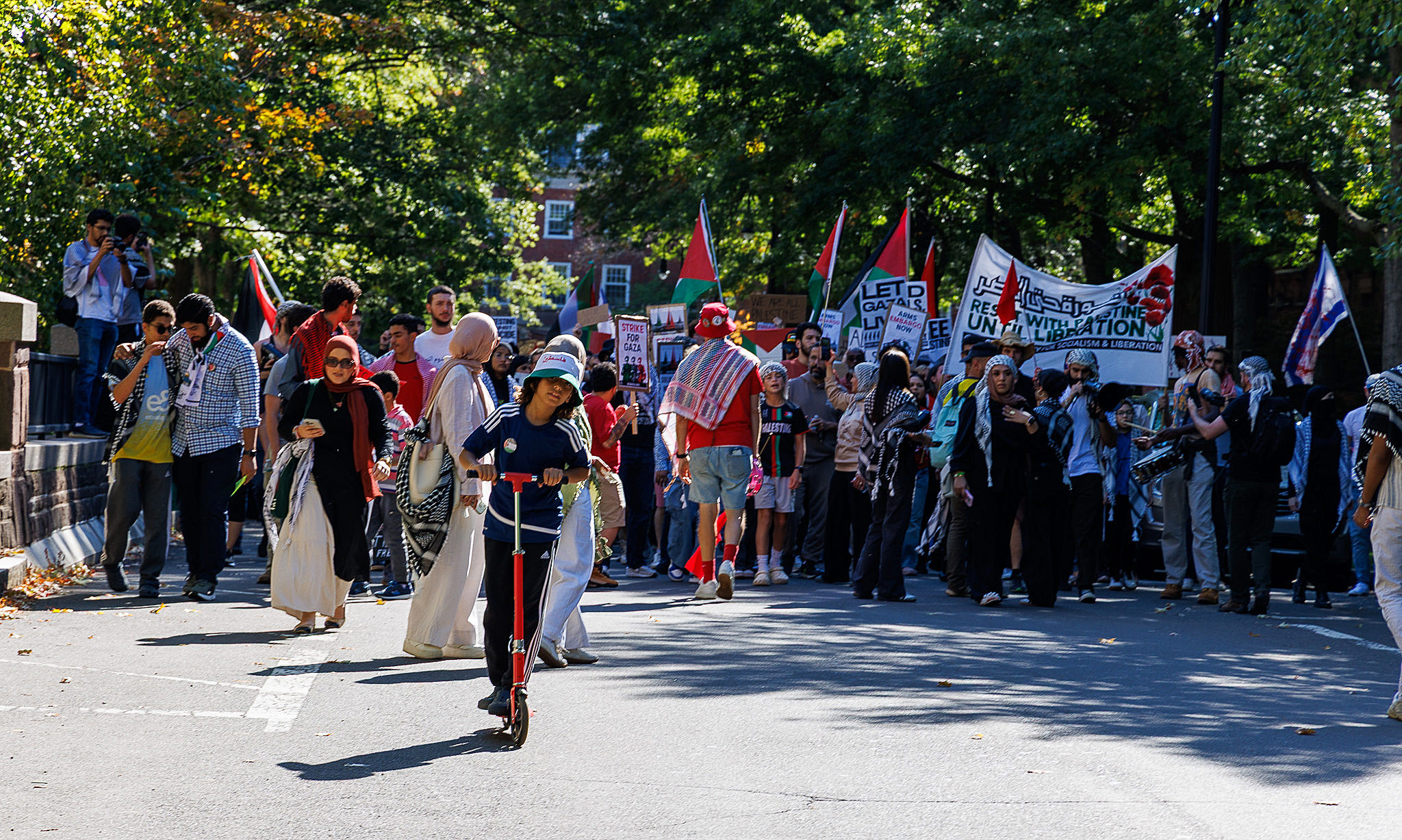
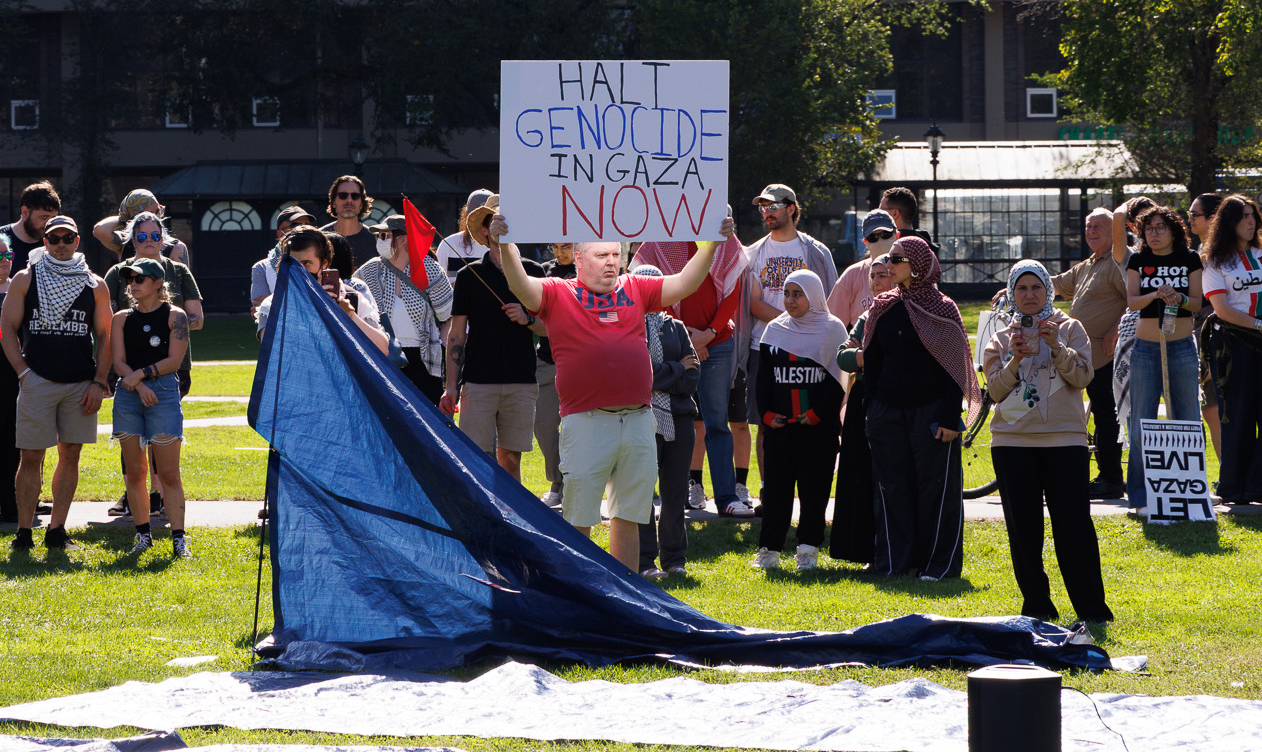
A large crowd of pro-Palestinian activists laid prayer mats on the New Haven Green and faced Mecca as a crowd gathered around them at a protest on Oct. 5, 2025. Quinnipiac University student Xiomara Saavedra Vicente was at the edge of the crowd, camera in hand, documenting them as they finished and marched through Yale’s campus and downtown New Haven.
Saavedra Vicente is a journalism major and also a founding member and co-president of Students for Social Justice, a group that began as an effort to start a Quinnipiac chapter of Students for Justice in Palestine, or SJP, a national network with chapters on more than 100 campuses. The National Students for Justice in Palestine organization works to help students form college clubs that “empower, unify, and support the Student Movement for Palestinian liberation.”
Her experience captures a struggle unfolding on campuses across the country: students pushing to speak on Palestine, and universities tightening their grip on who gets to organize under their names. At Quinnipiac, that tension centered on NSJP’s “Day of Resistance” toolkit. The decision left Saavedra Vicente confused.
“My intention was starting the organization here on campus,” she said. Yet the discussions kept returning to national controversies she couldn’t control.
Saavedra Vicente said she was moved by reports from Gaza following Hamas’ assault on Israel on Oct. 7, 2023. Social media was flooded with images and videos that pro-Palestinian activists described as possible war crimes and acts of genocide. As protests spread across the United States, she looked around Quinnipiac and saw little organized response.
“I noticed that we didn’t have one, or we didn’t have anything that was activism related,” Saavedra Vicente said.
Saavedra Vicente started the organization because she felt that Quinnipiac was insulated from much of what she saw as injustices in the US and around the world.
“My number one motive was to make sure that we started having those conversations on campus,” she said.
In late December 2023 she found the opportunity to connect with organizations and student groups that were aligned with her objectives.
Via group text, meetings and phone calls, student leaders from the University of Connecticut SJP chapter and CT Students for Justice in Palestine coalition familiarized her with by laws. They explained how they structured their events and coached her on how to navigate administrative approval. They became her main resource as she went through the process of starting the Quinnipiac chapter of the organization.
After submitting her application for Students for Justice in Palestine, some of Saavedra Vicente’s peers stopped attending the student-led meetings. At the same time, Quinnipiac’s Senior Director for Campus Life, Hannah F. Cranston, requested a private meeting.
Going into the meeting Saavedra Vicente was apprehensive.
“She [Cranston] wanted to talk more about the organization,” she said. “That kind of popped up as a red flag for me, because I figured if my organization was going to go through smoothly, I wouldn’t need a meeting with the with someone, a part of administration, and so I was kind of nervous going into that meeting because I didn’t know what to expect.”
This meeting, the first of at least two, is where she received the news that Students for Justice in Palestine would not be approved due to its association with the National Students for Justice in Palestine movement. Matthew Kurz, Assistant Vice President for Student Affairs confirmed that the group’s national ties were, in fact, the reason the application was denied.
“There was a national day of resistance that was planned to be held across SJP chapters,” Kurz said. “[The National Students for Justice in Palestine] called Oct. 7 a historic win.”
Kurz said that the rejection was made solely based on the content of the NSJP’s Day of resistance toolkit. The document, circulated online several weeks after the Oct. 7 attack and offers guidance for organizers.
The toolkit has been heavily debated. Critics, such as the Anti-Defamation League, say its references to “resistance,” including a line describing “armed struggle, general strikes, and popular demonstrations” as a legitimate endorsement of violence. They also argue its coordinated messaging, graphics, slogans and suggested protest language, resembles a national command structure that could limit campus oversight. Officials in states like Florida have gone further, claiming the toolkit provides “material support” for terrorism and pointing to imagery such as powered paragliders as implicit approval of the Oct. 7 attack.
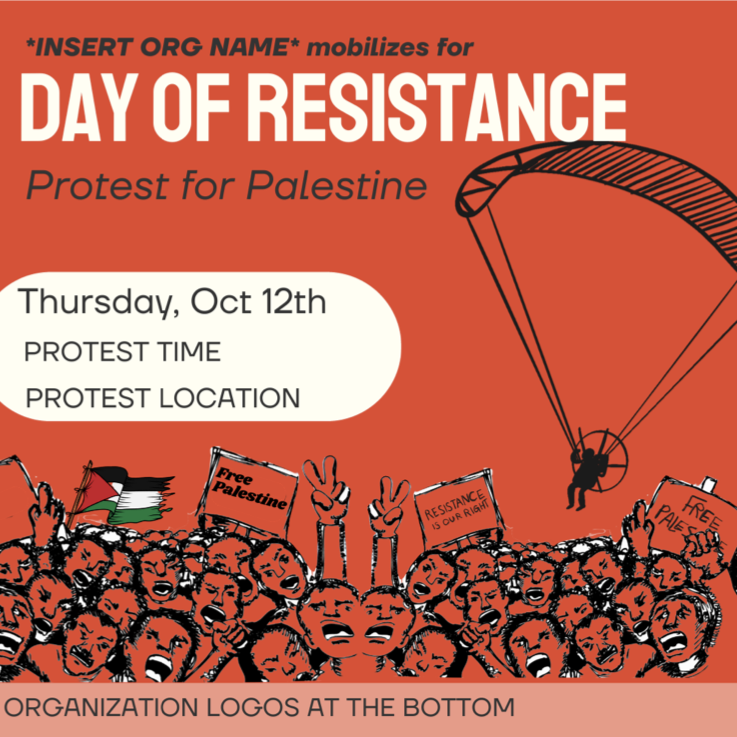
Kurz points to the line in the document stating “that SJP chapters are ‘part of the movement, not just in solidarity with the movement.’”
Supporters, such as the American Civil Liberties Union, counter that the toolkit is a standard organizing packet, similar to materials used by many other social movements. They say references to “armed struggle” appear in historical or political context, not as calls for student violence. That national coordination helps protect student organizers, especially those from marginalized communities, who face harassment and disciplinary pressure on campuses.
Saavedra Vicente said she was given additional justification.
“They mentioned antisemitism … They also mentioned that there was this one poster that one school did where there was a paraglider, and that paragliders are associated with terrorism, and they just didn’t see it fit at Quinnipiac,” Saavedra Vicente said.
Saavedra Vicente said she does not see a connection between pro-Palestinian activism and antisemitism. She continued to ask for more information, but receiving the same list of justifications, she left that meeting in shock. Kurz later confirmed that this first meeting took place between Cranston and Saavedra Vicente, and that he was not present. Cranston was unavailable for comment.
Looking for a clear explanation and seeking to understand what was at the core of the rejection Saavedra Vicente asked the university to provide a formal rejection letter or written statement outlining the reasons for the rejection, instead, she received another email requesting a second, closed-door meeting. This meeting involved Cranston, Kurz and Saavedra Vicente.
“She [Cranston] responded by saying that we could have an in-person meeting,” Saavedra Vicente said.
Saavedra Vicente arrived prepared to address the concerns she had been told about earlier: Antisemitism, safety, and the national organization’s reputation. But those topics didn’t come up the way she expected.
“They had printed statistics on how many Israeli people were killed, and they had given me information that did not really feel like it had anything to do with what my intention was with starting the organization,” Saavedra Vicente.
Kurz said in an interview that he referenced casualty numbers with Saavedra Vicente, though he said he did not bring printed materials. He said the statistics were raised only to give context for the decision based on how the NSJP movement draws scrutiny.
“The statistics reference was made to illustrate a point that during the specific attack… there were people who were killed that were not military combatants,” he said.
Independent investigations by Haaretz, The New York Times, +972 Magazine and others have found that Israeli fire contributed to some civilian deaths on Oct. 7.
The meeting left Saavedra Vicente more confused than before. She said she did not understand why a discussion about Oct. 7 was being used to evaluate a student club she intended to run on campus, with local membership and local goals.
“I was really shocked and I didn’t really know what to do or how to respond,” she said.
For Saavedra Vicente, none of what was discussed seemed connected to the organization she was trying to start. She left the meeting feeling shaken and unsure how to move forward.
“So that happened, and then they told me that I could give the club a new name,” she said
After the second meeting, Saavedra Vicente said administrators told her the club could move forward only if it adopted a different name. She agreed, reluctantly, and eventually settled on “Students for Social Justice.” Even then, she said she was warned that if the group’s activities resembled those of NSJP, the organization might face additional review and would likely attract further scrutiny. Saavedra Vicente felt her hands were tied and that the association with antisemitism and terrorism were insincere.
“Damned if I do and if I don’t,” she said. “I didn’t really want to give it a new name, because the whole point was for it to be Students for Justice in Palestine.”
Kurz offered a different account. He said no compromise was proposed during the meetings, and that about two weeks later Saavedra Vicente contacted the administration via email, of her own accord to ask whether she could start a new group instead of Students for Justice in Palestine. He said the meetings he attended were meant to help her find a path forward within University guidelines that could facilitate her goals. When asked, Kurz said he could not provide the emails, citing privacy concerns.
“We come from a place of wanting to support students,” Kurz said. “We always try to start from a place of trying to help a group be successful if we can.”
Kurz added that Quinnipiac’s student-organization management system, Bobcat Central, likely generated an automatic rejection notice by email, though he was unable to provide a copy. He described the April 9, 2024, meeting as the formal rejection of the SJP application. The university does not outline an appeals process for such decisions.
He also said that any student group planning events the university considers higher-risk, such as protests, outside speakers or other activities where safety concerns might arise, faces additional administrative review. To illustrate the point, he gave a hypothetical example of a student being injured during a climbing trip as part of a climbing themed student group, saying risk always shapes approval decisions.
Kurz mentioned that a Turning Point USA chapter is a group that’s in the works.
“Turning Point will be vetted, and all I can share is that they are seeking to apply,” Kurz said. “They will be vetted with the same rigor that everybody will be vetted.”
Turning Point USA’s founder, Charlie Kirk, who was killed earlier this year in a shooting on a college campus, has famously peppered his appearances and shows with racism and sexism, for example saying on his show in 2025 that “We’ve been warning about the rise of Islam on the show, to great amount of backlash. We don’t care, that’s what we do here. And we said that Islam is not compatible with western civilization.”
Saavedra Vicente considered submitting Bobcats for Palestine as an option. She felt, however, that adopting the new title gave Quinnipiac the appearance of supporting equity work while avoiding direct engagement with the issues she hoped to raise. She also questioned the university’s broader commitment to social justice, pointing out that it has not formally acknowledged the Indigenous land on which it sits.
“I just felt like the university hasn’t done its part in even acknowledging the indigenous land that we’re on,” she said.
She said she was disheartened by the university’s response. She saw the struggle for Palestinian liberation as connected to Indigenous resistance movements globally and felt the university was unwilling to allow students to explore those connections openly.
“I don’t know how they would even acknowledge us talking about indigenous groups resisting across the world,” Saavedra Vicente said.
Kurz said that political protests were not a thing at Quinnipiac University, and that he couldn’t recall any recent protests about anything.
“Not that I recall since I’ve been here at Quinnipiac,” Kurz said. “Students in my experience at Quinnipiac have been broadly apolitical. There’s a mixture of students here from high net worth families or whatever it may be, right? PWI (Predominantly White Institution), we’ve got this poll or whatever. And so I have found, across the board that are students have not been interested in engaging in extremes, one way or another.”
He said Quinnipiac students tend to be more career-oriented than students at other universities., and that they wouldn’t want their images as part of a protest on the pages of a newspaper.
Saavedra Vicente, on the other hand emphasized that students on campus need to understand the importance of those extremes.
“Injustices that are happening across the world… affects us here as students at Quinnipiac,” she said.
Back on the New Haven Green, Saavedra Vicente watched the gathering swell from a few dozen people to several hundred. After prayers ended, drums sounded out a steady beat, and the crowd began to move toward Yale’s campus. Chants of “Free, free Palestine!” and “From the river to the sea, Palestine will be free!”
As the march advanced, more community members joined , members of Jewish Voices for Peace, a local Catholic priest, a Methodist pastor, several Imams, Indigenous activists, First Amendment advocates, LGBTQ+ organizers and Veterans. For Saavedra Vicente, it showed how injustices abroad can feel directly connected to the struggles many people face at home.
“I see a connection between the ongoing injustices that Native American/indigenous groups in the United States are facing with direct correlation with what’s going on in Palestine,” she said.
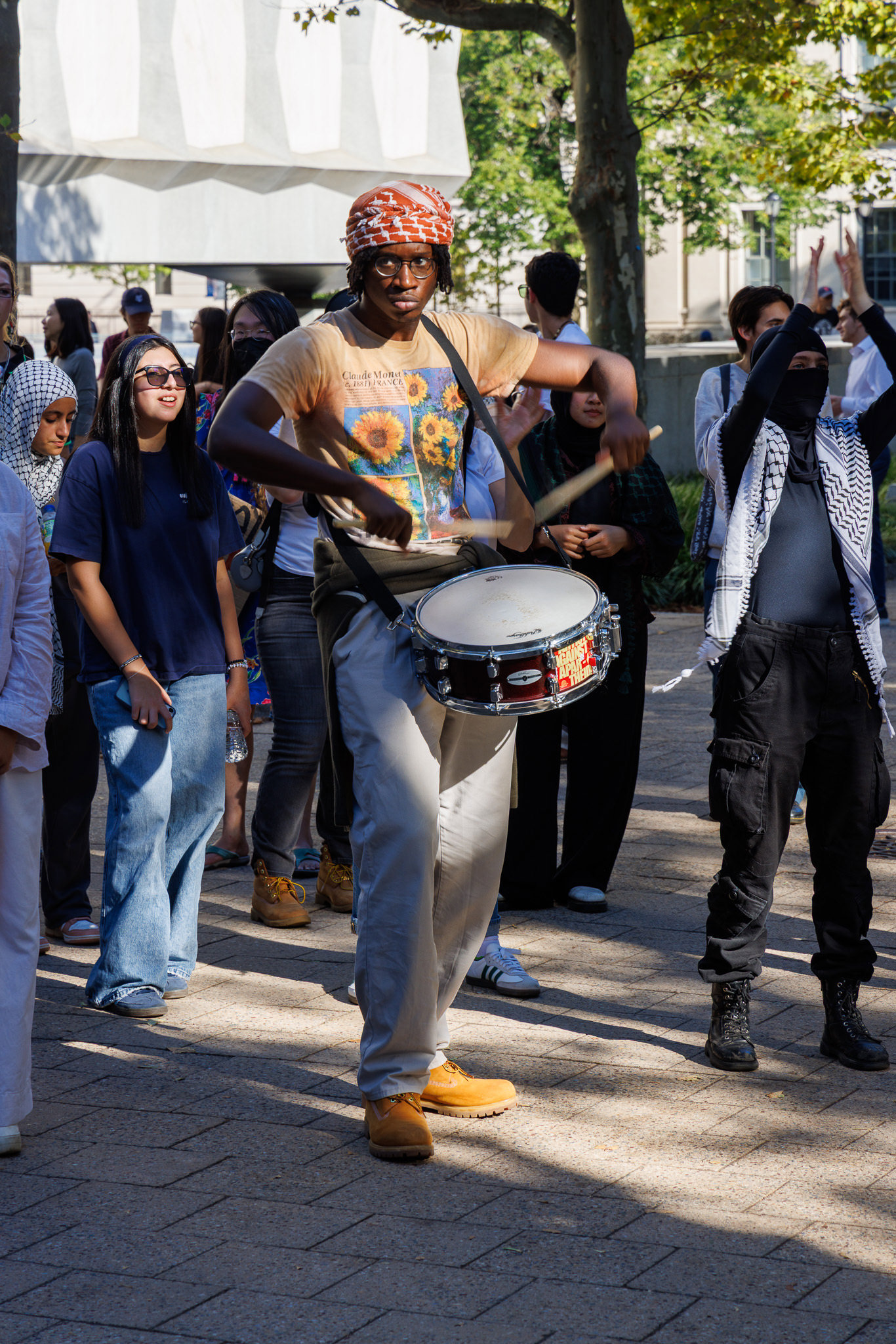
A set of drums set the cadence for the chants, shifting rhythms and pushing the crowd forward at what might have appeared to be a rehearsed pace. Police on every corner directed the protest through a preestablished path. As the crowd neared Yale’s buildings, the chants shifted from general chants of liberation and peace to specific accusation against specific institutions and people.
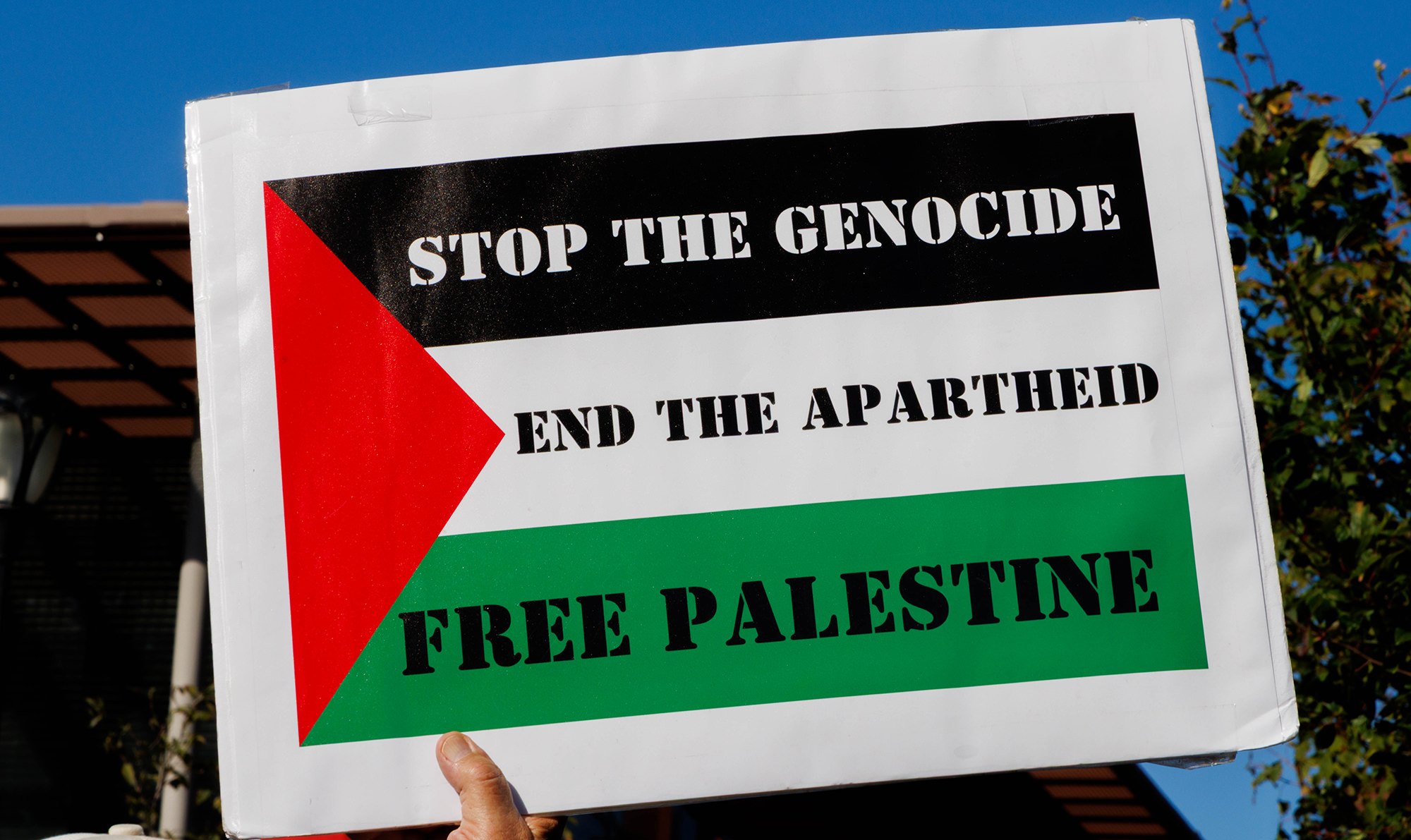
“Shame on you, Maurie McInnis!”, “Shame on the Board of Trustees!”, “Yale, Yale, stop the slaughter!” echoed through the streets, followed by “Your hands are red—700,000 dead!
The marchers accused Yale’s leadership of benefiting from investments tied to Israel and argued that the university could not stay neutral during an ongoing war.
The criticism centered on Yale’s president, Maurie McInnis, who had previously led Stony Brook University. Activists pointed to her administration’s handling of pro-Palestinian protests there, arguing that reliance on police contributed to an atmosphere of suppression. McInnis was still at Stony Brook during the months following the Oct. 7 attack, when student sit-ins and demonstrations spread across campuses nationwide.
Jonathan Sanders, a professor at Stony Brook and former CBS foreign correspondent, witnessed those protests and the police response firsthand. He said McInnis’ approach kept unrest from escalating into the kind of widely publicized clashes seen at Columbia University and the City University of New York.
“That Stony Brook did not turn into Columbia was what got her [the role as president of Yale],” he said.
Sanders noted that no images emerged of students bloodied or beaten by police at Stony Brook, which he believed worked in McInnis’ favor. Just as important, he said, was her fundraising record.
“Bringing in half a billion dollars is what attracted Yale,” he said. “In the world of university presidents, money doesn’t talk, it swears … Maybe she didn’t do it with the intent of silencing the protesters. But instead, she was motivated maybe because, protesters are bad for business,” and that delegating enforcement to campus police had consequences.
The gripes that activists expressed on the streets of New Haven had already surfaced almost a year earlier at Stony Brook University, where McInnis was serving as president. After the Oct. 7 attack, students there held sit-ins and demonstrations like those at campuses across the country. In one clash in May 2024, the administration responded with a heavy police presence, which alarmed both students and faculty.
“Her [McInnis] besetting sin, I think, was delegating to the police authorities on campus who were really insensitive and didn’t know, for instance, that male policemen shouldn’t be touching female Muslim protesters who were dressed in traditional garb,” Sanders said.
This, he said, was particularly incendiary to the student body and faculty who were in attendance when the arrests occurred.
In another incident in March 2024, students staging a peaceful sit-in in the foyer of the administration building were given 45 minutes to leave before police moved in. Fifteen minutes after the announcement, police started moving in cordoning the hallways, in some cases blocking routes some students were attempting to use to exit the space per instructions.
One student who later recounted at a April 1, 2024 faculty-senate meeting that SBU professors encouraged the students to disperse on the day of the March protest, saying to “think of our futures, to think of the opportunities we would lose. They believe we only do things to serve our careers, our best interests, as long as there’s money in our pockets, who cares what’s in our hearts.”
According to the meeting minutes, many faculty members questioned Stony Brook’s adherence to policy.
“Students were quietly sitting down in the foyer of the administration building. They were engaging in a sit-in strike, how was that disruptive to the campus community?” said one faculty member at the faculty senate meeting.
Another questioned the presence of police during the senate meeting, which is not standard practice.
“I was deeply saddened about the escalatory response of this administration, and a response that comes off as openly hostile towards our students. Why is the auditorium filled with police today? Is there any threat of violence here? Why did I have to walk in passing multiple university police cars parked in front and cops lining the hallways of the building today?”
Sanders said that ultimately no one administrator is responsible for the events in Gaza.
“In some ways, we all have blood on our hands because American made weapons that are reducing Gaza into a collection of broken concrete.”
The events surrounding pro-Palestinian protests at Columbia, Yale, NYU, and Stony Brook all point to what Saavedra Vicente has expressed, that the challenges she faced at Quinnipiac are part of a broader pattern in which universities respond to Palestinian activism with caution, control, and heightened scrutiny.
On the New Haven Green, the mood was very different from the one inside boardrooms and senate meetings. Here, community voices gathered in open solidarity, shaped more by shared grief and purpose than by office memos. Several speakers stepped forward, including Ahmed Abdelmageed, a Muslim Palestinian-American born and raised in the Middle East. His speech, titled ‘What’s the Point?’ lasted about seven minutes and drew on statistics from global institutions such as the International Criminal Court and the United Nations. At the time, those reports estimated that at least 66,288 people had been killed-including 19,242 children and that at least 170,000 injured, and another 440 had died from starvation.
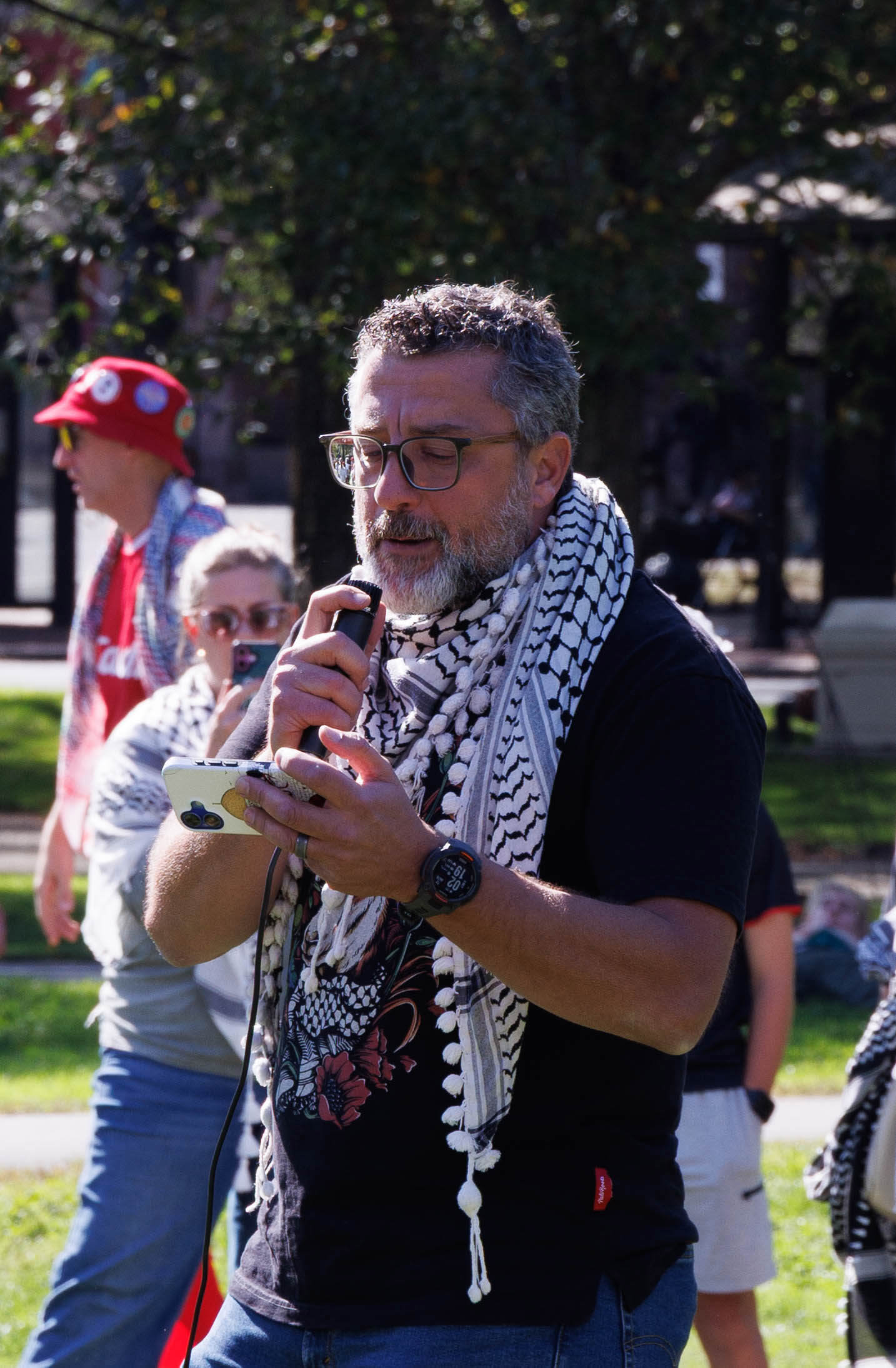
Throughout his speech on the Green, he asked, “What is the point?” as he listed the outcomes of Israel’s action towards Gaza, and ends with a message of resilience.
“The more I think about the question of ‘what’s the point’ the more I realize that the despair that comes from asking ‘what’s the point’ is exactly the point the military industrial complex and its colonialist cronies want to get to,” Abdelmageed, who is also a professor at The University of Saint Joseph.
Later, Abdelmageed reflected on what student activism requires in the long term. Emotion, he said, can spark action but cannot sustain it.
“The smart person is one who picks their fight… long-term influence is much better and more effective than a flash bang,” he said.
He explains that attention-grabbing actions might feel satisfying, but it can drain energy or create consequences that limit future work. Choosing moments carefully allows activists to stay effective and present for the long haul.
He explains that privilege plays a role from a big picture perspective as well.
“Maybe you don’t need to be front and center, find a different way that helps you influence the narrative. Let the others who are a little more protected take the brunt of the consequences,” he said.
He noted that undocumented and international students face a much higher risk of reprisal from the current administration.
Students like Rümeysa Öztürk-who, as CBS News reported on March 27, 2025, was arrested after publishing an op-ed in the Tufts University student newspaper, are far more vulnerable than U.S.-born students, especially those with American parents. Immigration and Customs Enforcement claimed Öztürk was “pro-Hamas,” though the op-ed she co-authored in The Tufts Daily never mentioned Hamas. Instead, it urged Tufts to act in line with the moral and political concerns raised by its student body.
Abdelmageed continued by emphasizing that students should play to their strengths.
“If I’m a good listener, a lot of people who are dealing with the stress and the trauma and everything else, that could be the way in which I can contribute to the cause,” Abdelmageed said. “Because maybe I’m not a very good speaker, maybe I’m a good organizer, and I can help organize, but I’m not a good person with a mic to be rallying.”
He urged students to avoid burnout, warning that “once you’re burnt out, it’s hard to get back and that doesn’t help anyone.”
Abdelmageed placed the struggle in historical context.
“We’ve been living with this for 78 years of an actual occupation, but over 100 years of all that led to it…It’s not going to happen overnight… I’ve been here for almost 30 years. The public discourse from when I was a student activist talking about Palestine to when these guys are student activists talking about Palestine, public discourse has shifted dramatically in understanding of Palestine and the apartheid and occupation, Abdelmageed said. “So that’s a huge win, and that shift in public discourse is going to keep moving forward, and it needs people to keep the conversation going and the enlightenment going so that eventually we get to a win.”
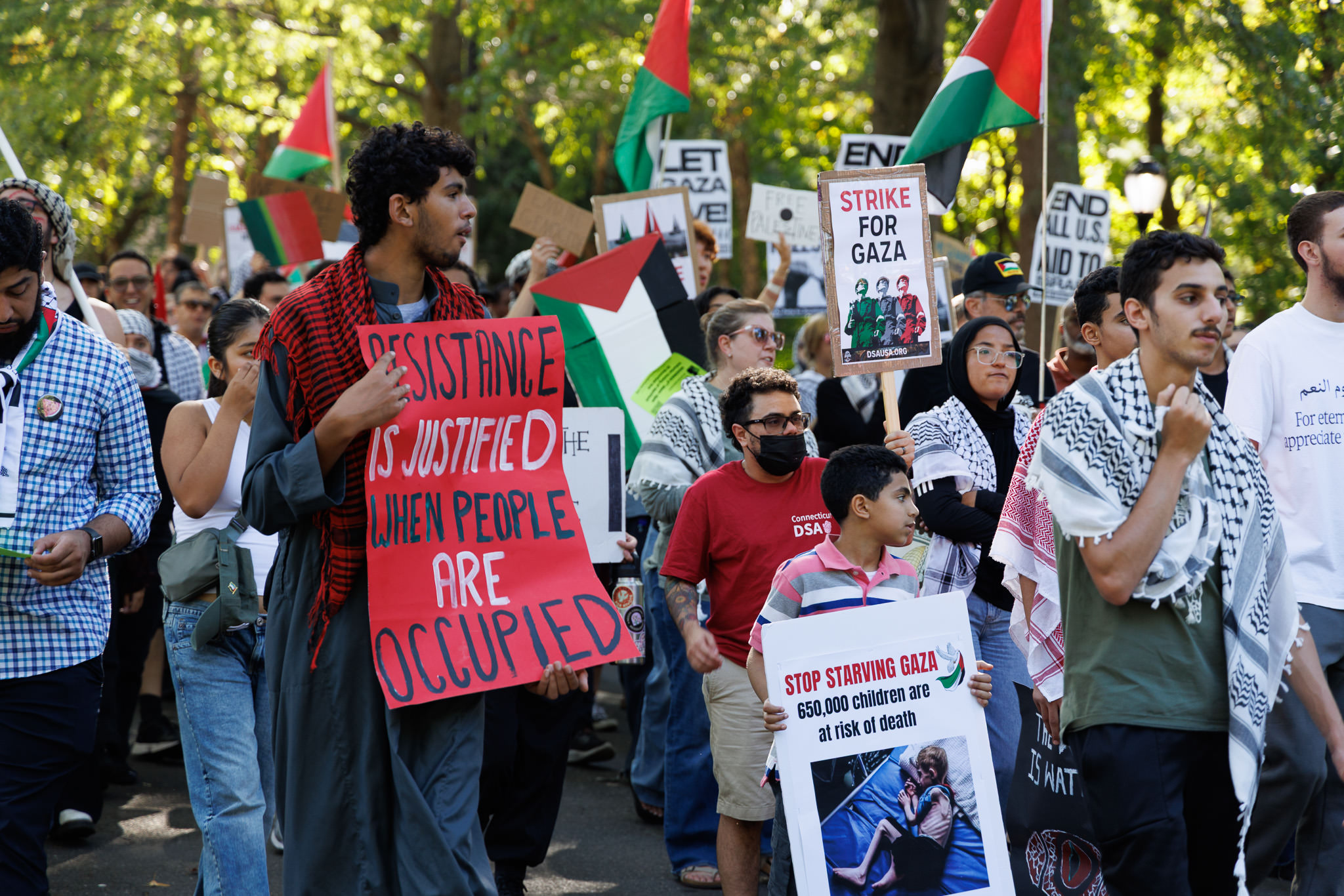
As the march looped back toward the New Haven Green, the chanting continued with the same fervor, bouncing off the brick buildings and shop walls. Saavedra walked, took photos and took it all in.
Quinnipiac’s Student for Social Justice now serves as a hub where broader issues relating to indigenous resistance, resilience and a broad variety of social activism are discussed with the goal of spreading awareness on campus that Saavedra Vicente feels is crucially lacking. Over time she hopes that the group can help break down the sense of separation that leads Quinnipiac to view off-campus issues as unrelated to campus life.
“I think growing up there [Brooklyn, New York], it made me very conscious from an early age of the injustices that we face as a community, the lack of resources we are given to be a flourishing community,” Saavedra Vicente said.