

By Beckett Calkins
19-year-old Sam Hayden joined the Quinnipiac men’s soccer team six years ago and has been with the team longer than any other player currently on the roster. How is that possible? Team Impact.

Team Impact is an organization that works with over 750 colleges and universities in all 50 states across the country. The organization matches children facing serious illness or disability with college sports teams to create lifelong friendships. Over 3,000 children have participated in Team Impact, involving north of 75,000 student-athletes.
Sam has down syndrome and he has been with the team since he was 13. One thing that has always remained consistent about Sam is his love for sports. Sam thrives when he is able to be active and outside and being a member of the Quinnipiac soccer team has helped him do just that. From going to practices or games, to supporting the team off the pitch as well, Sam has done it all. He has embraced the team, and they have done the same right back.
“They really brought him in like a little brother… he teased, he joked around with them, he participated in practices, he would bring cookies after a game to celebrate victories, and he would give them hugs after losses,” said Sam’s dad, Derek Hayden.
Sam is currently in a transition year after high school but remains listed on the Quinnipiac soccer roster and everyone in that locker room would tell you he is a member of the team more than anyone. He gets special access that only the athletes get. He is welcomed onto the field before and after games, he gets to go to media day and get his picture taken for promotional shoots, he is even on the official roster.
“He’s at Quinnipiac North Haven for his transition year and he’s been on the Hamden campus and run into the guys. I think that’s a highlight for him is when he’s just walking around campus with his friends and he runs into some of the team and they’re always happy to see him and high five him,” said Sam’s mom Marcie Hayden.
As parents Marcie and Derek Hayden had a difficult decision to make when deciding if Sam would participate with Team Impact, and while that decision paid off it wasn’t always easy.
“When we first got into Team Impact it was a way for Sam to connect with a community that we may not have thought he would connect with. He was 13 at the time, connecting with college aged guys,” said Derek. “It was speculative at the time, and it was a two-year commitment…I think we were overwhelmed by how much he was embraced by the team but also how much he enjoyed being around the team.”
Quinnipiac Clinical Associate Professor of Occupational Therapy, Elizabeth Wescott has spent countless hours studying inclusive sports and programs like Team Impact and even volunteers on the board of LOF Adaptive Skiers, a non-profit that provides adaptive water and snow ski opportunities.
“Whenever I start off a conversation about adaptive sports, inclusive sports or inclusive fitness, I always ask people their goals,” Wescott said.
While goals are different for everyone, Wescott recognizes that everyone is working through their own obstacles. Organizations like LOF Adaptive Skiers and of course Team Impact make sure that there is a space for everyone in sports.
“I think in terms of my passion, I started to look at (LOF Adaptive Skiers) as a huge piece of the continuum of care,” said Wescott. “It was so therapeutic and beneficial, not just physically but also socially and psychologically. When I think about things like wellness, well-being, socialization and quality of life, it really was helping.”
Quinnipiac Men’s Soccer head coach Eric Da Costa has seen the benefits of inclusion with Team Impact first-hand.
“It’s been massive. We got involved really early with Sam Hayden, which was just life changing for all of us,” said Da Costa. “For the players on the team at the time, for Sam, for his family, for me personally and our program…The growth that we’ve all gone through with our interactions with Sam, it’s just been overly rewarding.”
It’s been so rewarding that Da Costa and the soccer program have taken their relationship with Sam a step further.
“You know, Sam’s been graduated out of the (Team Impact) program for four or five years now, but he hasn’t graduated out of ours,” Da Costa said. “He’s still very much part of what we do. Sam is till ingrained in our team culture and the fabric of our team.”
Sacred Heart is another university in Connecticut that hosts multiple Team Impact members. Senior Associate Athletic Director Steve Conn agreed with Da Costa and Sam’s parents as well that the program influences the student athletes just as much.
“The student athletes they love having the Team Impact players around because they provide a different perspective,” said Conn. “In some ways, it makes them be able to feel fortunate to do what they are doing but in a lot of ways, it’s another friend and another family to bond with. It’s nice to have that built in component for a team that’s part of the bonding activities and things that form team chemistry.”
Back at Quinnipiac, Sam certainly helped build comradery throughout the team. While watching the games or going to the practices was great, outside of the sport was where the relationships and friendships grew, including the team supporting Sam on his very favorite holiday.
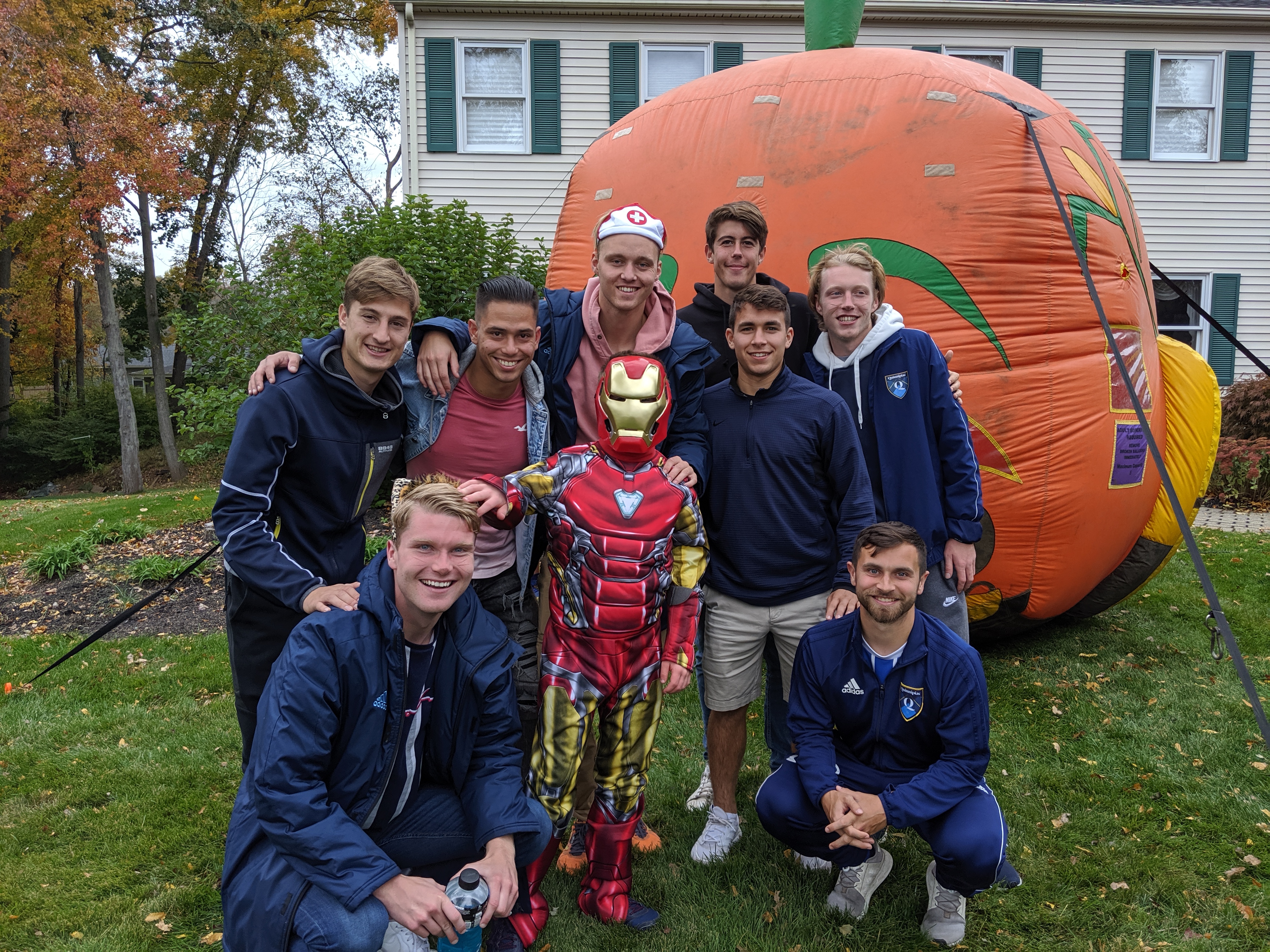
“On Halloween, we invited the guys to come, and we figured maybe a couple guys would come and hang out with Sam,” Derek said. “10 of them showed up and that was great that they can rally around that common interest that’s outside of the hyper intense sport.”
When it comes to adaptive sports there are plenty of misconceptions and Wescott talked about the importance of looking at things from both sides.
“One of the biggest misconceptions is that, depending on the term, non-disabled or able boded people make is that Parathletes or people who participate in adaptive sports are inspirational,’ Quinnipiac professor Wescott said. “I think to look at any athlete, what they are doing is incredible. If we separate someone whose an Olympian versus a Paralympian and we say the Paralympian is so much more inspirational. Why? It’s so crucial that everybody looks at these individuals as athletes.”