

“Hey, I think it’d be really fun to do a podcast together,” established hockey podcast host Jonny Lazarus recalled from a conversation with his friend, Justin Kapelmaster. The two and Max Mastbaum created “The Latke Room” in March 2020, featuring influential Jewish athletes and public figures.
With no previous experience, they set out on their podcasting journey interviewing guests from legendary hockey journalist Stan Fischler to stand-up comedian Jared Fried. Despite never becoming a popular show and stopping in 2021, Lazarus launched his media career, starting with YouTube tutorials on linear editing software and now hosting live morning shows.
Podcasting can be anything to a digital content creator, and for Lazarus, it was a chance to create something that would launch his career in sports media.
With over 6.5 million podcasts on Spotify alone, there must be some magic behind the microphone to explain it, right? Magic isn’t the right word in this situation. The appeal of this massive medium is simply attributed to its accessibility and diversity.
Free access across all platforms, with genres ranging from true crime to sports discussions, rambling friends to pre-produced news shows, and fiction to philosophy, ensures there is always a show for every listener, whether they are active or casual.
Having nearly every show available on a platform like YouTube, Spotify, or Apple makes it easier than ever to find a show.
Growth and Demographics
Podcasting is seeing tremendous growth, especially over the past five years. With the COVID-19 pandemic keeping people isolated, podcasting became an increasingly easy way to find new social experiences from your home. That period wasn’t a fluke — it was a catalyst for growth.
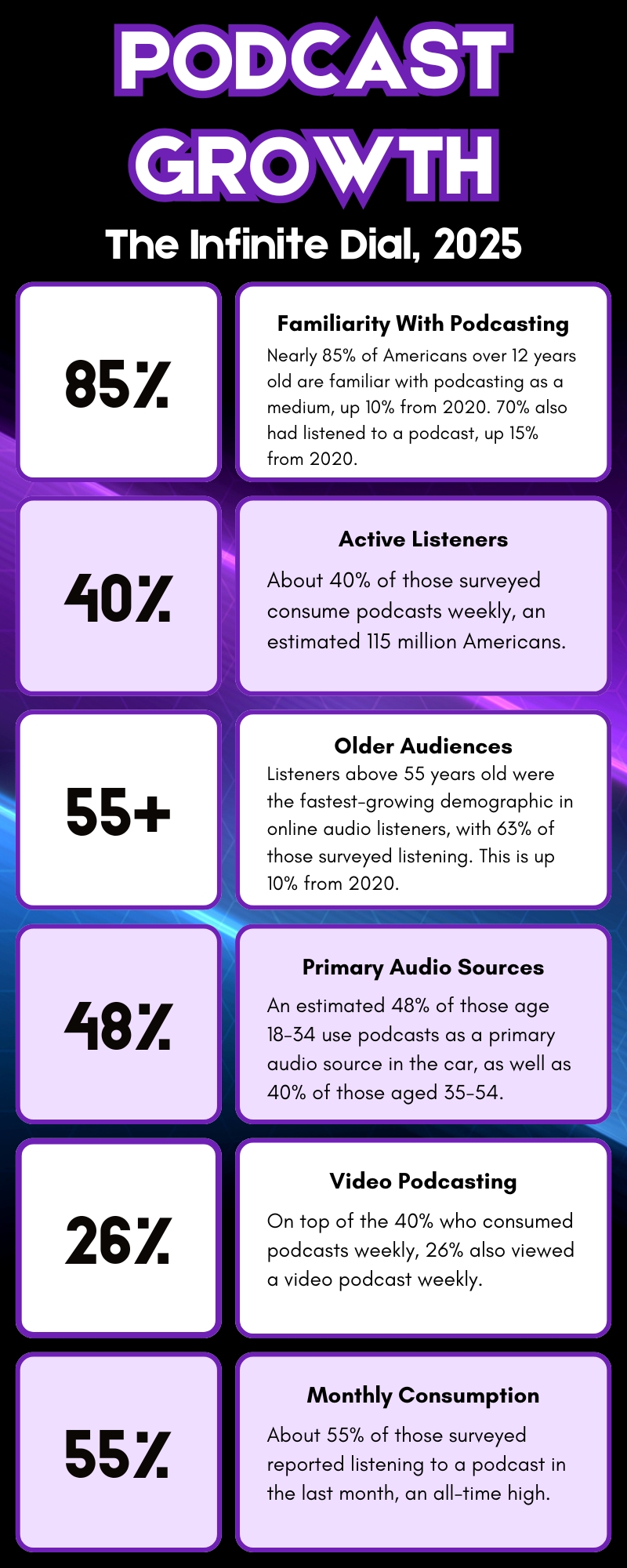
David DesRoches, Director of Community Programming at Quinnipiac University, teaching courses in audio production and a 25-year veteran of radio and podcasting also sees how the ease of podcasting is making it a faster-growing medium.
“The technology is becoming easier to navigate,” DesRoches said. It’s not as much of a problem as it used to be and I think it’s becoming more of a household name and it’s just going to continue to grow.
DesRoches also sees one path as more successful than others for some of the most well-known podcasts: pre-existing fame.
“I think that probably the common path to success is either you go viral through some sort of social media content or through your job,” he said. Large personalities and brands like Joe Rogan with “The Joe Rogan Experience,” Jason and Travis Kelce with “New Heights” and even an established brand like NBC’s “Dateline” are all allowing new listeners a seamless transition to another medium.
While he believes these types of shows will take over the market, the ease of access to technology and topics won’t stop creators from expressing their ideas to like-minded people.
“If you have a smartphone, you can open up the voice memo and be in a quiet space and you can record a podcast,” DesRoches said.
Creators’ Expression
There are countless motives for creators to start a podcast. One of which is becoming more popular is using knowledge from your work to promote a business or idea. Teresa Youngstrom, a retired registered nurse from Cincinnati and creator of “Memory Care,” found her niche in podcasting, helping people with their loved ones’ memory loss.
“It’s very involved and there are more than 120 diagnoses that give us symptoms of dementia,” Youngstrom said. “Not everybody has Alzheimer’s, which is what a lot of people believe. That’s what I get to do, I get to help people.”
“Memory Care” has over 200 episodes featuring guests from all walks of life and perspectives, with convenience being one of the main appeals for Youngstrom.
“There’s a lot of convenience doing this, so I do it recorded. I can edit anything, so there’s low stress some of the time,” she said. “It’s just me teaching about something and sometimes we’ve got guests.”
The educational relationship can be an extremely valuable asset for creators and listeners, and this can be taken to a new level when executed in highly-produced podcasts.
Chloe Wynne, a recent graduate of Columbia’s graduate journalism program in New York and a producer at CT Public, finds joy in helping share people’s stories online. She particularly enjoyed the revelation in her investigative work on “Admissible: Shreds of Evidence,” exposing and solving stories that investigators thought were closed.
“I think the most rewarding part is when you see the months and years of work that you’re putting in on one story, some form of change comes out of it, some form of reform comes out of it, or at least that people are talking about it, and it’s starting conversations,” Wynne said.
“Admissible” focused on the Virginia State Crime Lab rediscovering decades-old DNA evidence and proving wrongly convicted felons not guilty, resulting in 13 exonerations in the state.
Investigative journalism is already a pillar of our media society, but transforming it into a medium as easily accessible as podcasting can make its impact even greater than it would be in print or broadcast.
Wynne carries her responsibility with great care, understanding how much impact her show has on the community.
“We’re telling stories about people’s real life lived experiences,” Wynne said. “It’s such a huge responsibility that we all carry to deal with that with a delicate and careful perspective.”
Real-life stories and relations are a common theme throughout podcasters’ motivation to create, and like educational or investigative podcasts, sports are no different in many facets.
Jonny Lazarus, a former NCAA ice hockey player for The University of Massachusetts and Mercyhurst University, took his love of the sport and made his career out of it, now hosting a live hockey morning show and creating digital content for the NHL and Bleacher Report.
Evolving from “The Latke Room,” a show with friends about Jewish athletes, entertainers and public figures, to “The Blue Crew,” a New York Rangers-focused podcast, he now hosts “Morning Cuppa Hockey,” hockey site Daily Faceoff’s early live show.
Lazarus found that his experience was not just an outlet to speak about the game he loves but also to advance his career in media.

Image from Daily Faceoff/Apple Podcasts.
“That’s the stuff that you have to learn when you start just because it kind of makes you more of a Jack of all trades too, it’s super helpful,” Lazarus said. “When you apply for jobs and you’re younger and they know you can edit and they know you can create your own content it just makes you way more versatile.”
Lazarus also found himself making connections through his work, enjoying the conversations with everyone he met and sharing them with the world.
“That’s the coolest part is the network of people that you grow from having on your show and interviewing and then also highlighting their stuff,” Lazarus said. “People love to talk about themselves when you give them the chance to. I think that’s a really unique part of it that I get to basically make people happy to talk about themselves every day.”
As long as you have a microphone, in increasing cases, a cell phone camera, and an idea of what to talk about, you can make a podcast. Their mass appeal for creators is what makes the field so massive.
Listeners’ Appeal
With a podcast available for every interest and type of listener, it doesn’t take a scientist or a statistician to figure out that there is something for everyone to connect with. These listeners each have a different reason to connect with hosts and stories for an hour, taking them away from the noise of a commute, chores, or downtime.
For Helena Quinn, a Generation X listener from York, South Carolina, now residing in New York, it gives her a chance to connect with her family’s shared experiences with paranormal activity.
“It was just normal,” Quinn said. “Mom had to fight with the ghost, like, OK, that was just normal.”
Her family’s experience is just one aspect of how she connects to podcasts as a medium. For Quinn, imagination is a powerful tool in an audio-based story.
“I think that there’s something about, and even though, yes, you’re connected to technology, about taking away that visual aspect of it,” she said. “[Podcasts are] able to kind of paint that picture in your mind without having someone provide a visual for you.”
Others, like Tamara Stephen, a fellow Gen X listener from New York City, discovered podcasts through their interest in news and true stories, finding that longer stories provided more than a TV news segment would. To her, the deeper the story goes, the better it becomes.
Convenience is also an incredible asset for Stephen, who listens to heavily produced shows like NPR newscasts, as well as humorous, conversational shows that discuss pop culture news.

“I think it’s a combination of the deep dive and the ease of it,” Stephen said. “I mean, everyone can do everything on their phone.”
Access and connections are vital to podcasts building a foothold in the media landscape, but one aspect stands above all in its status.
Podcasting has variety nearly unmatched by any other accessible medium. With the ease of creation, connection, and sharing, its variety has come to define it as not oversaturated but catering to a broad audience.
Ryan DeMarco, a millennial listener from Wilmington, North Carolina, has his interests fully catered to with the sheer volume of podcasts available. He fulfills his interests with informational podcasts about sports like “The Bill Simmons Podcast” or “The Big Picture” for Hollywood news, but podcasts are more than just information for DeMarco.
“If work’s got me stressed out or something, I’ll want to just kind of turn my brain off for a minute,” DeMarco said. “I’ll get into the pop culture ones, like ‘How Did This Get Made?’ or ‘Conan‘ or ‘Happy Sad Confused.'”
The Future of a New Medium
Podcasting is still a relatively new medium, considering its titanic radio and TV counterparts. Its growth is immense and likely to continue, but with that comes changes to how it looks and, in this case, sounds.
Some creators, like Jonny Lazarus, host of “Morning Cuppa Hockey,” believe that more live shows will take prominence, boosting viewership buzz and building loyal viewer bases.
Others, like Teresa Youngstrom, creator of “Memory Care,” believe that video will become increasingly vital to shows’ success, with the added dimension increasing engagement with audience members.
However, one trend that is proving true is the increasing number of brands and personalities creating podcast content.
“If you’re looking at the top podcasts from last year (2024), we’ve got ‘The Joe Rogan Experience’ number one, ‘Crime Junkie,’ ‘The Daily,’ New Heights and Dateline NBC…Most of them are leveraging popularity in another way,” said Quinnipiac’s David DesRoches. “I think that probably is the common path to success is that you either go viral through some sort of social media content or through your job.”
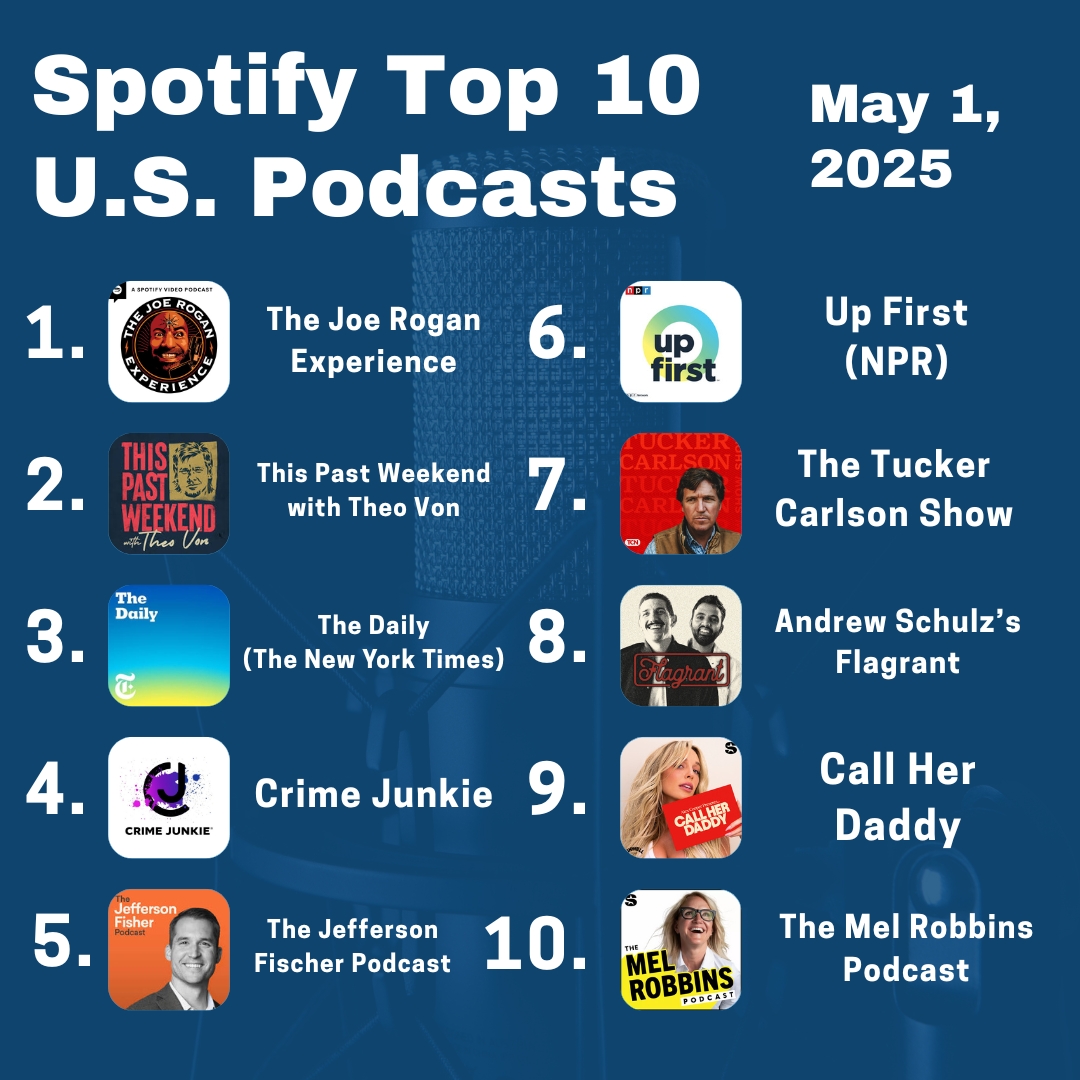
With three of the five podcasts still in the top five on Spotify’s U.S. podcast charts on May 1, 2025, exciting or established personalities are imperative to navigating a hyper-competitive market.
Everyone seems to have a podcast in the current landscape. With the way users laugh, connect with personalities or follow global news across subcultures, the medium stands alone in its ubiquity.
Next time someone asks, “Why does everyone have a podcast?” tell them to look around for something to listen to. It may change their commute for the rest of their life.