
Every kid has a dream when they are growing up. These dreams can be to be a firefighter, an astronaut, or a professional athlete. They may seem unrealistic, but with the right goals, you can get there. Senior guard, Jackie Grisdale, always wanted to play college basketball and became a walk-on player, then a scholarship athlete in 2022. The current captain of Quinnipiac’s women’s basketball team got her chance to be a college athlete.
For a route to becoming a professional athlete, college sports are always an option. With college sports becoming more accessible than ever, most people pick this option. High school athletes have the option to play in three different divisions and over 24 NCAA-sanctioned sports to choose from. There are over 1,100 colleges and universities offering NCAA sports. According to NCAA.org, over 520,000 athletes are playing collegiate NCAA sports.
With all the new rules being added to the NCAA, the athletic transfer pool is ever-changing. Since the 2021 court case, Alston v. NCAA, players are allowed to make money off of their name, image, and likeness (NIL). The NCAA has also been changing its rules, so players no longer lose eligibility if they leave their original school. If athletes aren’t happy with how a program isn’t being run or how they are treated, players can now transfer to any school and have a chance to play their favorite sport and make money.
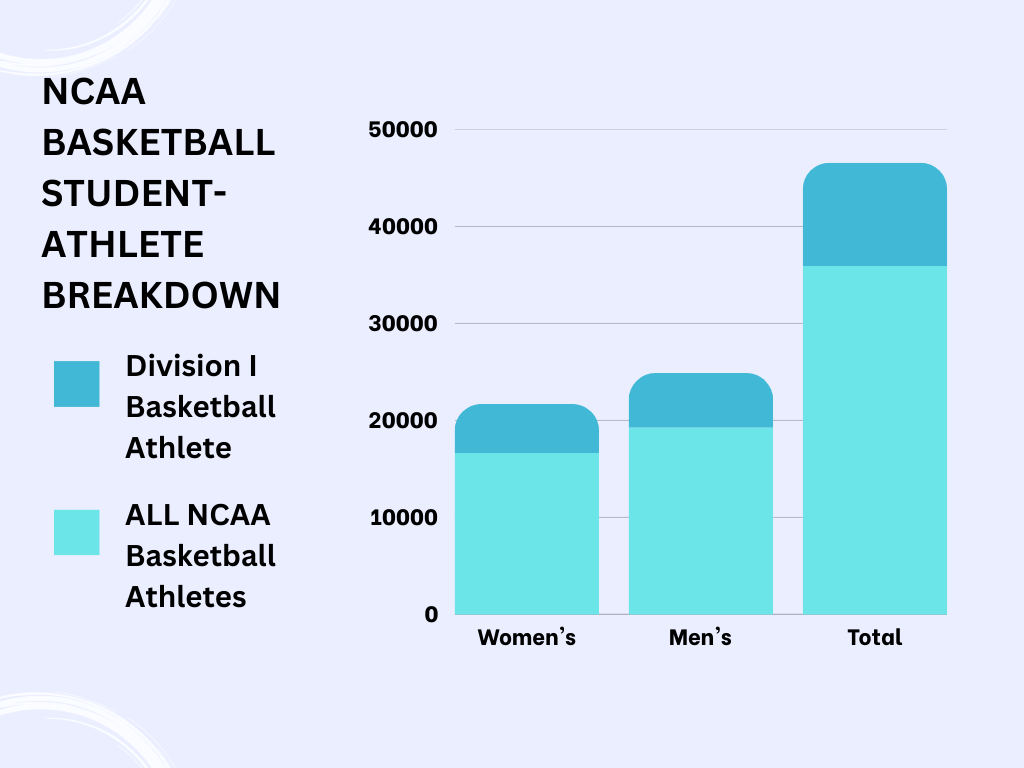
One of the sports being most affected by the transfer portal and NIL is college basketball. There are over 35,926 total NCAA basketball student-athletes in 2023-24, according to the latest NCAA sports sponsorship and participation data. According to NCAA.org. There are 19,275 men’s basketball student-athletes and 16,651 women’s basketball student-athletes. At just the Division I level, there are 10,655 total student-athletes. Currently, 5,607 play men’s basketball and 5,048 play women’s basketball.
Mid-major schools are being affected the most. A mid-major school is considered a Division I athletic program that does not make as much money or compete at the same level as the Power Five conferences, such as the ACC, SEC and other power conferences. Now that players can transfer more easily, fans see players starting their careers at a mid-major school, then transferring to a top conference, like the Big East, to earn money and play competitive basketball. Players can now transfer so easily because of the new rules with eligibility and no longer have to sit out for a year after leaving a school.
Sam Federman, MAAC basketball insider and reporter for Daily Dose of Hoops, explained how NIL and the transfer portal are affecting MAAC basketball.
“There’s money involved now, players can get paid to play for different schools. You’re getting high-quality players into the conference from high school, and you’re not keeping them for four years like you would in the past,” said Federman. “And also, previously, you’d get lower quality players into the conference from high school, because the higher quality players would go to higher quality programs right out of high school, because they had to stay there. Now you can get higher quality players out of high school because of the top quality, because the high major programs are recruiting the portal so much more.”
The last two years in the MAAC, the players entering have been able to make an impact on the program. Players like Adam Nije Jr., a first-year from Iona, and Adam “Budd” Clark, a sophomore from Merrimack. Nije was named to the All-MAAC Rookie team, and Clark was named to the All-MAAC First Team.
“So you look at the conference as a whole, and since there’s now financial incentive to going to a different high major school, obviously those schools can offer a heck of a lot more than mid-major schools,” said Federman. “Yeah, there’s a huge impact on where players are choosing to play. There are other reasons that go into it as well, but money is the thing that will drive all recruitments going forward.”
With the growth of competition within mid-major and the MAAC, this league is where competition is bred on athletes’ loyalty to the program. Gerry McNamara, Siena men’s basketball head coach, was formerly an assistant coach at Syracuse University, which is a well-known Division I program. McNamara spoke about how NIL and the transfer portal are affecting mid-major schools, from coaching at both a mid-major school and a high-level Division I.


“Obviously, there’s different levels, certain schools, the higher level, power five schools are going to have, obviously, more resources, depending on the house settlement, and now the schools are going to be able to pay the athletes directly,” said McNamara. “So, you know, to be quite honest, I still think there are so many really good players at this level, and there’s still going to be, you know, a lot of good options for these talented players to play at these levels. Some of these guys might get swayed by some of the higher levels, because they can afford a little bit more money, but I think we’re going to find the right guys to represent our league.”
For a small school like Quinnipiac University, it is not common to see that many players transferring out of the men’s and women’s basketball programs. On the women’s side in the past two years, only four players have transferred out of the program, and they have been able to have one player transfer in. According to Quinnipiac women’s basketball head coach Tricia Fabbri and the basketball team, this is because Fabbri builds this program on a family mindset and playing great basketball. She keeps a competitive program and recruits players who are good at heart.
Fabbri also explained how Quinnipiac is a family and how important it is to be shown on and off the court.
Even the players on the team explain why they love it here; it’s the family environment that makes them want to stay. For the 2024-2025 season, the women’s team finished second in the MAAC, making it to the championship game. Grisdale and Grace Labarge explain why they chose to stay and play their four years here.
On the men’s side, Quinnipiac has also been able to keep this family mentality. Entering his third year as head coach of the program, Tom Pecora has expressed how he has built this program out of hard work and the family mentality. In both years, he has led Quinnipiac to back-to-back regular-season championships. The most impactful task Pecora has accomplished is keeping the MAAC Player of the Year, junior forward Amarri Monroe.
Monroe has had multiple opportunities to leave Quinnipiac and have a chance to make more money. Last season, he announced to the world he was returning. This year, after entering the transfer portal, for two weeks, he decided again to stay. He announced his decision to stay at Quinnipiac on April 5. Monroe stated on X and Instagram, “I came back because of my love for this program, this team, this community. It’s more than basketball to me. They gave me a home when everyone forgot about me. I’m sticking with the people who helped me find myself again.”
Monroe also explained how he has plans to build a legacy at this program and how Quinnipiac helped him fall back in love with basketball.
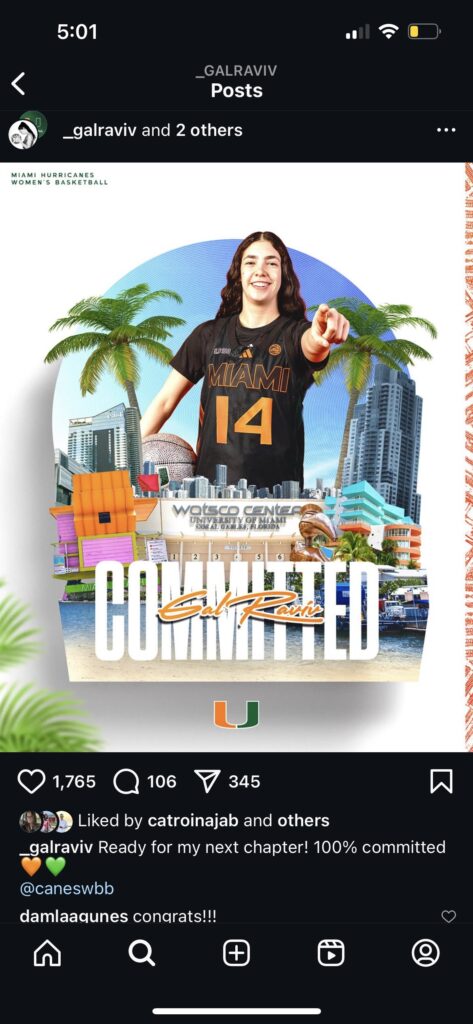
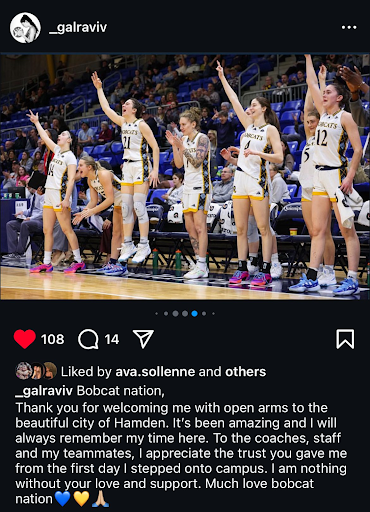
While both men’s and women’s programs have built this family environment, players will still leave at the chance to make more money and play at a bigger school. First-year guard Gal Raviv entered the portal on March 25 and announced she will be transferring to Miami on April 6. The MAAC Rookie and Player of the Year averaged just under 18 points a game and just over four assists a game. Raviv was the first player to ever accomplish winning these two awards on both the men’s and women’s sides. Raviv was the leading scorer for the team, and in only one year, scored a total of 591 points. Miami had a record of 14-15 this season and defeated Quinnipiac in overtime during the Miami Thanksgiving Tournament.
On the men’s side, Quinnipiac is losing four players to the transfer portal. The four players are senior forward Paul Otieno, junior shooting guard Ryan Mabrey, senior guard Doug Young, and sophomore shooting guard Khaden Bennett. Otieno will be transferring to Saint Louis University, Mabrey will be transferring to Maine, Young is going to Prairie View A&M, and Bennett will be attending Wyoming. In his three seasons as a Bobcat, Otieno started in all 98 games he played, averaging just under 10 points and eight rebounds a game. Bennett started in 20 games this season and shot 40% from the field. Mabrey and Young are players who would be able to come off the bench and make baskets when the team needed them. These players are not as impactful as Monroe and Raviv, but they still made an impact.
Even with the players transferring out, Quinnipiac men’s and women’s basketball programs have built a foundation of hard work and family. NIL and the transfer portal will continue to affect mid-major schools. With the ongoing court case, House v. NCAA, now, past athletes will be able to be paid for their NIL rights. Another position being addressed is limiting the size of athletic rosters, which affects the number of players allowed to play. The already competitive level for a roster spot at mid-major schools will only get more competitive. These factors will only add to the increased use of the transfer portal.