
NIL, or Name Image and Likeness, rules have radically changed the landscape of college sports. With the ruling and establishment of NIL in NCAA sports, student athletes are now allowed to be financially compensated for any use of the above categories. There have been plenty of positive benefits to this as NIL brings the potential of generational wealth to some athletes before they even turn pro. A few years ago, after the NIL ruling, EA Sports brought back their college football games, much to the joy of college football fans, and have even hinted at a future college basketball game. The games were cut short back in 2014 when players argued that they their names and likeness should not be allowed to be used in the games since they were not being paid for it, now each athlete gets a small stipend to be added into the game.
Whether it be through brand sponsorships, custom jerseys, video games or a friend or family member complaining about how the game will never be the same, just about everyone has heard of NIL by now. For those who have not, the Name Image and Likeness deal has opened a whole new economy within college sports.
Between NIL and a favorable ruling towards athletes in The House vs. NCAA, which allows athletes to be paid directly by schools alongside athletic scholarships, it is safe to say that college recruiting will never be the same. However, it is not simply these payroll changes that will affect some college sports. In fact, the dawn of NIL sparked the question of “What separates a pro athlete from an amateur?”
For the longest time, the answer to that was simply whether or not they received payment to play. Athletes that received payment in the past, whether it be a small stipend, or a paycheck, were deemed “professionals” and therefore ineligible to play in the NCAA. However, all that changed earlier in 2025 when the NCAA proposed a rule change that stated players who were previously paid for playing could still be eligible for NCAA sports, including hockey, as long as they are “not paid more than actual and necessary expenses as part of that participation.”
Once the rule change was passed, it tore down years of precedent that originally barred players from Canadian major junior leagues. The Canadian major juniors are made up of three leagues, the Ontario Hockey League (OHL), the Western Hockey League (WHL) and the Quebec Maritimes Junior Hockey League (QMJHL). The three leagues all fall under the umbrella of the Canadian Hockey League (CHL), with all three leagues sending teams to play for the Memorial Cup, the championship of the CHL.
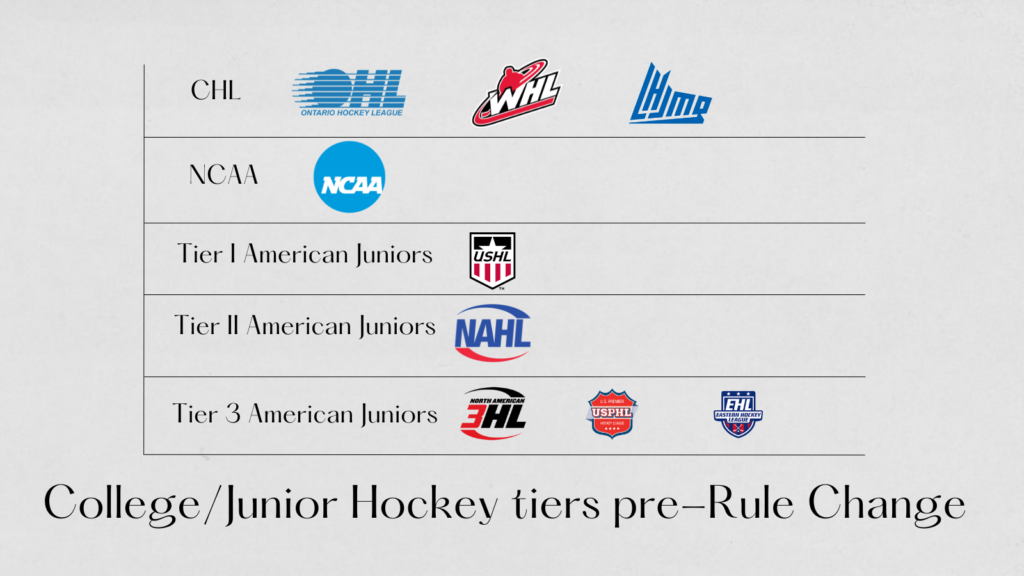
For the players, a move to any CHL league used to mean the end of their college eligibility. That is because the CHL players receive a stipend for their expenses while they live with a host family and play in the CHL. Players can only remain in the CHL until they are 20 years old, if they wish to continue their studies and play college hockey, they receive a full scholarship to any Canadian university. If the player goes undrafted and looks to go to college and still play hockey, they can
play in what is called Canadian U Sports, or Canadian college hockey. However, the quality of play between Canadian and American collegiate hockey is quite noticeable, and for some players, they simply need more time in their development before they can get noticed by pro teams. In the past, U Sports simply could not hold up for players looking for a pro career. Now, they are no longer forced into that decision.
Players wasted no time taking advantage of the new rule, with some of the top CHL prospects announcing their college commitments almost immediately.
“Me, my family, everyone that’s a part of my circle, we all decided that the best spot for me next year would be Penn State University,” said projected No.1 overall pick in the 2026 NHL Draft Gavin McKenna as he announced his commitment live on SportsCenter.
But what is the real draw to college hockey as opposed to major juniors? According to Philadelphia Flyers Head of Player Development, Riley Armstrong, it all depends on a player’s needs.
“I feel every player is different. I think some players need to make the step for a major junior to NCAA, and I think some players need to stay in the major junior and continue to play the amount of games. I think it depends on the player and where they’re at in their development,” said Armstrong.
While players would have the chance to play nearly a 70 game season in a major juniors, the NCAA, offers a lighter schedule with more time for off-ice training, such as time in the gym or weight room, and games against older players in a more physical style of hockey.
Not only does the new rule open the door for high end Canadian athletes to come over to college hockey, but it could also raise the average age in the NHL.
“You know, if you looked at a player that played junior hockey in Canada and they were done, they would play in U Sports, at a Canadian University. And now it allows those players to then come over when they’re 20 years old, 21, and start playing NCAA and then who knows, maybe when they’re 22, they finally find their next step and they’re playing good hockey and an NHL team sees them,” explained Armstrong.
This notion has also caught the attention of the CHL, and they may have even surprised fans with what they said in their statement regarding the rule change.
“While we will take time to fully review this rule change, we believe this is a positive development that will provide our players with more opportunities to continue their hockey and
academic careers following their time in the CHL,” said OHL team, the Owen Sound Attack on a statement posted on the CHL website.
According to a Sports Illustrated article from June of 2025, over 250 CHL players have made the jump from CHL to NCAA, with many more moves potentially coming along the way. And while this may have many benefits for Canadian players heading to the U.S., there is some concern about the disappearance of some American Junior leagues.
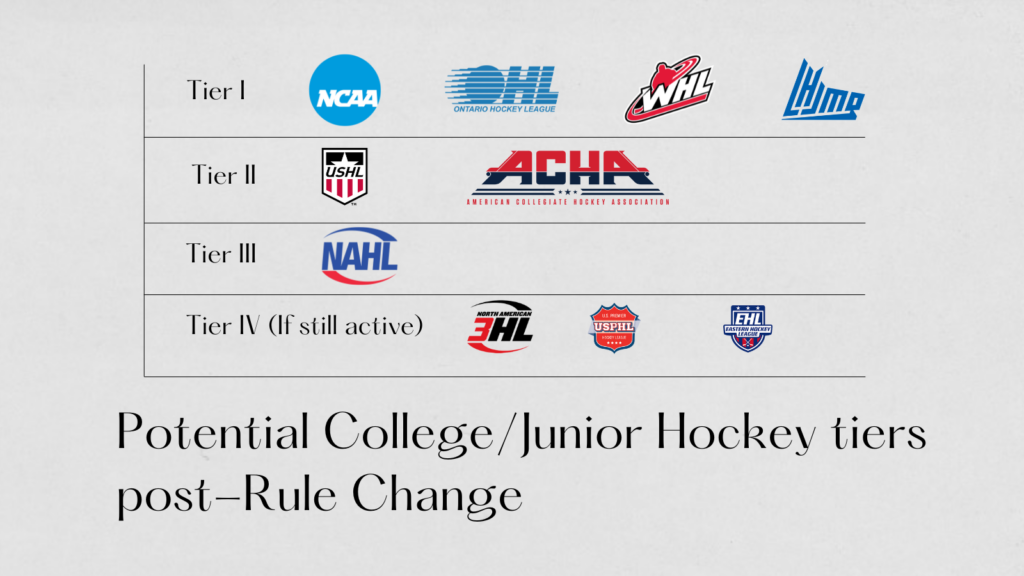
The top American junior league is by far the USHL (United States Hockey League) as it serves as one of the largest feeders into NCAA hockey. However, the CHL ruling could change that, and more importantly, the leagues below the USHL could disappear. Just below the USHL sits the North American Hockey League, NAHL, commonly called the “Nall,” which makes up the second tier of American Junior hockey. While these two leagues would likely be safe for the time being, it’s the leagues below, tier three of American Juniors, that will be sent into the most turmoil.
“I think you’re going to see a lot more volatility in those lower leagues,” said James Witherite.
Witherite is the co-founder and CEO of 412 Communications which covers a variety of games at the second and third tier of American Junior hockey in leagues such as the North American 3 Hockey League (NA3HL), the U.S. Premier Hockey League (USPHL) and the Eastern Hockey League (EHL). While some of these leagues tout themselves as tier two leagues, Witherite confirmed the overall skill of the league matches that of third tier leagues.
When asked about the overall situation for American junior leagues, Armstrong agreed that “it’s getting weaker”. Witherite added that the panic level for the tier three leagues is “extreme.”
“I’m seeing teams that are even struggling to ice a full team on those game days,” added Witherite when speaking to the current struggles of the NA3HL, the USPHL and EHL.
One other interesting league on the American side that could actually benefit from this rule change is the American Collegiate Hockey Association (ACHA). ACHA operates at three divisions on the men’s side and two on the women’s side, falling closely along the lines of NCAA divisions. If a division I NCAA school wants to field a hockey team but may not have the funds or resources to compete at the NCAA level, they can elect to join the ACHA. With CHL players taking some of the spots on NCAA rosters, this trickle down effect could potentially bring more talent down to the ACHA, making the league another stepping stone towards NCAA division I.
No matter anyone’s opinion on these rule changes, one thing that remains true is that the landscape of college, and junior hockey will never be the same again. Lower level American leagues could only have a few years left behind them, and the CHL could continue to lose some of their best talents to the NCAA. However, the improvements that these players will make out of college could truly make NCAA players NHL ready upon graduation, and the rule change has the possibility to topple the junior league systems as we know it.