
How a former professional soccer player with a doctorate found purpose, identity and belonging in Hamden
On a fall afternoon at the Quinnipiac University soccer field in Hamden, Connecticut, the turf is slowly waking up. The sun hits the turf at an angle that flattens every blade of grass. Players shuffle through warmups, trainers haul equipment and music plays from the stadium speakers. Near the bench, assistant coach Dan Fabian crouches down and tightens his boots.
He doesn’t gear up to play. He gears up to connect.
“I try to be very conscious of every decision I am making, and what it means for me to lace up the boots,” Fabian said. “For me, that’s always been a connection point with the players.”
Fabian now stands as one of the most distinctive coaches in Division I athletics. Part mentor, part educator, part therapist, part motivator. A former professional soccer player who also happens to be a former theater, dance, and film major. A coach who teaches mindset as effectively as he teaches pressing triggers.
Junior forward Evelyn Keay has played under him for three years now.
“He’s definitely unique to any other coach I’ve had before,” Keay said. “He provides a real, like, unique perspective… not just on the game, but on the human side.”
That human side is where Fabian quietly reshapes this program, after a decade spent moving between professional sports and graduate school. Fabian earned a Master of Education degree in counseling and a Doctor of Psychology degree in Counseling Psychology with a concentration in Athletic Counseling. All while slowly losing and then rediscovering his identity as a soccer player.
Before soccer, there was the stage
Long before college and professional soccer, Fabian’s world revolved around performing outside off the pitch. He grew up doing modeling shoots, commercials and creative work in New York. Theater, dance and film became way to express emotion for Fabian.
When Fabian arrived at Providence College, he decided to make theatre his major, despite the warnings. Coaches, advisors, even theater professors told him an athlete could not major in theater — too demanding, too unpredictable, too incompatible with soccer.
He did it anyway.
“I think theater is so transferable to everything,” he said.
That belief would later define his coaching identity.
Providence: where confidence became identity
Fabian’s soccer journey took shape at Providence College, where he developed not only as a player but as a person. Recruited heavily by schools, including Quinnipiac men’s head coach Eric DaCosta, Fabian ultimately chose Providence because of how the staff made him feel.
“They were a group of people that made me feel like the best version of myself,” Fabian said. “Every time I was with them, they helped me to feel confident.”
Providence became a developmental chapter in ways Fabian still carries. Over four seasons, he appeared in 74 matches, starting 52 of them and finished his career with 15 points, including four goals and seven assists. He earned the Providence College John Murphy Team Award in 2011 and was named to the NEISL Division I All-Star Team that same year.
He also balanced performance with academics receiving Student-Athlete Academic Honors in 2010 and 2011 and being named a Big East Academic Honorable Mention three times.
That growth peaked during his junior year, when Providence reached the Big East Championship for the first time in program history, pushing No. 1 Louisville to penalty kicks at Red Bull Arena.
They lost. But Fabian left with something far more lasting — a sense of identity rooted in the sport.
He had no way of knowing he would one day lose that identity, then spend nearly 10 years trying to find it again.
The pro years and a shift in perspective
After Providence, Fabian pursued the next step every college standout dreams of. In the preseason of the 2012 season, he was with the Pittsburgh Riverhounds of the United Soccer League, a professional league in the United States, just below Major League Soccer. Fabian then signed with the Kitsap Pumas of the USL, just before the start of the 2012 season.
It was with Kitsap when something shifted.
“My ability on its own wasn’t good enough anymore… there were other things I needed to do to really stand out,” he said.
Instinctively, he reached out to Dr. John Sullivan, the sports psychologist who had worked with Fabian and his team at Providence years earlier. Sullivan did not talk to him about techniques or tactics. He talked about sleep, hydration, recovery cycles, mental patterns and lifestyle habits.
“It had such a tremendous impact on me,” Fabian said.
In 2014, Fabian joined the Western Mass Pioneers, competing in the American Soccer League, a semi-professional league in the United States. That season, he helped lead the club to the league’s first ever Championship Cup.
When Western Mass moved into the Premier Development League – later renamed USL League Two – Fabian became a central figure. From 2016 through 2018, he served as team captain and was later named to the Pioneers’ 20th Anniversary Team, honoring the 20 greatest players in club history.
The decade of academic grind and losing his soccer identity
abian pursued deeper meaning. He graduated from Providence in 2015 with a Master of Education degree in counseling and then earned his Doctor of Psychology degree in Counseling Psychology with a concentration in Athletic Counseling from Springfield in 2020.
During his clinical residency, he worked directly with patients facing anxiety, identity struggles and performance related stress.
It took a toll.
“I definitely got burnt out going through that. I feel like I lost a sense of myself, lost that soccer identity.”
Dan Fabian
He was not burnt out from soccer. Rather he was burnt out from everything else — the workload, the pressure, the emotional weight of counseling and the distance from the game that had once grounded him.
Near the end of his residency, he started to feel it. He needed soccer back. He did not say it, but his wife noticed it.
Quietly, without telling him, she searched for college coaching openings. She found one. Part-time, at Quinnipiac, on the men’s side. She showed him the listing. He recognized the name instantly.
Eric DaCosta — the coach who recruited him in high school, the coach he always respected.
Fabian texted him:
“Hey, you still looking for a coach?”
That message pulled him back into the soccer world he had been missing.
The men’s team: where it started at Quinnipiac
Fabian joined the Quinnipiac men’s soccer staff for the 2022 season. What followed was one of the most accomplished years in program history.
With Fabian on the staff, the Bobcats won both the MAAC regular-season championship and the MAAC Championship. Quinnipiac finished 13-5-3 (6-2-2 MAAC), tied for the most wins in program history. Their season ended in a double-overtime loss at No. 8 Vermont, in their second-ever NCAA Tournament run.
Kevin Clarke, a midfielder on that 2022 team, said Fabian’s influence was evident in how players prepared each day.
“On top of Danny being a great person and coach, he helped get the team mentally active every day,” Clarke said. “Before training, he ran us through warmups that were both physically and mentally stimulating. At the time, they seemed trivial, but I believe they really helped overall.”
For Fabian, the men’s team was not just a return to the game. It was a proving ground.
A coach who sees the person, not just the player
Fabian transitioned to the women’s program full time ahead of the 2023 season. The start was not seamless. Losses stacked up early and anxiety followed.
But they did not splinter. They recalibrated.
Individual sessions with head coach Dave Clarke and Fabian helped rebuild confidence. Players leaned on the staff and the staff leaned on each other.
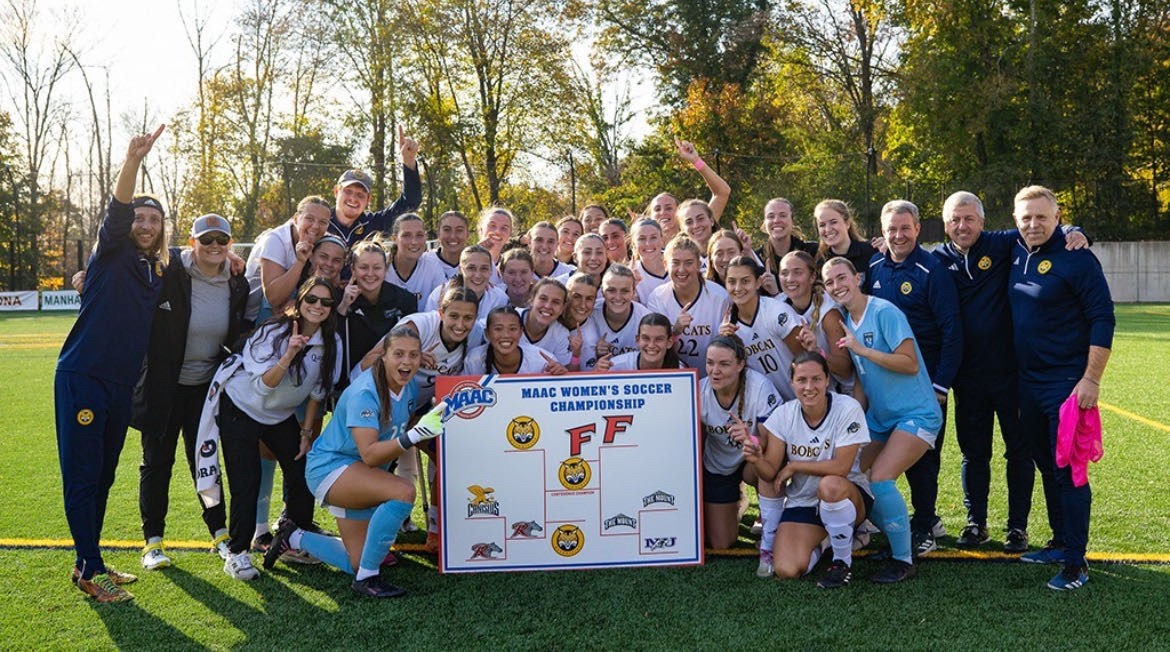
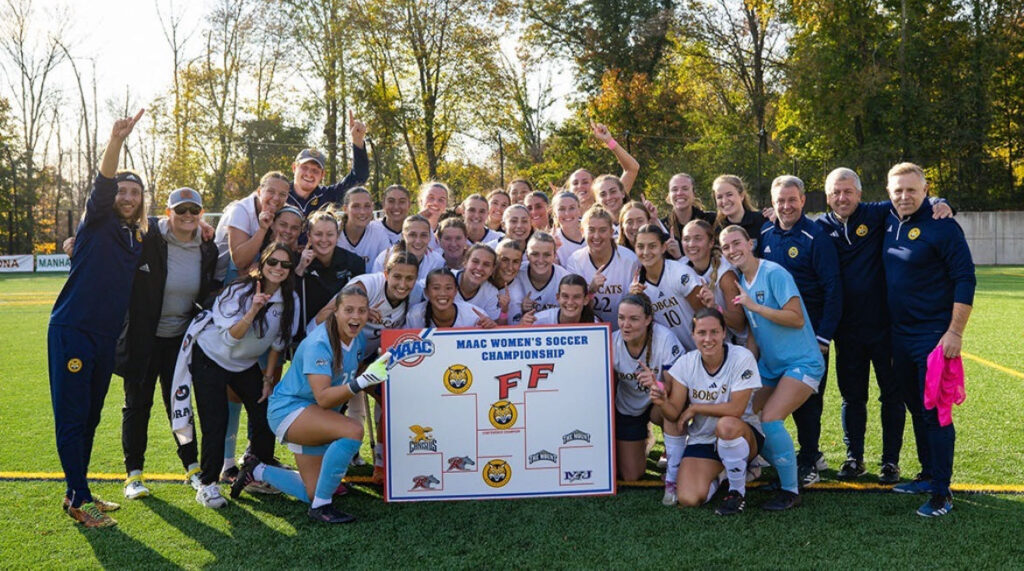
That season ended with a MAAC Championship.
“Watching the girls celebrate… it was beautiful,” he said. “All the hard work that they put in… just to see it come to fruition.”
Junior Evelyn Keay said Fabian’s impact often begins with conversation.
“With Dan, you don’t always have to be talking about soccer,” Keay said. “It’s more personal — how are you feeling? Why are you not confident in this moment?”
For junior midfielder Anna Hurlbut, that approach mattered most during her adjustment to college athletics.
“The transition from high school to college can be really difficult, especially in sports,” Hurlbut said. “Coach Fabian helped make that transition a lot easier, seeing me as a human and a student, not just a soccer player.”
Motivation beyond the whiteboard
Fabian’s influence is not limited to conversations or warmups. It also appears on a screen.
Before every match, Fabian creates short motivational videos for the team. Cutting together practice and game footage, music and graphics.
“For every single game, I clip a lot of the practice footage and game footage,” Fabian said. “I design some things and edit something together. They’re usually four or five minutes.”
Keay is grateful for the videos and acknowledges that there’s also a deeper layer.
“He talks a lot about mirror neurons,” she added. “If you see yourself doing good things, you’re more likely to do it.”
Some videos are serious, while others are intentionally lighthearted.
“Game day is supposed to be fun,” Keay said. “And that balance matters.”
The psychology behind the performance
Fabian does not diagnose or treat the players clinically, but he uses the same awareness, empathy, and communication style that made him effective in therapy settings to give athletes something most programs don’t have: a coach who understands the emotional architecture of performance.
Licensed therapist Michelle Bussolotti, LMFT, ChT, EMDR II, said that experience matters.
“College athletes are high achievers who often enter therapy from a place of burnout and stress,” Bussolotti said. “When performance becomes tied to identity, the emotional cost can be significant.”
She added that mental skills translate directly to results.
“When athletes learn emotional regulation, confidence building and mental flexibility, it directly translates to performance,” Bussolotti said.
Where he belongs
Fabian still joins in training sessions, sometimes to demonstrate, sometimes to connect.
“He’s a son of a bitch on the field,” Keay said, laughing. “You love having Dan on your team. But if you’re playing against him, you’re hoping not to get schooled.”
People ask Fabian about head coaching jobs.
“Maybe one day,” he said. “But I’m learning so much under Dave [Clarke] – there’s no better teacher.”