
By: Hannah Freshman
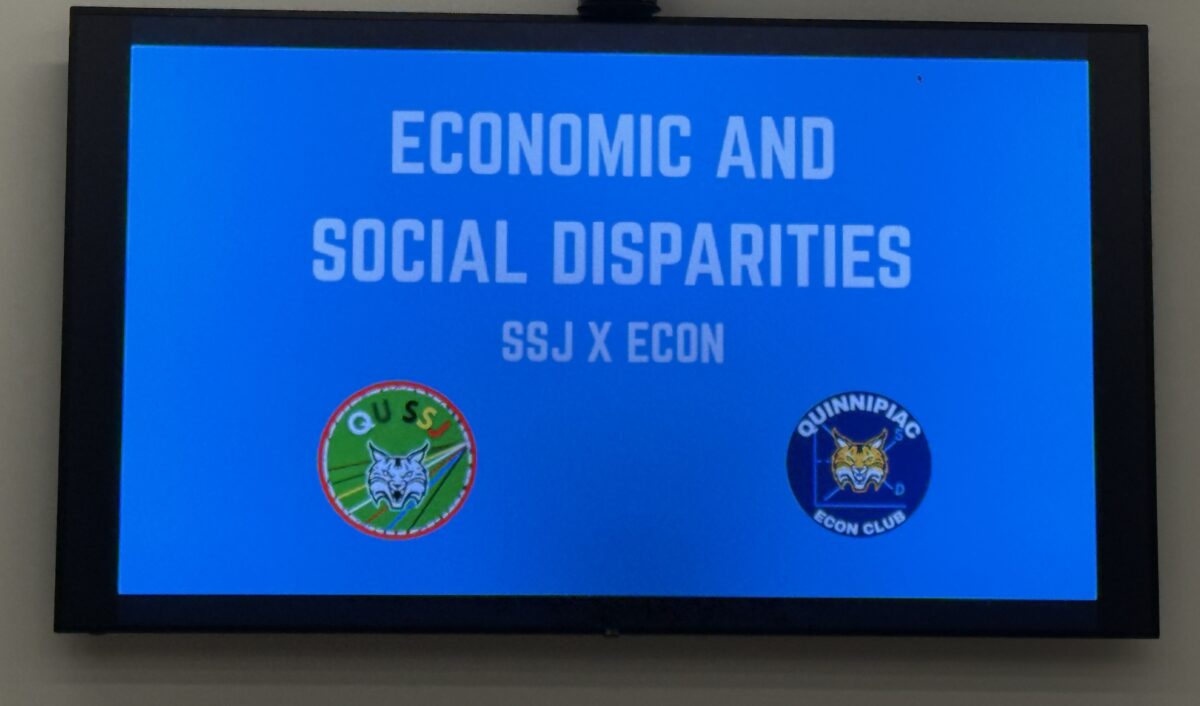
On Tuesday, Feb. 10, Students for Social Justice (SSJ) and the Economics Club kicked off the spring semester with a joint event on economic and social inequality. Held in the School of Business, the collaboration aimed to make complex topics accessible to students from all majors.
Attendees were welcomed with pizza and drinks, creating a casual and inviting atmosphere.
The discussion began with pollution and its impact on communities. Students noted that lower-income neighborhoods often face the worst environmental harm, even when residents did not cause it.
Participants debated whether companies should face strict pollution limits and compared pollution from medical research to that produced by luxury industries, like high-end car production. The conversation examined which types of pollution society tends to excuse.
Next, the focus turned to wages and labor. Students explored who should decide fair pay, the job market, government policy or living costs.
“I believe it should be proportionate to the cost of living,” SSJ Outreach Coordinator Maraje Beasley said.
Her comment connected the debate to everyday concerns such as rent, food and transportation.
Age and labor laws also sparked discussion. Students considered global examples where children work to support their families. Some argued child labor is harmful, while others noted that work may be necessary for survival in certain situations. The conversation highlighted how cultural and economic circumstances shape perspectives on work.
The group then examined wealth and inequality. Students debated what wealth truly means, considering money, property and other assets. They discussed why some families can pass wealth across generations while others cannot, noting that race often plays a role, as many of the world’s wealthiest individuals have benefited from systems historically favoring white Americans.
Climate justice was another key topic. Participants discussed how environmental hazards disproportionately affect lower-income neighborhoods. Factories and industrial buildings often appear in these areas because land is cheaper, exposing residents to higher pollution levels and related health risks.
Following the event, SSJ Co-President and economics major Mariam Saad reflected on the organization’s goals for the semester.
“Since we are now chartered, we have the ability to deliver bigger, better events, like our Indigenous Representation in Film event coming up in March,” Saad said. “Something SSJ is also very passionate about is fundraising, which we are planning to do with NISA.”
Saad encouraged students to stay informed about upcoming events, urging them to keep up with the events on the @quinnipiacssj Instagram and join their GroupMe.
For those interested in joining SSJ, she emphasized the club’s commitment to open dialogue and inclusivity.
“Our intention with SSJ is to create a safe space to educate students and encourage discussion about things that truly matter,” Saad said. “We love to hear students’ thoughts and opinions about a variety of domestic and global issues. If students are eager to discuss or just want to listen in, they should feel free to join us.”
Looking ahead, SSJ plans several collaborations throughout the semester. One upcoming event is a partnership with OLAS to make Valentine’s Day cards for the IRIS Refugee Community on Thursday, Feb. 12, in the School of Business. Meetings are held bi-weekly, giving students regular opportunities to engage in discussions and participate in events.