
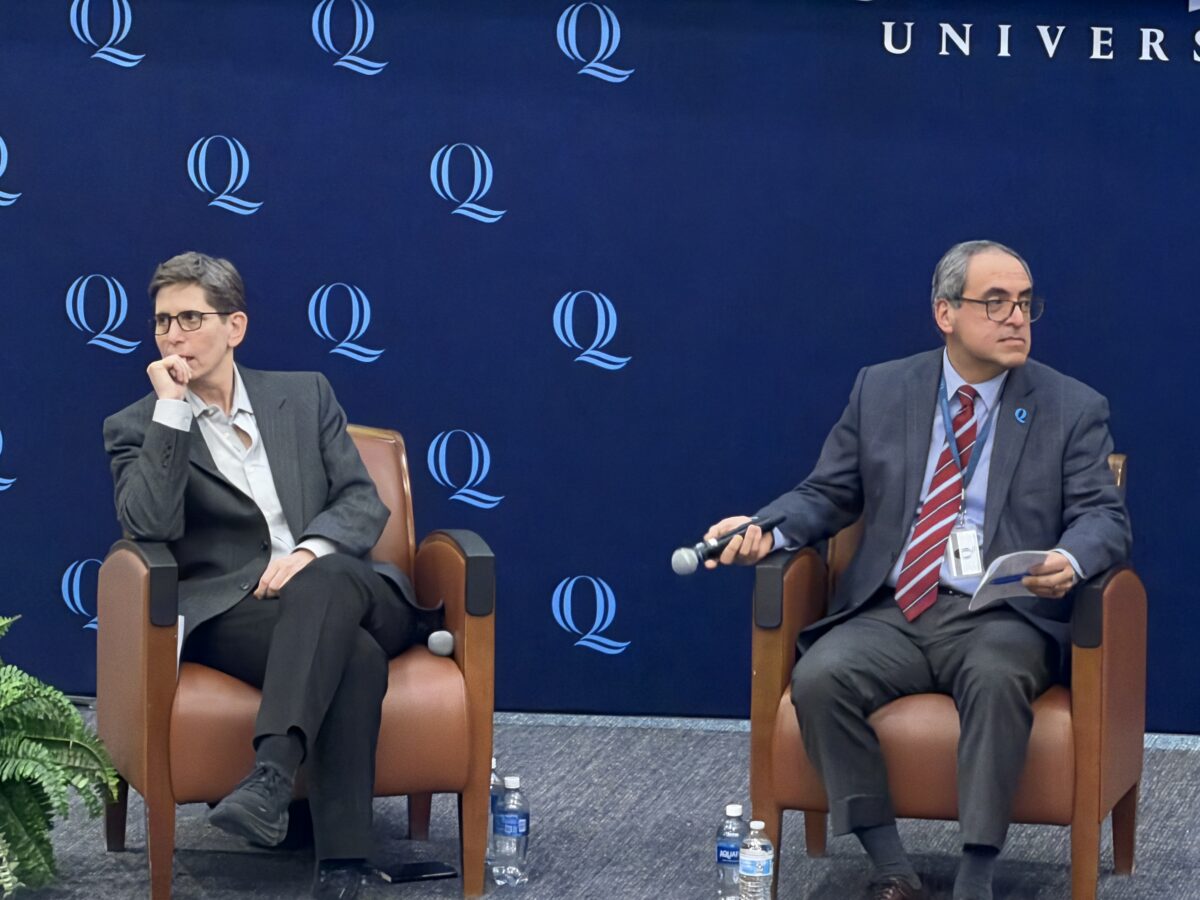
Quinnipiac University’s Student Government Association hosted its annual “State of QUnion” panel with members of the university administration on Wednesday afternoon.
This event gives an opportunity for panel members to lay out new and upcoming university policies, and allows students to speak directly with Quinnipiac’s administration.
This year’s panel featured a virtual appearance from President Marie Hardin, Chief Experience Officer Tom Ellett, Vice President for Inclusive Excellence John Armendariz, Provost Debra Liebowitz and Vice President of the Student Government Association and panel host Julianna Mazzella.
Affordability
The beginning of the State of QUnion began with Mazzella reading off questions proposed by students before the start of the event.
One of the first questions was about how the university plans to keep Quinnipiac affordable.
“I think what is important for you all to know is how incredibly important this is for our students,” Hardin said. “We all understand how important affordability is; we’re always looking for ways to make sure that we can, as much as possible, support all of you.”
Hardin said that Quinnipiac gave more financial aid per student this academic year than in any recent year, and that the university must continue to raise money in order to keep up with scholarships.
Both Hardin and Ellett mentioned the success of the 1929 Fund, a student-run scholarship fund designed to help those who can’t afford to attend Quinnipiac.
Ellett discussed the significance of student employment, specifically in the Mount Carmel Campus dining hall, and how over 250 students currently work there.
A student then asked about people who want to work but don’t have federal work study grants.
Ellett said that if anyone was struggling to find a job on campus, they could reach out to him directly.
Adapting to Artificial Intelligence
AI is steadily creeping its way into academia. Quinnipiac is looking to get ahead of the curve on the ever-evolving technology.
The university is currently altering several of its programs to implement courses focused on AI and its effects on both college and the workplace.
“We have a minor that’s focused on AI,” Liebowitz said. “And it is made as a minor for anyone, not just someone coming from a technical background.”
Quinnipiac currently offers undergraduate programs such as AI and Computing and Applied AI and Business Analytics, as well as several undergraduate and graduate courses that focus on AI.
Parking
Parking is a long-standing issue at Quinnipiac, with student complaints rising throughout the years.
With the introduction of the new bookstore next to North Lot, parking is even more condensed.
Ellett confirmed that there are no long-term plans to implement new parking spots and stressed that students to use the shuttle system.
“There is some talk about potential space for additional parking,” Ellett said. “Maybe 100+ spaces, but that has to go through a process, and it wouldn’t change anything this fall or spring.”
Panel members expressed the importance of using Hogan Lot, which often has empty spaces because of its distance from academic buildings.
“Give yourself a little bit more time,” Ellet said. “(It’s) probably not what you want to hear, that (in) the long term there’s not going to be additional lots on campus, but utilize resources.”
Irma’s closed bridge
Since September, the wooden bridge that connects freshman residence Irmagarde Tator Hall to the northern half of campus has been out of order, with minimal updates since its closure.
“I was told that we needed to get an engineer to redo it,” Ellet said. “There were some problems with the bridge itself.”
While Ellett could not give an update on when the bridge will be reopened, he acknowledged its inconvenience.
Dining at Quinnipiac
Students have criticized Quinnipiac’s partnership with Chartwells for the lack of food options and minimal rotations, specifically on the York Hill Campus.
“It is a smaller facility than the Cafe Q,” Ellett said. “So you’re going to have a little bit less options. But again, we want to start, our goal is to make sure we serve what you want.”
Ellett announced that starting on Feb. 9, the grill station on York, which used to only accept mobile orders, now allows students to walk up and order food.
Accountability in funding
One student asked the panel whether fellow students could trust the administration about funding restrictions, when the administration doesn’t tell them where it directs their tuition money.
The student mentioned the $48 million in hedge funds that the private university has spread throughout offshore accounts.
“I appreciate that question very much, because there has to be a relationship of trust,” Hardin said. “We are constantly having to make tough decisions, but we very much want to hear your concerns.”
Panel members did not address the $48 million remark, but reiterated that every decision goes through a process, which makes it difficult to make budgetary decisions.
“We have a set of principles that we use that guide those decisions,” Liebowitz said. “You’ll see that the number one thing we do is think about the impact that (decisions) have on students.”