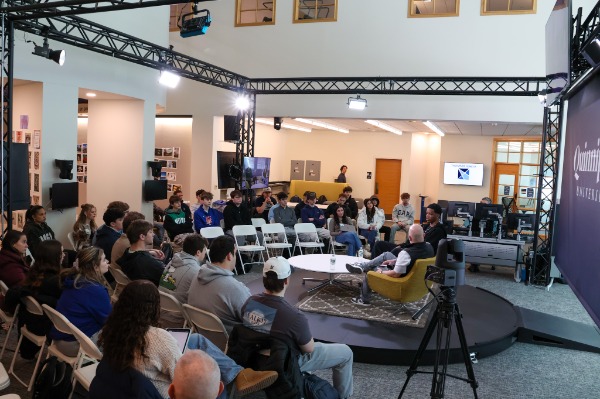

Program Director of Sports Communications and Associate Professor of Journalism Nick Pietruskiewicz had one important question for men’s basketball’s senior forward Amarri Monroe Wednesday morning during the latest installment of the “What’s Your Story?” series:
“LeBron or Jordan?”
And for the Newburgh, N.Y. native, the answer was obviously NBA star LeBron James, not only because he grew up idolizing him, but because when asked who he wants to be compared to from the league, his answer was the same.
“I think I bring a lot to the table,” Monroe said. “The way I can move, not a lot of people my size can move that way. There’s aspects of my game where it’s like ‘Alright, this is what he’s really good at,’ but I think you can say that about many aspects of my game.”
Monroe — formerly known as Tice before he adopted his mom’s surname — has certainly made his mark on Quinnipiac basketball. Named MAAC Player of the Year after his junior campaign, Monroe had many options to leave Hamden, Connecticut, and go beyond mid-major basketball. Against everyone’s expectations, he chose to stay.
Monroe, however, has no regrets about his decision.
“I made that decision for a reason, and I’m still happy with the decision that I made,” he said. “It was the best decision I can make for myself in my career; it didn’t really have to make sense to anyone else as long as it made sense to me.”
Under the new NCAA Name, Image, Likeness settlement, universities can now pay money directly to their athletes, meaning at larger institutions, athletes get paid more than some professional players.
That’s why when bigger schools like University of Connecticut or University of Miami — where former Quinnipiac women’s basketball guard Gal Raviv transferred to — started offering big numbers, no one expected Monroe to turn them down.
Monroe described the entire recruiting process as “speed dating.”
“You don’t have all the time in the world to have these relationships with these coaches, so you kind of just got to put all your marbles into one basket and hope you made the right decision,” he said.
When Pietruskiewicz asked what the worst pitch he got was, Monroe described a phone call he received from an unnamed school, where they asked him, “What’s your number?”
“I think he’s talking about what’s my cell phone number, but he’s talking about how much money do I want,” he said. “As soon as that happened, I knew I wasn’t going. It was a good school, it sucks that that’s how they try to get kids. That’s not me. Money’s cool, but I’m going to make it down the road. I wanted to make sure I was taken care of.”
In the same spirit, Monroe admitted he thought the new system of recruiting transfers was “messed up.”
Despite his fast climb to fame, Monroe never let it affect the way he treated people and other students around him.
“I’m a fan of many people out there, I’d hate it if they ignored me,” Monroe admitted. “So I always try to talk to everyone, I try to memorize names. I like having genuine relationships. You never know, someone in this room could end up bigger than I am.”
On Sunday at 2 p.m., Monroe will step on the M&T Bank court in a Bobcat uniform one last time, a moment he is painfully aware of already.
“I got a text yesterday asking who’s going to walk me out on senior night and I was like ‘This is it,’” Monroe said. “And it’s pretty brutal to even think about it. You might see me crying a little bit.”
In his senior season, as of Feb. 19, Monroe has posted 421 points, 64 steals and 900 minutes played.
Quinnipiac men’s basketball currently sits fourth in the conference and already punched the ticket to the postseason tournament in Atlantic City, N.J. For the last two years, the Bobcats have only managed to reach the semifinals.
Monroe understands that in coming back to Hamden, he set the expectations for this year higher than ever before.
But that’s also partially why March is his favorite month, not only because of his birthday, but because of college basketball and the promise to get the Bobcats there.
“I want them to say ‘Amarri Monroe, that player who led Quinnipiac to its first March Madness,’” Monroe said. “I don’t care about how many points I score for that. I want to see that banner up there. And I want people to talk about that banner and say my name.”
Following the interview, Pietruskiewicz answered questions from the media while Monroe hung around, talking with his friends who joined the live recording.
“He thinks he’s funny, but he’s not,” Pietruskiewicz joked. “No, I think his self-awareness is impressive. He knows when to be self-deprecating, what his journey means to him, he knows the expectations that are on him. But he’s also just a student, and I think often we forget that.”
Monroe was the first student-athlete on this YouTube series, following other guests such as Quinnipiac President Marie Hardin and ESPN’s Jay Harris. His appearance opens up the door to many more, providing not only a space for the athletes to share their story, but also a lesson to the communications students at Quinnipiac.
“I think it’s valuable,” Pietruskiewicz said. “When I first started this, it was a journalism thing, but it evolved. The evolution of it is important. This is my project, but I want it to be something you all spent an hour getting something out of.”