Mary Schmitt, Assistant Professor of Film, Television and Media Arts said society is living in a “world that’s on fire.”
And while many may escape to the movie theaters to block out the noise, often times the big screen mirrors reality anyway.
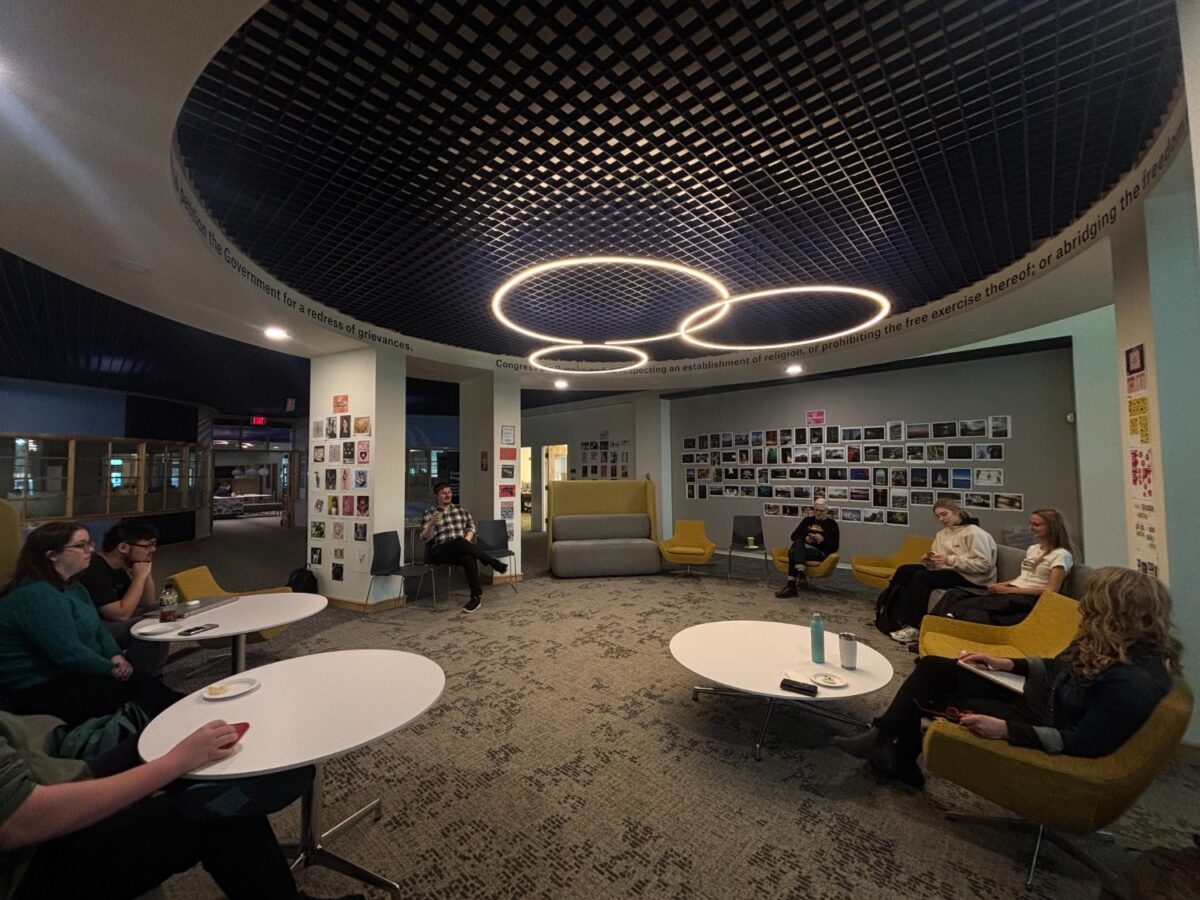
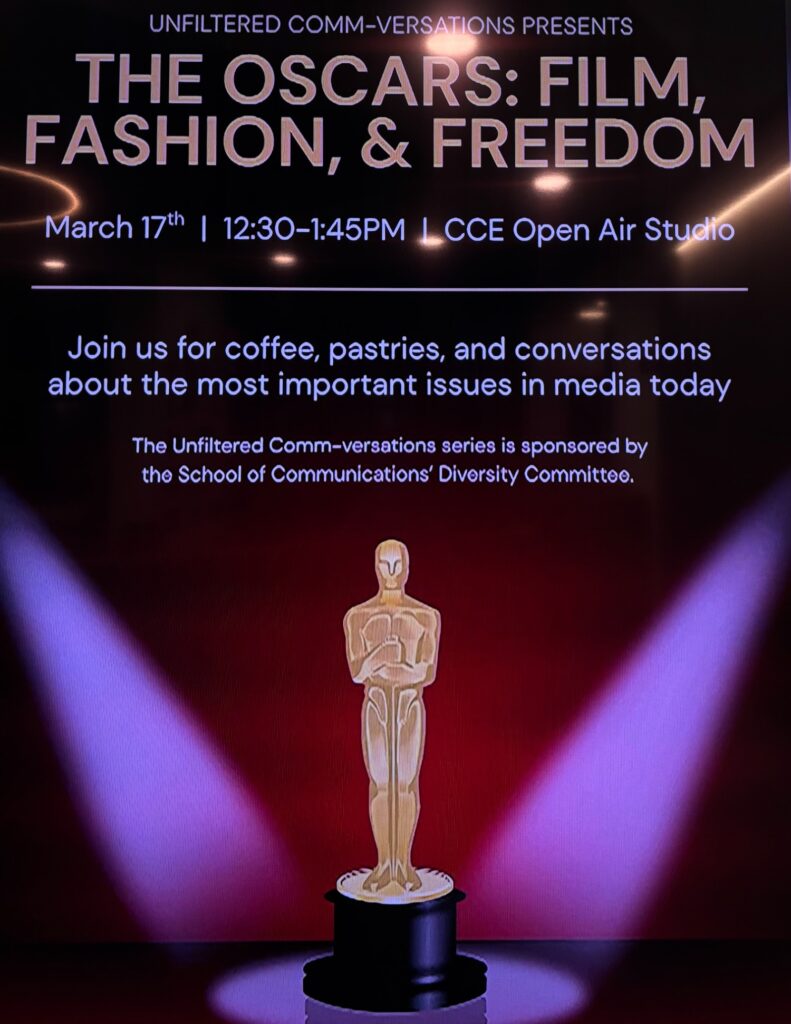
Quinnipiac University’s School of Communications’ Diversity Committee held its newest edition of “Unfiltered Comm-versations” on Tuesday afternoon in the College of Communications and Engineering Open Air Studio to discuss the 2026 Oscars, which aired Sunday evening.
Schmitt centered the conversation around the societal impact of the Academy Awards, asking whether it’s a filmmaker’s or an actor’s responsibility to make statements in their acceptance speeches about the current state of the world.
She expressed her belief that it is the artists’ job to use their platform in the wake of significant world events. Ongoing political issues include the United States and Israel’s war against Iran, the Israel-Palestinian conflict and Americans calling for ICE’s abolition following several unprecedented violent incidents.
“I think sometimes for me, it just feels performative,” first-year film, television and media arts major Cecilia LaSpina said. “But then you also see them online, because there’s such a presence on social media, it’s like, ‘You haven’t said anything about this the entire time it’s happening.’”
Someone who has been extremely vocal about his political stance is Spanish actor Javier Bardem. He used his time on stage as a presenter to speak up by saying, “No to war and free Palestine.”
On the red carpet, he was seen wearing a patch that read “no a la guerra,” which means “no to war” in Spanish, and a pin with an emblem in support of Palestine.
Other actors were less vocal, but still wore “ICE OUT” or “Free Palestine” pins on their clothing in protest of these political injustices.
“I remember when Vanessa Redgrave got booed for saying something about Palestine,” Associate Professor of Journalism Margarita Diaz said, referring to online discourse related to Bardem. “That was like the 70s.”
In 1978, Redgrave won best supporting actress in “Julia.” She received severe backlash from the industry following her acceptance speech.
On the other side of the coin, there are Hollywood figures who choose not to speak up at all.
Oscar-winning director of “One Battle After Another,” Paul Thomas Anderson, received backlash online for not making a statement about the film’s greater purpose in his acceptance speech.
Diaz offered the perspective that the picture doesn’t require further comment, as it consistently focuses on political activism and encouraging the next generation to stop history from repeating itself.
“But this is the moment when he is anointed, part of Hollywood royalty,” Diaz said. “Is this the moment to make a political statement? Or are you so humble and grateful…that you hold back rather than taking the opportunity to make a political statement?”
The question remains unknown. Politics and film are intertwined. The interpretation is based on how the medium speaks to the viewer.
“The idea of politics being involved in stuff isn’t just about elections,” Assistant Professor of Media Studies David Peter Kocik said. “It’s about how you see the world and how things should be organized and how things should be kind of constructed, right? How our society should have laws and how they should be run.”
Best animated feature winner “KPop Demon Hunters” emerged as a film that fits that mold. Although it’s not inherently political and is mainly curated toward young audiences, it recognizes Korean culture, which is often underrepresented in media.
Creator Maggie Kang said in her acceptance speech, “This is for Korea and Koreans everywhere.”
Award shows will likely continue having political undertones as international events unfold, but there was discussion among students and faculty as to whether the Oscars’ transition to Netflix in 2029 would change the narrative because it will be run by a streaming service.
As Kocik put it, “not that anybody has the answer,” but the Oscars have always been and will be for the next three years, a “television production.”
This poses the question: what’s going to change between now and then?