
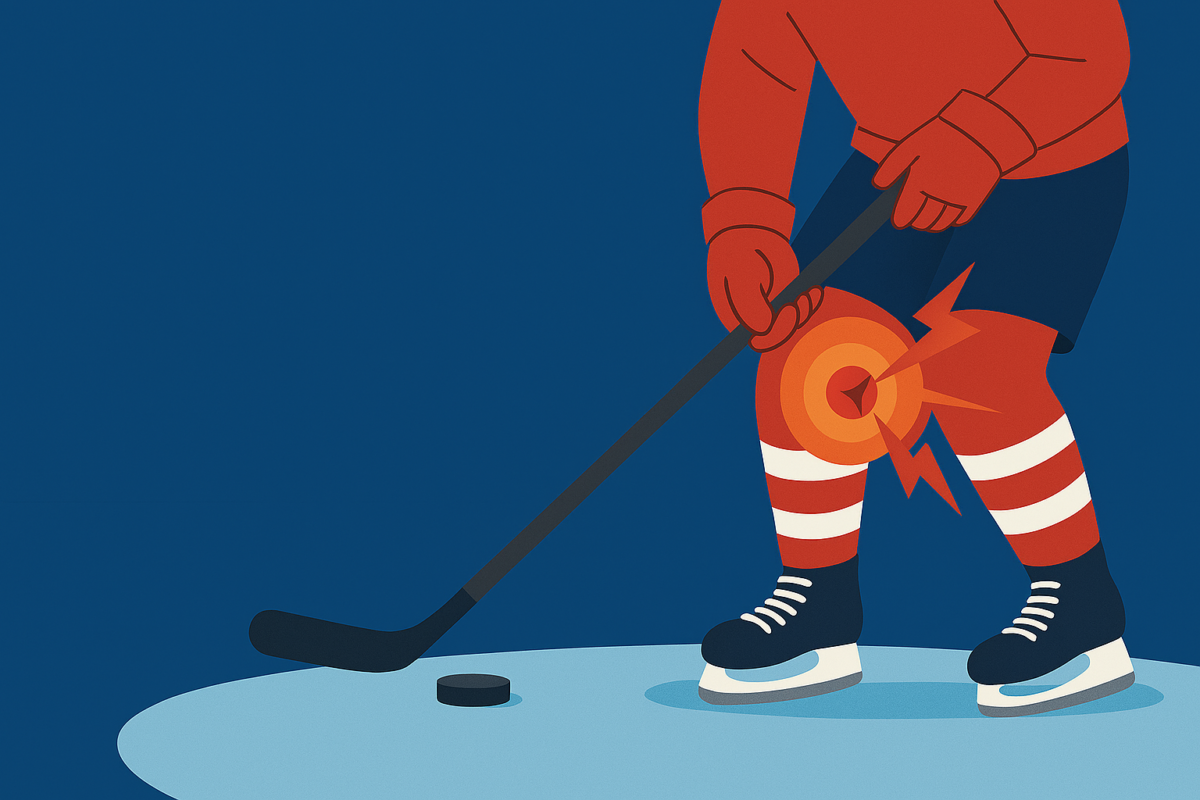
Knee injuries in sports are often described in simple terms: the diagnosis, the recovery timeline and the expected return date. But for student-athletes, the impact is rarely that simple. A torn ACL, MCL injury or meniscus issue can take an athlete away from competition, daily routine, teammates and the sport that has shaped much of their identity.
The two injuries at the center of this story, ACL and MCL tears, affect different ligaments in the knee. The ACL, or anterior cruciate ligament, is one of the key ligaments that stabilizes the knee and connects the thighbone to the shinbone. ACL injuries often happen in sports that involve sudden stops, quick changes in direction, jumping, landing or direct contact. According to Mayo Clinic athletes may feel a pop, swelling, pain, loss of motion or instability after an ACL injury. Depending on the severity, treatment can include rehabilitation or surgery followed by months of recovery.
The MCL, or medial collateral ligament, runs along the inside of the knee and helps prevent side-to-side movement. MCL injuries can range from mild sprains to partial tears or complete ruptures. They often happen when the outside of the knee is hit, forcing the knee inward and stretching or tearing the ligament. Mass General Brigham notes that athletes in high-impact sports or sports with jumping, sprinting and quick direction changes are at higher risk. Unlike ACL injuries, which often require surgery, many MCL injuries can heal without surgery, depending on the severity.
For college athletes, the injury is not only physical. It can become a mental and emotional challenge, especially when the recovery process stretches across months. While fans may only notice when a player is missing from the lineup, the athlete is often dealing with rehab, frustration, fear of reinjury and the pressure of trying to return as the same player they were before.
Brijesh Patel, a member of Quinnipiac University’s athletic performance staff, said one of the biggest misconceptions about knee injuries is that athletes cannot get back to where they were before. He said that idea is “incorrect,” and that some athletes can return with more than they had before the injury.
“Some players often get better,” Patel said. “The way we look at an injury is if the guy or girl gets injured and they’re out for a significant period of time, we try to educate that student athlete that that’s an opportunity to get better at something else.”
Patel said that time can be used for “getting their body stronger,” “working on mental skills,” “looking at the game from a different perspective” or “working on leadership qualities.” Instead of viewing recovery only as lost time, Patel said athletes can use it to add “another layer to their game.”
That mindset is important because a knee injury can quickly change how an athlete spends each day. Instead of practices, games and team travel, the schedule becomes rehab, physical therapy, strength work and gradual progress. For student-athletes used to competing every day, that change can be difficult to accept.
Quinnipiac men’s hockey player Jeremy Wilmer experienced that shift after tearing his ACL during his senior year. For Wilmer, the injury was not just about missing games. It also meant losing the chance to meet the goals he had set for himself and the team.
“I think the hardest part was not living up to expectations that I had for myself and that I had for the team,” Wilmer said. “I dedicated a lot of my life to playing hockey and it felt like it got taken away pretty abruptly.”
Wilmer’s experience shows how knee injuries can affect an athlete beyond the physical pain. His recovery became its own routine, built around rehab, physical therapy, workouts and gradually getting back on the ice.
“From a day-to-day standpoint, it’s pretty standard,” Wilmer said. “I still have a good routine going. I still have rehab, PT, working out. I’ve been getting on the ice a lot too.”
Still, one of the most frustrating parts was that feeling better did not mean he was fully ready to compete.
“The hardest part though was, honestly, feeling well physically, but not just biologically having to wait for the graft to sort of heal and not being able to compete when I feel good,” Wilmer said.
That waiting period is one of the hardest parts of recovery. Athletes may feel ready before their body is actually prepared to handle the stress of competition. In sports that require cutting, skating, stopping, pivoting or absorbing contact, the knee has to be ready for more than everyday movement. It has to be ready for game speed.
Quinnipiac men’s hockey player Charlie Leddy faced a different kind of challenge after suffering a torn MCL late in the season. With the playoffs approaching, the injury left his status uncertain at one of the most important points of the year. Instead of dealing with a season-ending injury like Wilmer, Leddy had to manage the mental and physical pressure of trying to return quickly while still protecting his body.
“The hardest part about that recovery was having to juggle between physical therapy, doctor appointments, school work and having to be at the rink every day not participating in the sport that you love,” Leddy said.
For a student-athlete, that kind of injury creates a difficult balance between wanting to help the team compete and knowing one wrong move could make the recovery even harder. It also shows that not every knee injury follows the same path. Some athletes are forced to sit and wait. Others are left trying to compete through uncertainty.
Patel said the mental side of recovery is often the hardest part of returning to play. Athletes have to regain the feeling that they are themselves again and that they can do the same things they did before the injury.
“That’s the hardest part, right?” Patel said. “The most significant part of return to play is the mental side of things, is to try to feel like they were themselves, or that they could do the things that they could do before they got hurt.”
That confidence does not return all at once. Patel said it has to be rebuilt through repeated exposure to game-like situations.
“The only way you gain confidence, whether you’re healthy or you’re injured, is through repetitions,” Patel said. “It’s building in repetitions, building in return-to-play situations where they’re getting bumped.”
For student-athletes, that mental process can be just as important as the physical one. A player may regain strength and mobility but still hesitate during competition. They may worry about reinjury, question whether they can move the same way or feel pressure to return quickly because the season is still moving forward without them.
Being away from competition can also change how athletes see the game. Wilmer said watching from above gave him a different view of hockey and helped him understand the game in a simpler way.
“Watching from up top, it definitely simplifies the game a lot more, taking a step back, it was just seeing how much maybe you overcomplicate the game.” Wilmer said.
From that view, Wilmer said he could notice teammates’ tendencies, see when players were playing well and watch the game slow down from a distance.
“The game looks a lot slower from up top,” Wilmer said. “It simplified the game a lot. And it also made me realize how grateful or how lucky I sort of had it before.”
For fans in the stands, an injured player’s absence can look different. The focus often shifts to when that player will return and what their return could mean for the team. Quinnipiac student Brandon Mendez said he often wondered when Leddy would be back after his knee injury because, as a fan, he wanted to watch him compete.
“Every day during the season, I always wondered and asked when Charlie Leddy was going to be back,” Mendez said. “As a fan, I always want to watch our best players, especially Charlie since he’s a New Jersey Devils pick. I pay my money to watch them play, and I am always wondering when he will be back. When I see him back, I always expect good things.”
That perspective shows the difference between watching an injury from the stands and living through it as an athlete. Fans may see the return as the finish line, but for injured players, getting back into the lineup is often only one step in a longer physical and mental recovery.
That hidden part of recovery is why injured athletes are often still expected to stay connected to the team even when they cannot play. While athletes are removed from the lineup, they are not removed from the sport. Many are still watching, learning and finding ways to contribute.
Quinnipiac men’s hockey head coach Rand Pecknold said there is value in having injured players watch the game from a different perspective.
“You can gain so much knowledge of what’s happening,” Pecknold said. “It makes it feel like you can take control in a way that you can’t when playing.”
Pecknold said watching power plays and penalty kills from above can open up “a different thought process.” But even with that opportunity to learn, being away from the ice does not erase the emotional challenge of being unable to contribute the way an athlete is used to.
Knee injuries can also force athletes to confront their identity outside of sports. For Wilmer, the injury made him realize how much of his daily life and sense of self had been built around hockey.
“I realized that most of my life was spent preparing for a hockey season or preparing for the next game within the season,” Wilmer said. “It made me look at myself away from hockey, which honestly was sort of a tough thing.”
Wilmer said the experience was difficult because so much of his identity came from the sport, but it also gave him a chance to learn more about himself.
“I feel like a lot of my identity came from hockey,” Wilmer said. “Being able to take a step back and learn more about myself is honestly very humbling.”
That feeling is common for many student-athletes. Their schedules, friendships, goals and sense of purpose are often built around their sport. When an injury takes away the ability to compete, it can leave athletes trying to figure out who they are without the daily structure of practices and games.
The return-to-play process is also more complicated than many people realize. Patel said athletes have to clear multiple steps before they are truly ready to compete again.
“There’s going to be different benchmarks,” Patel said. “Off the ice, there’s going to be benchmarks that they can hit where they have their range of motion back.”
From a strength and performance standpoint, Patel said staff look at whether athletes can get back to important physical markers.
“Can they hit their metrics from where they were before? Baseline testing, vertical jumps, sprints, strength levels,” Patel said. “We try to get their power outputs probably as close to 90% or better from where they were before.”
But those numbers are only part of the process. Patel said staff also have to look at how athletes respond in practice and how they feel the next day.
“It’s not as simple as, yeah, your range of motion is clear, you’re ready to go,” Patel said. “Can they perform and can they keep up with the pace at which everybody else is playing? And then also, can they recover day to day?”
That makes recovery a team effort. Sports medicine staff, strength coaches, team coaches and the athlete all play a role in deciding when someone is ready. A player has to be physically capable, mentally confident and able to recover from repeated practices or game-like situations.
For fans, seeing an athlete back in uniform can look like the end of the injury. But for athletes, returning to play can be just one step in a longer process. Patel said people outside the locker room may not fully understand what it takes to come back from a serious knee injury.
“I don’t know if an outsider can truly understand,” Patel said. “If you’re talking from a fan’s perspective, they’re going to expect that player to be at the same capacity and same level they’re at before.”
That expectation is why Patel said patience matters.
“If they expect their favorite player to be back to where they were before, it takes time,” Patel said. “From knee injuries, extreme knee injuries, it takes a whole year after that for them to actually feel 100%.”
When Wilmer finally returns fully, he expects the moment to be emotional. After months of rehab, waiting and watching, getting back to full competition will mean more than simply playing again.
“It’ll be emotional for sure,” Wilmer said. “It’ll mean a lot. I think it’s all sort of going to come full circle, and I’m confident that I’m going to be ready to go and better for this.”
That patience is what makes knee injuries more than just a sports setback. They test how athletes handle time away from competition, how they rebuild trust in their bodies and how they stay connected to who they are when the game is temporarily taken away. For student-athletes, recovery is not only about getting cleared. It is about becoming ready physically, mentally and emotionally to compete again.