

In 2021, Connecticut passed its “nickel-per-nip” program to update the state’s Bottle Bill. A “nip” is classified as a small bottle of liquor. In its first full year, the program generated over $4.2 million for municipalities throughout the state. The money from the program is designed to support the collection and proper disposal of “nip” bottles.
Nearly four years since its start,“nickel-per-nip” has generated more than $13.5 million in revenue for cities and towns around the state.
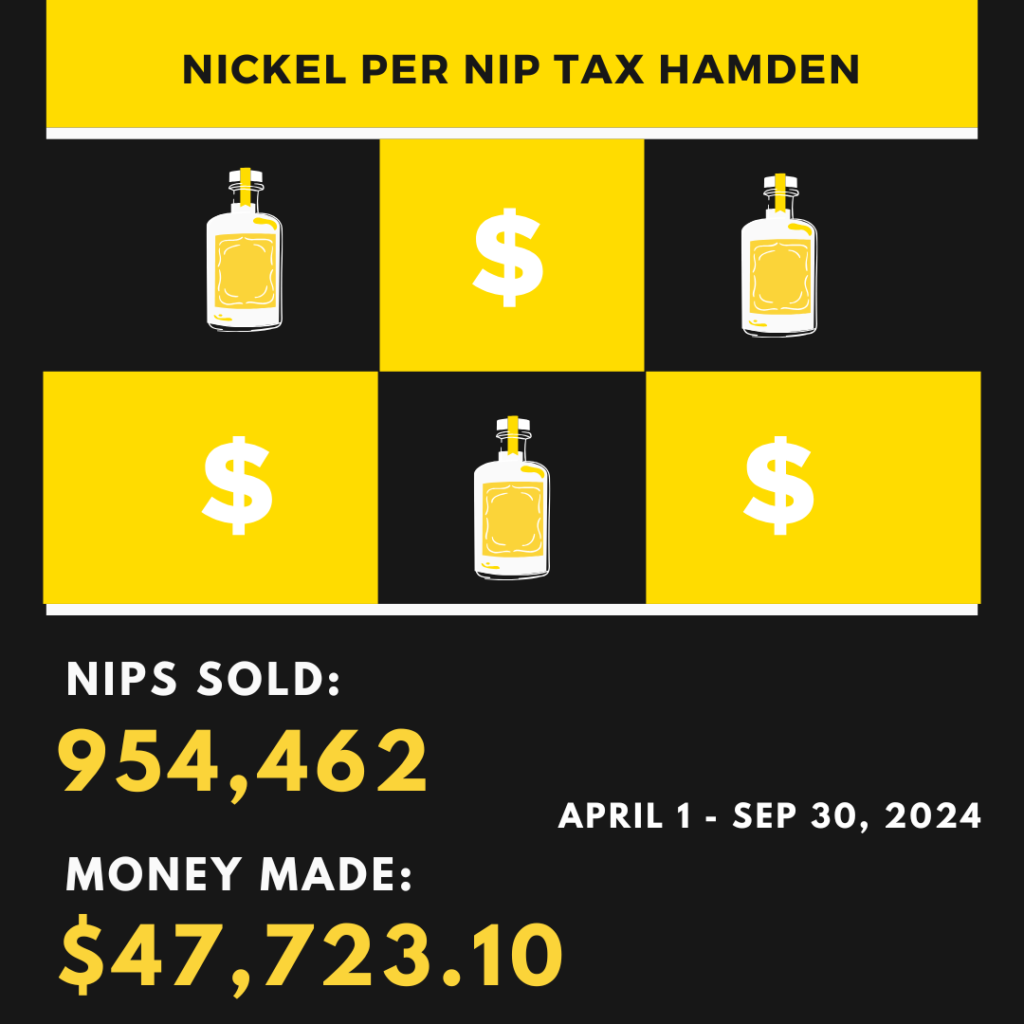
From April through September of 2024, the town of Hamden sold 954,462 nips, generating $47,723.10. But local liquor stores aren’t seeing these big numbers reflected in the recycling program.
Amity Wine and Spirits owns five different locations across Connecticut. In Hamden, the store is a popular choice for those looking to purchase alcohol.

Colin Meghot, who has worked at all five locations, learned that the tax’s implementation was meant to fund recycling programs and roadside clean-up crews. Yet, he and the other Amity staff have not seen any significant changes.
“In the last three years we haven’t seen a single person picking it up,” Meghot said.
He went on to explain his frustrations with the lack of improvement, as it seems to him the money is not going where it should.
“Everybody at the corporate state house has collected a huge pay raise every year,” Meghot said. “They’ve made probably well over a million dollars on it. But they’re not doing anything to clean up the mess that’s made with it. So it’s a little frustrating to see that.”
In April, a 2.5% pay raise was approved for 46,000 state employees. The raise would cost an estimated $190 million. It is unclear whether some of the $13.5 million raised from the nip tax between Oct. 2021 and Sept. 2023 was allocated towards these raises.
As for Amity’s customers, Meghot did not witness any outright complaints or inquiries about the tax.
“Everybody kind of is accepting of the fact that a Fireball nip that used to cost $1.05 out the door now costs $1.10 out the door,” he said.
“As long as the tax isn’t ridiculous, then yes, I think it’s an ok thing,” said Samantha Snyder, an Amity customer who barely noticed the extra tax. “It has not affected my purchasing much. I’ve also not really noticed nips on the ground outside of big party weekends/drinking events.”.
There was, however, some confusion as to whether the tax was an incentive to return empty nip containers. Meghot noted this occurred frequently at Amity’s New Haven location.
“When it first went into effect, a lot of people thought it was a deposit,” Meghot explained. “Our New Haven store, in particular, had a lot of homeless people who collected nips bring them back to the store for the five-cent deposit — thinking it was a deposit that they’re gonna get five cents for each one.”
Regardless of the tax, nips continue to be a popular product at each of Amity’s locations.
“I’ve worked at all five of our stores, and they all have considerably different clienteles. One fact remains: Everybody loves their nips, right?” Meghot said.
For Meghot, conservation efforts are extremely important. In Meriden, where he and his wife live, they often take a trash bag with them when going on walks to pick up trash. Whether he picks up water bottles, vapes, broken glass, cigarette packs, or nips, Meghot believes in making an effort to protect the environment.
For nips, in particular, Meghot emphasizes how simple it is to dispose of them. He feels if individuals make small efforts on their own, change will become more noticeable.
“I think if people just took a little bit more responsibility for themselves, and found a garbage can, or threw it out when they got home,” Meghot said. “You’ve got a garbage can at your house, throw it out when you get home. They’re everywhere on the street.”
But after seeing the ineffectiveness of the tax in Hamden, Meghot is unsure of what Connecticut can do next to boost clean-up efforts.
“I don’t know what’s gonna crack down on litter,” Meghot said. “I wish I had a genie bottle to say.”