
By Cameron Levasseur
In the spring of 2022, Quinnipiac University men’s lacrosse played 10 of its 13 games on the road. It traveled as far north as Buffalo, New York, to play Canisius and as far south as Charlottesville, Virginia, to face the nationally ranked Cavaliers. It went to UMass Lowell, Brown, LIU, Sacred Heart, Fairfield, Manhattan, Yale and Siena. It hosted Monmouth, Marist and St. Bonaventure at the Quinnipiac Soccer & Lacrosse Stadium on its Hamden, Connecticut campus.
In that stretch, the university reported spending $9,907 to pay for travel, lodging, meals, uniforms and equipment for 40 athletes, plus coaches and support staff and expenses related to game officials.
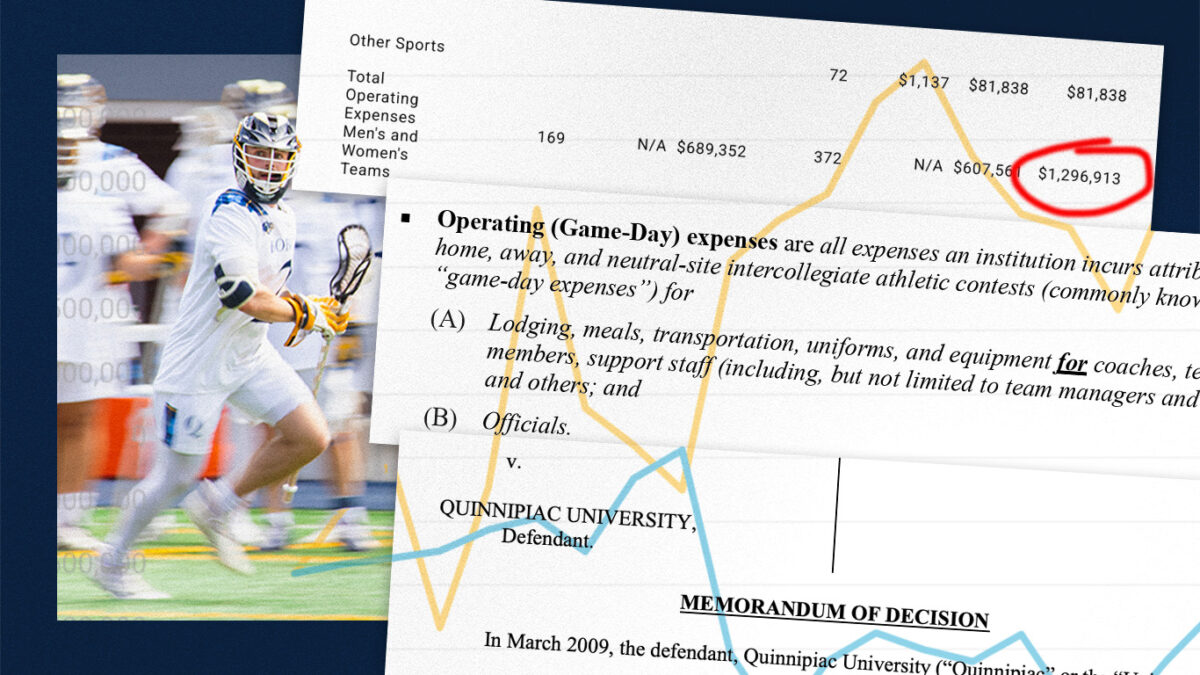
That’s what the U.S. Office of Postsecondary Education classifies as “operating (game day) expenses” within Equity in Athletics Disclosure Act (EADA) reports, the only comprehensive public source of financial data for college athletics. Every postsecondary institution that offers intercollegiate athletics and receives federal student aid is mandated to submit an EADA report annually.
Quinnipiac’s reported operating expenses from the 2022 season are the lowest any Division I men’s lacrosse team has spent for a full season in available records dating back to 2002.
The program reported total expenses of $1.27 million for the year, more than all but one of its Metro Atlantic Athletic Conference peers. But less than 1% of that went toward operating expenses.
No Division I program has ever allocated a smaller percentage to game-day costs. On average, NCAA men’s lacrosse teams spend 21% of their total budget on operating expenses. Of the 10 lowest percentage years on record, Quinnipiac accounts for eight, including each of the top-seven spots. All came within the last 11 years. None are above 3.5%.
It’s a trend that repeats itself, over and over again, across every sport at Quinnipiac, and has for more than a decade. The reason why is unknown, even within the school’s athletic department. One thing is for certain, however. It’s not just crafty budgeting. Quinnipiac’s reported spending is impossible.
Take the $9,907 the university reported as the operating total for men’s lacrosse in 2021-22.
Quinnipiac’s official transportation partner is DATTCO Motorcoach, which holds similar partnerships with the University of Connecticut and Trinity College. UConn’s contract with the company, obtained through a public records request, lays out a single day minimum rate of $1,225 and multi-day minimum of $1,625 for a 52-passenger coach, the standard needed to accommodate the team’s traveling party of around 45 people.
Calculating those figures for Quinnipiac’s 10 road trips that season, at least two of which were multi-day trips, the minimum charter cost would have been over $13,000. DATTCO’s mileage protection rate of $5.55 per mile adds at least an additional $17,200 to that cost, bringing it to over $30,000 for bus travel alone, more than three times the amount the university reported to have spent to cover the entirety of its game-day expenses.
DATTCO did not respond to multiple requests for comment to clarify if Quinnipiac and UConn share the same charter rates. But using those rates, a similar level of impossibility blankets the operating costs reported for nearly every sport at the university.
Quinnipiac reported operating expenses of $16,411 for its baseball program in 2021-22, the lowest in the nation, despite overall expenses of nearly $1.1 million. Using the same calculations, it would have spent north of $60,000 for bus travel alone across 18 roadtrips.
In 2022-23, Quinnipiac field hockey traveled to nine road contests, its longest being trips to Orono, Maine, to face the Black Bears and Lynchberg, Virginia to play Liberty. An estimated cost for bus travel for that fall reaches a minimum of $30,000. Quinnipiac reported $11,304 for operating expenses that season within an overall budget of over $1.3 million. The next closest school? Lindenwood — which in its first year at the Division I level reported operating expenses of $63,735.
It’s not simply that the university may be funding operating costs by other means. The EADA User’s Guide is clear that, “The original source of the funds used to pay operating expenses (e.g., fund-raising organizations) does not exempt the institution from reporting those expenses.”
So why does Quinnipiac consistently report operating expenses at a level well below what’s feasible to cover the costs of a full season, a fact that seemingly does not comply with federal law? After more than a year of investigation, that remains unclear.
What is clear is that it was not always this way. Until 2012, the university spent an average of 14.5% of its overall budget on operating expenses, around the national average. From the 2012-13 academic year on, Quinnipiac’s average plummeted to 3.2%, despite overall revenues and expenses continuing to rise.
That shift came around the time Quinnipiac’s EADA filings were last in the hot seat, central evidence in a Title IX lawsuit that would define the next decade of the university’s athletics.
On the morning of June 25, 2010, Jonathan Orleans stood in a courtroom at Brien McMahon Federal Building in Bridgeport to deliver closing remarks in the bench trial for a class action lawsuit filed over a year earlier.
Orleans represented the plaintiffs, a collection of Quinnipiac volleyball players and their coach — Robin Lamott Sparks — who were suing the university for violating Title IX of the Education Amendments Act of 1972 in its decision to eliminate the volleyball program the previous spring.
The basis of their case was the assertion that cutting the team made the university non-compliant with Prong One of Title IX, which requires female athletic participation be closely proportional to the ratio of female enrollment at a school.
In fact, Orleans contended, the way Quinnipiac had managed its rosters for years was inherently discriminatory.
The plaintiffs presented evidence drawn from EADA reports to suggest that the university mandated ceilings for its men’s rosters and floors for its women’s teams to artificially pump up women’s roster numbers to appear compliant. In reality, Orleans asserted, the additional athletes were not afforded genuine athletic participation opportunities or were simply cut following the first day of competition, when roster numbers were reported.
“What Quinnipiac is doing is exploiting counting rules,” Orleans said.
One month later, presiding judge Stefen Underhill ruled that Quinnipiac had “discriminated on the basis of sex during the 2009-10 academic year by failing to provide equal athletic participation opportunities for women.”
Underhill found Quinnipiac’s roster management practices to be a Title IX violation in a preliminary injunction granted for the plaintiffs in May of 2009. However, the EADA data included in that ruling dated back to the 2007-08 and 2008-09 reporting years.
The scope of the bench trial was exclusively the 2009-10 academic year, by which time Quinnipiac’s use of the roster management practices questioned throughout the trial had been modified. So in his final ruling, Underhill concluded that the current data was “insufficient to conclude that Quinnipiac violated Title IX as a matter of law,” but that it “supports the ultimate conclusion that the University is not offering equal participation opportunities for its female students.”
Quinnipiac lost the case on appeal in August 2012. In June 2013, Underhill approved a consent decree mandating — among other requirements — that the university strengthen its Title IX policy, expand the number of scholarships offered by several women’s teams, add varsity women’s golf and rugby, invest $5 million into athletic facilities used by women’s teams, including building a “superior” field hockey facility and elevate field hockey and one other women’s sport to tier one status, meaning the team is authorized to offer NCAA maximum scholarships (27 for field hockey), among other resources.
The decree took effect for the 2013-14 academic year. That October, Quinnipiac submitted its EADA report for 2012-13. Its roster management was no longer in question, but it had slashed operating expenses by nearly two-thirds.
A $2.6 million line item for operating expenses in 2011-12 came in at $955,437 in 2012-13.
It was not the result of a lack of funding. Quinnipiac saw a $3.4 million dollar increase in revenue that year, its largest year-over-year rise on record. Instead, it appears much of the money was reallocated as non-allocated expenses.
The OPE defines non-allocated expenses as those, “not attributable to a particular sport.” This includes expenses for athletics staff not associated with a particular sport, general and administrative overhead and funding for a team that was anticipated to compete, but had no games or participants in a given year.
In 2011-12, Quinnipiac reported spending $2.2 million on non-allocated expenses. The next year that figure jumped to $4 million, increasing by roughly the same amount that operating expenses decreased.
That meant that the percentage of Quinnipiac’s budget dedicated to operating expenses dropped from an average of 14.5% since the 2002-03 academic year — the first year EADA data was published online — to 4.4% in 2012-13. In reports from the 11 academic years available since, the university has never exceeded that percentage.
To put this in perspective, since 2012-13, Division I athletic departments have spent on average 13.5% of their budgets on operating expenses.
There have been 45 instances of a school spending less than 4.5% on those expenses in a given year in that span. 26 of those cases came during the COVID-altered 2019-20 and 2020-21 reporting year, where minimized travel and fewer competitions limited spending. Of the other 19 examples, nine can be attributed to Quinnipiac. No other school spent below that threshold more than once in the span.
Jack McDonald, Quinnipiac’s athletic director from 1995 to 2015, said he was “baffled” when shown the data.
“I’d really be bullshitting you if I tried to make up a reason why,” McDonald said.
Quinnipiac Athletics declined multiple interview requests for this story, writing in a statement, “Quinnipiac is deeply committed to supporting our student-athletes and providing them with the resources they need to excel both in competition and in the classroom. Our investment in athletics reflects our dedication to fostering a competitive and enriching experience for all of our teams.
“We believe success is measured by more than just budget figures,” the statement continued. “Quinnipiac continuously enhances its athletic facilities, coaching staff and student-athlete support services to ensure our teams compete at the highest level. Our championship-winning programs, strong academic performance among student-athletes and commitment to well-rounded development demonstrate the value of our approach. Quinnipiac will continue to invest strategically in our athletics programs, ensuring that our student-athletes receive the support, training, and opportunities they need to succeed.”
And indeed, the university’s EADA reporting practices do not appear to impact student-athletes.
“I never felt neglected,” said Ian Ostberg, who played baseball at Quinnipiac from 2018 to 2022. “I never felt like there was any money that we should have been receiving or travel amenities that we should have been receiving and were not.”
Nonetheless, it paints a misleading picture of the reality that exists at Quinnipiac, one that — confusingly — is better than the numbers show. It also clashes with the requirements of a federal law, and is not the only way the university does not comply with the EADA.
The act mandates that schools publish their annual reports by October 15 each year, and that they, “must be made available upon request to your students, prospective students, and the public.”
Quinnipiac does not do so. The only reference to the report on the university’s website is a link to the web portal operated by the OPE, which is updated in the late spring of each year. Multiple requests to access Quinnipiac’s 2022-23 report after the October 15, 2023, deadline were declined by an athletics spokesperson, citing first that the report was still under internal review, then that it was anticipated to be published online shortly.
The last response came in November 2023. The report was only made available after the OPE released its complete data in April of 2024. Quinnipiac’s report for the 2023-24 academic year is not yet available.