
On a dark and stormy night, the pine trees seem to grow taller than usual under the cover of moonlight alongside a steep and twisty road. Static interrupts some old power ballad on the radio as windshield wipers work overtime to clear the view ahead. But as you squint to see the potholes and avoid any wandering animals on your drive home, you notice in the rearview a set of headlights.
And just as quickly as you see them, they flicker off.
The car gets closer and closer as you try to speed up just a smidge to outrun them to the nearest intersection, traffic light or sign of civilization. You try and keep your cool, but they’re too close and you swear you can see an outline of a shadowy figure of the driver. Or is there a passenger too?
In that split second it takes you to ask yourself, “dear god, there’s more than one person?” you’re swerving for a squirrel and running off the road. You try to regain control of the steering wheel, but there’s just too much rain and not enough traction for your tires to regain control.
Sounds like something straight out of a horror movie, right? For women, this is a common if not sickly unifying experience that sounds nearly identical to the opening to several true crime podcasts.
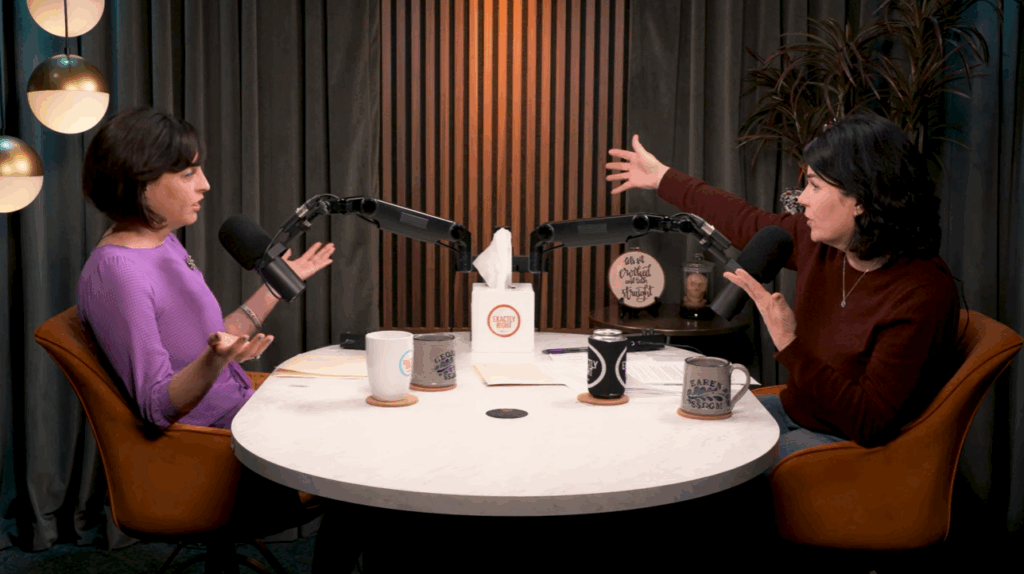
“In the back of my mind, I’m like, ‘is this for real?’ Like, this was legit and this is like the opening scene of a true crime documentary,” Katie King, one of the cohosts of “True Crime New England,” recalled her experience with drivers following her down a deserted New England road at nighttime with their headlights off.
King, 26, was on her way home from a wedding when a truck saw she was driving alone down a dark road, and followed her with no headlights. “The only way that I could see that these people were still behind me was by tapping my brakes, and my brake light would illuminate their license plate.”
What are true crime podcasts?
True crime is one of the most popular podcast genres to date, as 24% of the top-ranked podcasts in the United States are true crime based. They amass millions of listeners (including 34% of the US population) and rake in the big bucks: “My Favorite Murder” was the second most profitable podcast in 2019 making $15 million, behind only “The Joe Rogan Experience,” which made $30 million.
Unlike scheming con artists and deceitful killers, true crime podcasts are exactly as advertised: podcasts that usually dig into one or more true crime case(s) per episode. They range from darkly comedic (“My Favorite Murder”) to deeply serious (“Serial”), and the variety of podcasts, subgenres and thematic elements attracts a wide variety of listeners across all demographics (43% are Latino, 36% are Black and 34% are white, according to NBC News), but the most common listeners are millennial and gen Z women.
According to the Pew Research Center, women are almost twice as likely than men to listen to true crime podcasts. Among US podcast listeners, 41% of younger listeners ages 18-41 (of all genders) are much more likely to listen to true crime podcasts, compared with 15% of ages 65 and over.
So much community is found in online spaces nowadays, and true crime functions as a way for vulnerable communities to explore more macabre subjects such as death and violence in a (usually) safe space. The standard “opening scene” to true crime podcasts isn’t just thematic exposition; it’s a shared life experience.

It’s experiences like these that serve as a testament to the communities that true crime has built for its fans – which are primarily women, as they make up 73% of true crime’s audience. King and Corey have noticed that the majority of fans who approach them in person or swipe up on social media to say “kudos” align with that statistic.
Growing up in New Hampshire, King and Corey were fascinated with local small town tall tales of missing children and seemingly one-off violent crimes, and grew up reading Stephen King novels. The picturesque background of a quiet and woodsy region being the setting for ghastly stories and gruesome crimes always perplexed the two, who met back in school.
Now, King, a hospice nurse, and Corey, a labor and delivery nurse, want to keep telling the real stories that don’t get told.
“You don’t know how you’re going to act when this happens or if you’re in this situation, but listening to true crime watching documentaries, or if you watch the girls who do makeup and talk about true crime, it really does help you feel prepared,” Liz Corey, King’s co host on “TCNE” said. “I think that’s part of what we really wanted to drive home with our podcast, because it doesn’t matter who you are…people are crazy. It’s not to try and scare anyone at all. It’s just reality.”
This fear of violence (either sexual violence or bodily harm) is not an outlier as to why women are so enthralled with true crime. According to a study conducted by Oakland University, women who were fearful of rape were twice as likely to consume true crime content, and “indicated that this consumption was specifically motivated by the desire to learn strategies to prevent or escape an attack.”
A safe space to discuss and debrief
As twisted as it is to acknowledge that the reality of gruesome crimes has grown into a collective media empire, there’s a growing trend at universities across the country where true crime lives offline. The True Crime Club at Ohio State University went dormant during the pandemic, until Anne Traver, a double major in world politics and communications at OSU, revitalized it in 2023.
“It’s both a social and academic club,” Traver, the club’s current president, said. “One of the biggest goals is to create a community of people who can talk about true crime together, and host our events on campus.”
These events range from murder mystery parties to guest speakers from the Cincinnati bureau of the FBI, as well as social wellness nights. The “Stories and Cider walk” in the fall is particularly popular, where club members sip cider on an evening stroll and have an open space to discuss true crime in the Columbus and OSU community.
Psychology, anthropology, forensic science, biology and political science are the biggest majors within the club, and it’s predominantly female: The club roster is over 90% women. “True crime can serve as a way to stay aware as a woman in terms of personal safety,” Traver said. “I feel when I stay up to date on true crime, I am better prepared to deal with a potentially violent situation, if I were to ever end up in one.”
Even though every club member has different career aspirations either within or outside the world of crime, candid conversations about the accessibility, potential irresponsibility and advocacy these podcasts and other forms of media carry are supremely important when dissecting this topic.
“Especially with the explosion of interest in true crime, there has been a flooding of media that is not only better than others in terms of education about domestic violence or safety but also is just more credible than others,” Traver said. “The more a person can be aware of their surroundings or warning signs in something such as domestic abuse or other kinds of violence, the better equipped they can be to stay safe when going about their day to day life. I think knowing and learning about true crime is a pretty accessible way to do this.”
Community impacts
Keeping true crime accessible doesn’t always mean expanding a national podcast’s outreach. Katie King and Liz Corey set out to localize true crime when they started their podcast, based on their upbringing in New Hampshire and the local tales they’d heard for so long about cold cases in the area.
“I got into true crime because my dad, in the eighties, his best friend had a little sister, and she was abducted walking to school,” Corey said. “It’s been 40 years this past November, and she’s still not been found. I grew up very fascinated with this specific case, but then it just kind of evolved into, ‘oh, there are more like that out there,’ and it’s not just in my small town.”
As they graduated school and began working in the region, they kept hearing of more and more stories just like the one Corey’s father told her.
“New England is considered one of the safest parts of the country,” King added. “And so, we wanted to kind of say, ‘well, that’s great and all. But also it’s not true, we still have a lot of crimes’, and our goal was to kind of get those stories out there that weren’t being told.”
One of the biggest things King and Corey have set out to do is to keep their community at the forefront of their storytelling. Friends, family, neighbors and more have approached the duo with cold case ideas, or cases that have impacted them personally.
The impact on victims’ families
It’s a staunch difference from why so many true crime podcasts, shows and documentaries make headlines these days from ignoring requests from the victims’ families and loved ones. Renowned and established television creator Ryan Murphy, who’s anthology series “Monster” and “American Crime Story” offer narrative perspectives of the killers and cases that shocked America, has received legions of backlash from both victim and killer’s families.
After “Monster: The Menendez Brothers” amassed 2.7 billion minutes watched in the fall of 2024, Tammi Menendez, wife of convicted killer and series subject Erik Menendez, released a statement from the Menendez family condemning the “grotesque shockadrama.”
“The character assasination of Erik and Lyle, who are our nephews and cousins, under the guise of a ‘storytelling narrative’ is repulsive,” the family wrote. “It is sad that Ryan Murphy, Netflix and all others involved in this series, do not have an understanding of the impact of years of physical, emotional, and sexual abuse.”
This is the official response from Joan VanderMolen (Erik's Aunt) and the Menendez Family to the Netflix Series" "Monsters, the Lyle and Erik Menendez Story" and to Ryan Murphy.#Menendez #NetflixMonsters #RyanMurphy pic.twitter.com/o7KEOEoYwr
— Tammi Menendez (@TammiMenendez1) September 26, 2024
It’s this backlash that has become so common among some of the most popular true crime shows and movies. Podcasts too are not immune from this criticism, as series such as “My Favorite Murder” have come under scrutiny for misleading facts and too humorous of tone (The slogan of “My Favorite Murder,” “stay sexy and don’t get murdered,” has raised some eyebrows among true crime fans).
Because their podcast is so rooted in their community, King and Corey ask themselves questions whenever they start research and recording of a local story.
“Did we do right by them? Is this something that the family wanted out there? Everything we use is public information. But it’s obviously a touchy subject, and it’s kind of hard to navigate,” Corey said. “But more often than not, people really appreciate getting their loved one’s case out there, especially because the ones we talk about are so hardly reported.”
For some more seasoned fans of the genre, it’s this responsibility factor that plays a key role in deciding which podcasts and creators they listen to. Alexandra Cusson, a current marketing assistant in Massachusetts, has been a fan of true crime since she was in middle school. She makes an effort to stay on top of news in the true crime sphere through social media like TikTok and Reddit, which helps her see what cases are gaining lots of attention, and finding new creators to follow.
“A big ‘red flag’ for me is podcasts that treat the crime itself like a fiction story,” Cusson tells me. “I avoid all of those makeup creators who will do a smokey eye and talk about a gruesome murder.”
She’s referencing creators such as Bailey Sarian, who has built a true crime YouTube page centered around telling true crime stories while she does her makeup. Videos average about a half hour, and she’s amassed 7.65 million subscribers, as well as a slew of criticism.
Do “antis” help or harm the online community?
“True crime antis” have been a constant presence in the online fandom for years. While they aren’t necessarily “anti true crime” in the sense that they think the genre is completely corrupt and toxic, they do take it upon themselves to call out toxic creators and appalling fan behavior.
Way back in 2018, when true crime was just beginning to reach its cultural and financial stay at the top, a high school freshman was deeply troubled by the obscene and disturbing behavior of some “true crime community” (TCC) fans on Tumblr, the popular social media blogging website. Never one to sit idly by but fearful of their identity being “doxxed” (publishing private or identifying information about someone on the internet), they enlisted the help of a friend and started the account “Gibby Against the TCC.”
Using a “deep fried, meme-ified” picture of the character Gibby from iCarly, the account (“Gibby”) anonymously called out bloggers who went too far in idolizing and romanticizing mass murderers and serial killers, such as Adam Lanza, the killer behind the Sandy Hook school shooting in 2012 that killed 20 children and six adult staff members, and Dylann Roof, the white supremacist killer behind the Mother Emanuel church shooting in 2015 that killed nine Black churchgoers.
The inciting incident behind the account creation was seeing “cutesy fan art of the Boston Marathon bomber (Dzhokar Tsarnev). I found that profoundly disturbing as someone from the area,” “Gibby” said.
Between the years of 2018 and 2019 when the account was active, it got thousands of impressions and even inspired other fans who were disgusted with the state of discourse on Tumblr to make their own “anti” accounts, such as “Trixie–Mattel-against-the-tcc”.
“The response was extremely warm from people who didn’t idolize criminals,” they said. “I also feel extremely grateful that I never revealed any part of my identity whatsoever on Tumblr because I could’ve been potentially doxxed or worse. I wasn’t exactly calling out mentally sane people.”
The dark side of the community isn’t always talked about, because true crime in particular is already a pretty dark corner of the internet. But, some of the things that “Gibby” witnessed through their DM’s and Tumblr homepage were just too disturbing to ignore.
“I came across this woman’s account that was dedicated to idolizing Dylann Roof, a white supremacist mass shooter. She sent me a lot of disturbing, racist messages talking about how she wanted to recreate his crimes. I posted on my account to my followers, ‘please block this person for your own safety, especially if you’re Black,’” they said. “A few days later I got a message from a follower saying that she recognized the woman and reported her to the police and she was now in their custody. If she hadn’t been reported, who knows how many people she could have harmed?”
The public accessibility of true crime plays into both phenomenons of fans taking it too far and others using them as resources for “worst case scenarios.” For better or worse, police reports, courtroom footage and livestreams, and other public media surrounding all of these cases is relatively easy to access compared to other topics in the podcast sphere that are harder to report on.
Public records=content
It plays a huge part not just with the quality of true crime podcasts, but also the quantity of them, too. They offer “an inexhaustible, cost-effective cache of stories, characters, and even sets,” according to Mackenzie Brennan of the Reynolds Center of Business Journalism.
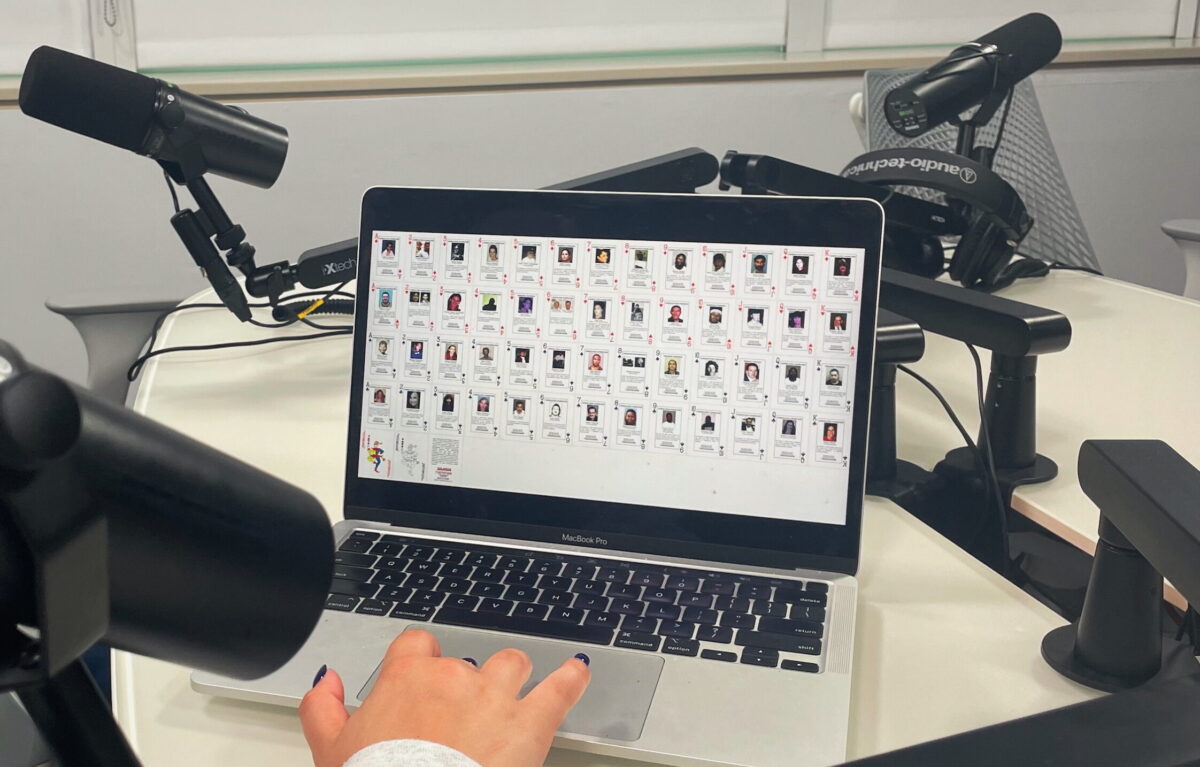
A common resource is “cold case cards,” which are exactly what they sound like: playing cards with cold cases on them. They vary by state or federal cases, and are commonly seen in penitentiaries. But, King and Corey use them for inspiration when researching cases.
“Most states have them. They have 4 or 5 different decks, and what they do is they put together like a full deck of cards, and each card has an unsolved case,” King said. “Whether it’s an abduction, whether someone was murdered, whether it was a disappearance — who knows, but these cards are distributed around jails, prisons and mental health facilities.”
While it’s a way to potentially generate more information with incarcerated people who could know more about a certain case, these cards are readily available online — for print through the Connecticut state website, or even Amazon.
“They’re like, ‘Oh, do you have the ace of spades?’ And then it’s a case on that card, and it will have the information,” King adds. “And all of the cards are public record. We pull cases off of there, too, especially because they’re unsolved. But even if the case is solved, we want to get it out there and tell that story.”
While “telling the story” can lead to exploitation and idolization, a big part of why people keep coming back to the true crime creators they trust is advocacy.
Bigotry and discrimination are major elements of the crimes covered in true crime media — whether it’s rooted in race, gender or sexuality, many crimes that are told have to do with one or more of those subjects. This is why creators and fans alike take it upon themselves to not only tell the stories, but to help support organizations who are dedicated to preventing these biases from escalating into another story told on a podcast.
King and Corey work together to be involved in community media, and even taught a class for a community college. “We just really talked about what we do, and what to do equipment-wise, finding your niche, all that fun stuff. But it was very interesting and unexpected,” Corey said. “We’ve been on the radio. We’ve been on cable news, which was cool.
“It’s kind of grown more than we ever thought, and it’s a big commitment, but it’s a great one at the same time. We’ve really felt very lucky that people care about these stories.”
The True Crime Club at Ohio State University is one of those fan communities that believes in giving back to the community and supporting criminal justice reform. Coming from young students who are constantly learning about how to carry out investigations and research in the criminal justice field, they believe reform is just as important as awareness.
“So far, we have done fundraising for the Innocence Project through a bake sale event,” club president Traver said. “As forensic technology evolves, we feel as a club it is important to reevaluate criminal cases and work to get criminal justice reform, and we think that supporting the Innocence Project is a great way to do this.”
True crime is not going anywhere for the foreseeable future. While it’s tricky to navigate the ethics of storytelling elements in real-life, extremely sensitive cases and subjects, it makes fans think deeper about what kind of world they’d like to live in. Whether it’s a self-defense class or calling out disturbing behavior online, true crime opens a lot of doors for vulnerable communities, especially women.
Time will tell if true crime actually makes a long-standing difference in helping to raise awareness about personal safety and violence, but for now, it’s looking to make a difference — one podcast at a time.