
By: Hannah Freshman
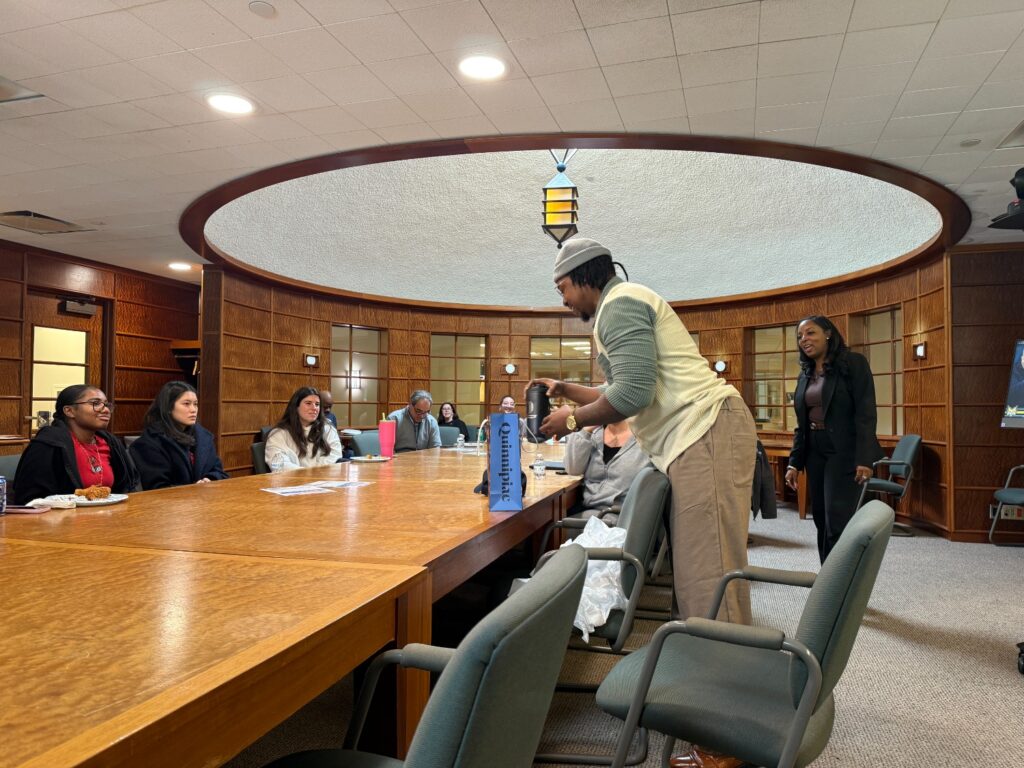
The Office of Inclusive Excellence and Assistant Professor of Sport and Entertainment Management Donald McAulay Jr. hosted “Still I Rise: Navigating Imposter Syndrome,” an event part of Quinnipiac’s Black History Month programming Monday afternoon in the Communications, Computing and Engineering building.
Students sat around a large conference table as McAulay opened the discussion with the question, “Who is here with us in the room today?”
The discussion invited students to reflect on their identities and sense of belonging at Quinnipiac, which has a predominantly white student population. Participants shared their names, majors, and what McAulay called their “superpower.”
Attendees enjoyed food from American Soul Kitchen, including mac and cheese, cornbread, collard greens and fried chicken.
McAulay guided the discussion with reflective questions. He asked students to consider how they present themselves in different spaces and how self-doubt can affect participation. He drew on personal experiences of growing up in New Haven, attending a conservative college and navigating assumptions about his appearance. He asked the group to reflect on what creates feelings of inadequacy or imposter syndrome.
McAulay challenged students to embrace discomfort and take action.
“There will be opportunities where I’m uncomfortable, but I need to take a shot,” he said. “I need to take the chance and not predict what the outcome is.”
Lexy Pleasant, a sophomore criminal justice and law and society major and member of both the Student Government Association and Black, Indigenous and People of Color Caucus, said the session helped her recognize her own confidence.
“I’m content with who I am in the room,” Pleasant said.
Taura Smith, a junior health science major and SGA member, reflected on the challenges of navigating identity at a predominantly white institution.
“‘Predominantly white institution’ me is here,” she said. “How I present myself at school is different from how I am at home.”
Smith added that the Office of Inclusive Excellence “helps me connect with my identity” and reminds her “I can be a person of color at a predominantly white institution.”
McAulay encouraged students to think about how they want to show up in different spaces and how their presence can shape conversations. The discussion emphasized creating environments where individuals feel heard and valued.
What began as a simple question evolved into a space for exploring identity, representation and self-doubt. Students reflected on their voices and sense of belonging in academic and social settings.
The event concluded with an announcement from the Office of Inclusive Excellence about another opportunity, “Belonging at the Booth: Inclusive Strategies for Career Fair Success” on Tuesday, Feb. 24, at 12:30 p.m. in CCE 185.
This interactive workshop, open to students of all backgrounds, continues the focus on inclusion, confidence and professional development in their careers and academic spaces.