

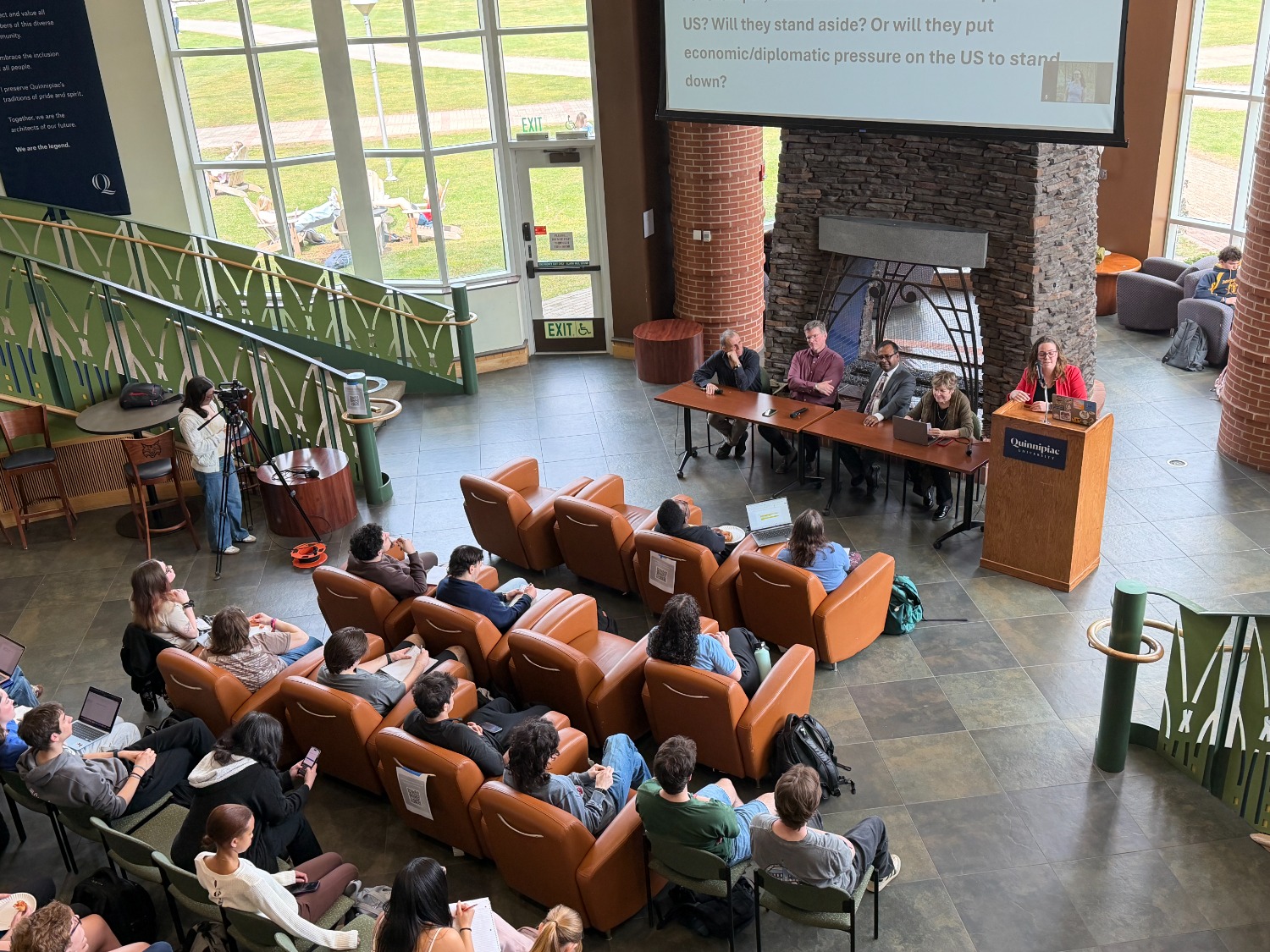
The United States’ military involvement in Iran is one of the most widely discussed issues in the country right now. Quinnipiac University had the opportunity to discuss the conflict with students and faculty on March 31 in the Carl Hansen Student Center piazza.
Sponsored and hosted by the Political Science Program, Honors Program and and the Office of Student Experience, the “All-Campus Teach-In” allowed for a discussion with people from all sides of the spectrum.
Candice Travis, visiting assistant professor of political science, moderated the event with a panel of guests including Anat Biletzki, Albert Schweitzer professor of philosophy, Professor of International Business Mohammad Elahee, Executive Director of the Albert Schweitzer Institute Sean Duffy and Professor of Education Mordechai Gordon.
Students submitted questions anonymously using a QR code that redirected to a Microsoft Form. And towards the end of the debate, students in the audience were able to ask questions.
The event began with strong comments, with Biletzki emphasizing that Israeli Prime Minister Benjamin Netanyahu has been warning about Iran’s potential for nuclear weapons for a long time.
“For over 30 years, Bibi Netanyahu and Israel have stated that Iran is just two weeks away from nuclear weapons,” Biletzki said. “It’s ridiculous because he’s been saying this for 30 years, but Israel has had nuclear power for 57 years.”
When Travis asked panelists about how the war would affect federal programs and the economy, Elahee took a bold approach to his response.
“I think this war, if it continues, will have a disastrous impact on the U.S. economy,” Elahee said. “This Operation Epic Fury may turn out to be an epic disaster, I think it will be a disaster of epic proportions.”
The discussion started off by immediately getting into some hot button issues, which included putting boots on the ground in Iran and regime change.
As the topic shifted to Israel’s push for the United States to get involved with Iran, faculty members began disagreeing with each other.
Biletzki once again emphasized her beliefs that Netanyahu pushed the United States to go to war against Iran, and that the Prime Minister’s influence on Congress is concerning.
“I just want to respond a little bit to Professor Biletzki, where I slightly disagree with her,” Gordon said. “There’s no doubt that Bibi is pushing for this war, but [Donald] Trump has agency. Trump chose to go to war.”
Travis asked panelists what the chances were of other countries or terrorist groups entering the conflict by attacking Israel or the United States. Duffy thought the chances were not just high, but inevitable.
“I think the prospects are very strong,” Duffy said. “Iran and its proxies play the long game. And I would be surprised if there wasn’t something that we saw six months from now. Not just here in the U.S., not just in Israel but through Europe and perhaps other parts of the Middle East and the Southeast.”
Elahee vehemently disagreed with this sentiment, and immediately rebutted the argument by looking at the issue from Iran’s point of view.
“I don’t accept the premise of the discussion,” Elahee said. “It’s not that Iran is attacking, Iran is retaliating. You can play with the semantics, but they have to be truthful.”
While faculty on multiple occasions disagreed with each other, each time it was with a tone of mutual respect. The debate stayed respectful, critical and peaceful.
As the event wound down, the organizers allowed students from the audience to ask questions. One student was concerned about the involvement of AI and data centers in the military and war.
“We’re in the age of AI warfare, I’m concerned about the massive defensive risks of data centers and our economy being AI centric,” the student said. “Do you think this is a liability to our military efforts?”
Faculty members paused for a second, as it seemed for a brief moment that no one wanted to address the question first. But after a couple of seconds, Duffy grabbed the mic.
“I think you’re absolutely right,” Duffy said. “I think one of the things that this conflict has already demonstrated is that this kind of technological advantage is not necessarily going to solve the challenge we’re trying to bring to it.”
Another student had concerns about United States allies.
“Primarily regarding the war, our allies see the United States as unstable with decision making. How much more can we put them through?”
“I wouldn’t be surprised that as a result of this conflict, Trump decides to completely abandon NATO,” Gordon said. “That just because they don’t agree with his perspective that he’ll just say ‘F them.’”
Healthy dialogues are ncessary for world conflicts, especially ones that involve a global superpower such as the United States. Quinnipiac’s “All-Campus Teach-In” allowed for just that.