
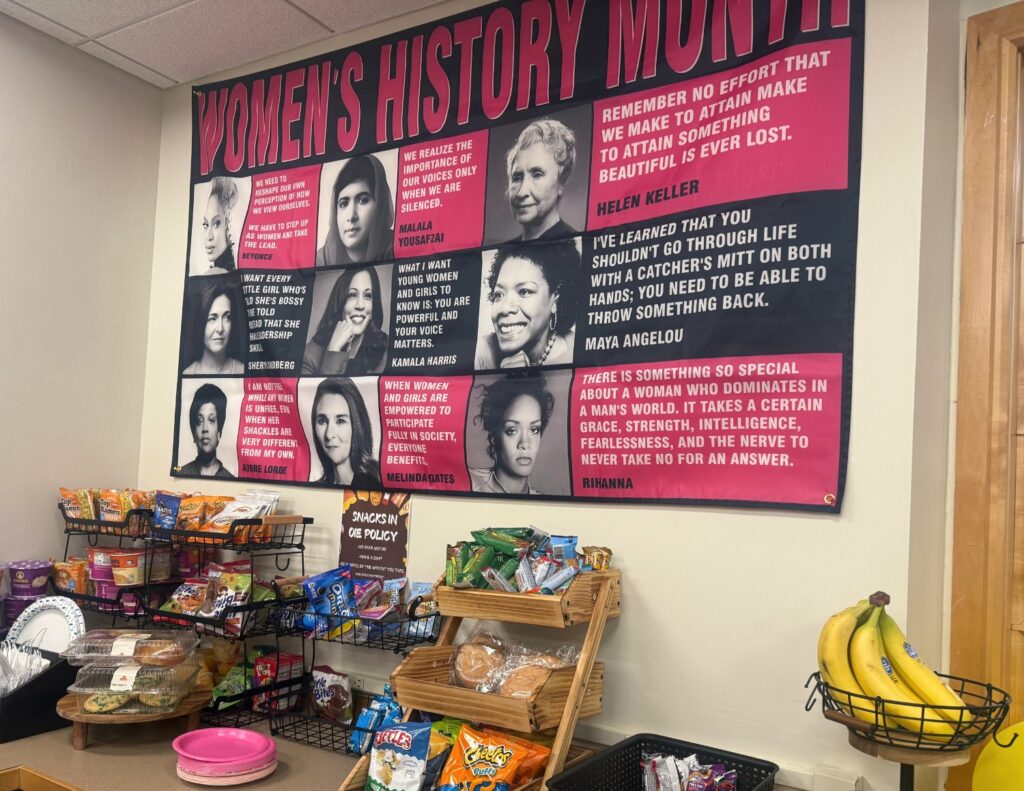
At Quinnipiac University The Office of Inclusive Excellence does not feel like a political battlefield. Inside, free snacks and relaxing music create a stillness that invites visitors to exhale.
In the high-stress ecosystem of a modern university, critics often misunderstand the work within these walls as a political project. However, the labor in Hamden looks less like activism and more like community building. It involves steady efforts, such as touching base with a student struggling or assisting a faculty member in bridging classroom gaps.
The three letters dominating national headlines — “DEI” — are missing from the door. Instead, the sign reads “Inclusive Excellence.” Yet in the current climate, those words alone have become a battlefield.
“A big scope of my position is to ensure that everyone on campus has a place where they belong, where they find community, where they find their people.” explains Briona Grant, assistant director of inclusive excellence. She isn’t talking about a specific subset of the student body, but the entire Bobcat family: “Despite what walk of life they come from… socioeconomic status, gender identity, race—whatever you name it.”
The federal storm
While the Hamden office remains a quiet support space, a louder storm is brewing in Washington. Since the January 2025 inauguration, the Trump administration has moved to dismantle diversity initiatives across the federal government. Two executive orders drive this effort: “Executive Order 14173: Ending Illegal Discrimination and Restoring Merit-Based Opportunity” and “Ending Radical And Wasteful Government DEI Programs and Preferencing”.
These orders exerted immediate pressure on institutions to ban diversity, equity, and inclusion policies. By threatening to withhold federal grants, the administration effectively rebranded student belonging as a legal liability.
The newly formed and subsequently disbanded, Department of Government Efficiency (DOGE) intially spearheaded this crackdown. Viral deposition videos show staffers using artificial intelligence to scan federal grants for terms like “BIPOC” or “immigrant.” These staffers often struggle to define “DEI” when questioned. The resulting campaign targets an acronym it cannot explain, sweeping up the real work of inclusion in the process.
Despite this pressure, the office continues to advocate for students. In a written statement, Claude Mayo, director of inclusive excellence at Quinnipiac University, said he remains focused on the “microcosm” of university life. Mayo views the university as a reflection of society that leaders must intentionally engineer to welcome a “richness of identities.”
“We know that by and large, people report that we are a welcoming campus,” Mayo stated. “But we also know there are some who might struggle to find community or to be accepted.”
Mayo’s office coordinates massive cultural engagements to bridge these gaps. For example, the 2025 Garba Festival drew over 700 attendees. His work also extends into academic foundations through programs like Bobcat Academy, the First-Year Immersion Program, and QU Enriching Student Transitions (QUEST). These initiatives mentor students through the high-stakes transition of their first year. By focusing on these early academic milestones, Mayo ensures that belonging remains a shared, intentional effort from a student’s first day on campus.
However, the survival of these tangible programs often depends on the very language currently being challenged. This shift from physical community building to the battle over terminology is where the current political friction is most visible.
The problem with acronyms
Don Sawyer served as Quinnipiac’s vice president for equity and inclusion from 2021 to 2023. He currently serves as the vice president for diversity, inclusion, and belonging at Fairfield University. Sawyer argues that relying on acronyms is a deliberate tactic to avoid the moral weight of dismantling these programs.
“We’ve allowed the acronym ‘DEI’ to be used as a lightning rod,” Sawyer said. “People say, ‘We need to be against DEI’ or ‘That’s a DEI hire’ But if you talk with them, many don’t even know what that means.”
Sawyer challenges critics to strip away the shorthand and use the words in their fullness: diversity, equity, inclusion, and belonging. He argues that being against the acronym requires an admission of being against the concepts themselves.
Bridges for the majority
At Quinnipiac, this challenge hits a specific nerve. National rhetoric often frames inclusion as a zero-sum game where one group wins at another’s expense. In Hamden, however, the reality is designed to be the opposite. At a predominantly white institution (PWI), these efforts build bridges for the entire population rather than walls around a minority.
Numbers clarify the current landscape. For the 2024 academic year, 78.6% of the undergraduate population identified as white. While the underrepresented minority population has grown to roughly 20%, the majority still vastly outnumber the rest.
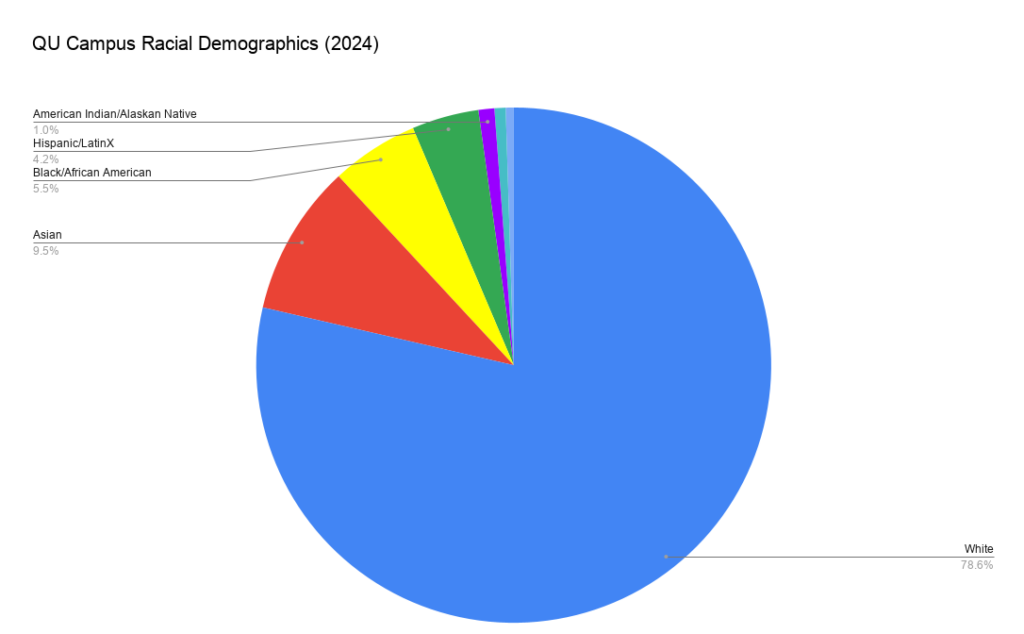
For Grant, these statistics define her job description. She rejects the idea that her office is a “members-only” club.
“I often hear that we’re a PWI,” Grant said. “A big portion of our work is to ensure those from the non-majority feel they have a space… but a big part of our intentionality is also to ensure that the majority feels they can come to our events to learn.”
Grant explicitly pushes back against the narrative that these spaces are exclusive. “You’re not banned because you’re not a marginalized student,” Grant said. “This is for everyone. Inclusive excellence is for everyone. I just want to heavily emphasize that.”
Grant’s philosophy mirrors what Sawyer calls “universal design.” This framework ensures the system elevates everyone rather than trading one group’s success for another’s.
“It was always this idea of a universal design,” Sawyer said. “The unfortunate thing is the assumption that diversity, equity, and inclusion is something that’s just for people who have historically been underrepresented or marginalized in higher education, and that’s never been the case, and it shouldn’t be the case.”
Sawyer noted that if white male students see a fall-off in performance, that is also a diversity issue that requires an institutional address.
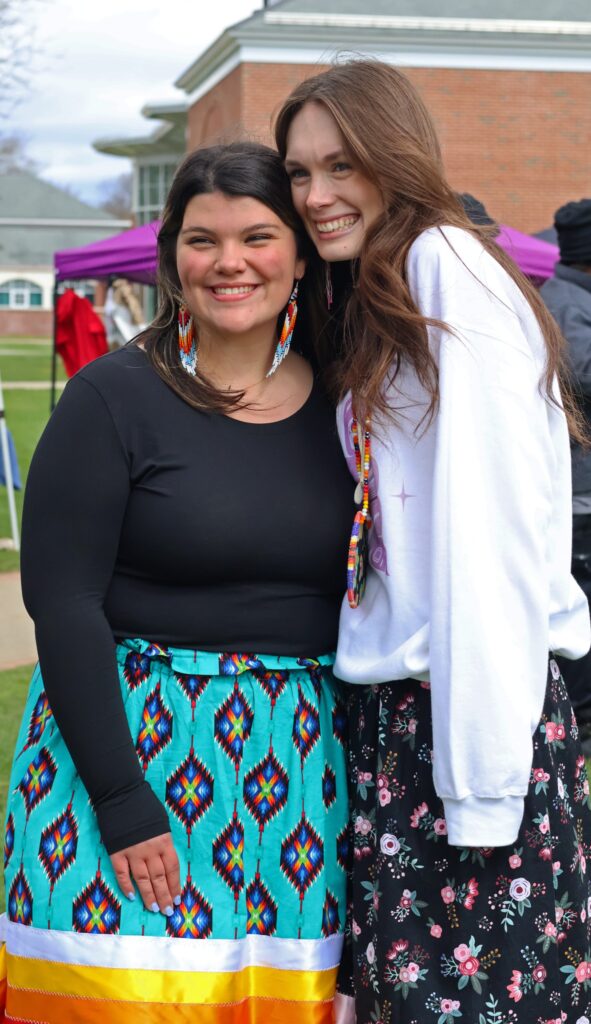
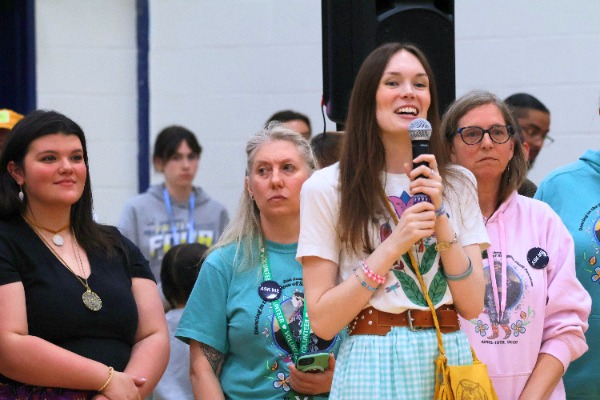
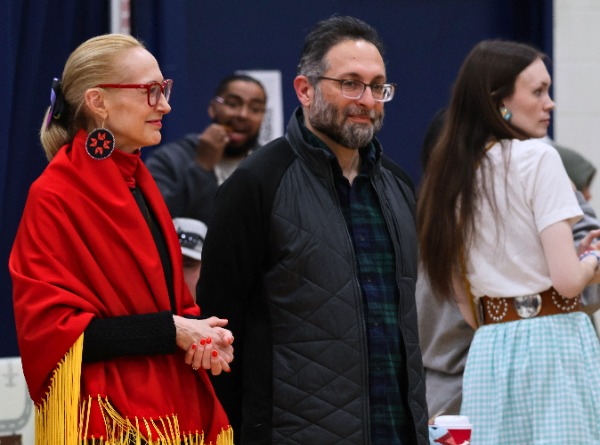
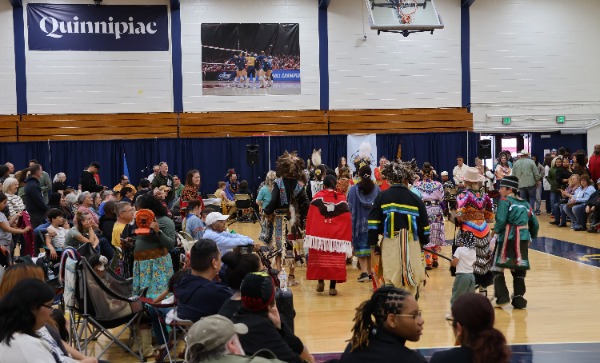
This commitment to the “100%” is a moral obligation inherited from the land. The Mount Carmel quad sits on the ancestral home of the Quinnipiac people. The second annual Powwow moves this work from behind desks and onto the grass. This partnership between the office and the Indigenous Student Union serves as a physical rebuttal to the narrative that inclusion only serves a few.
Under the shadow of the Sleeping Giant, the grounding beat of a drum replaces political slogans. By sponsoring the Powwow, the office proves that stripping away labels leaves something deeply human. People from every walk of life stand together to honor the land’s original inhabitants.
The front lines of belonging: Student perspectives
While the Powwow stands as a visible moment of unity, the work of inclusion continues in student lounges and dining halls. When the Department of Government Efficiency (DOGE) flags terms like “BIPOC” for termination, it flags the very people and spaces that allow students to thrive.
For student leaders like Adhira Arun, a junior computer science major, and Joseph “JJ” Saunders, a sophomore film major, life at a PWI requires more than academic focus. As leaders within the BIPOC Caucus, which operates under the Student Government Association (SGA), they carry an unseen responsibility to protect community spaces that national rhetoric is actively trying to erase.
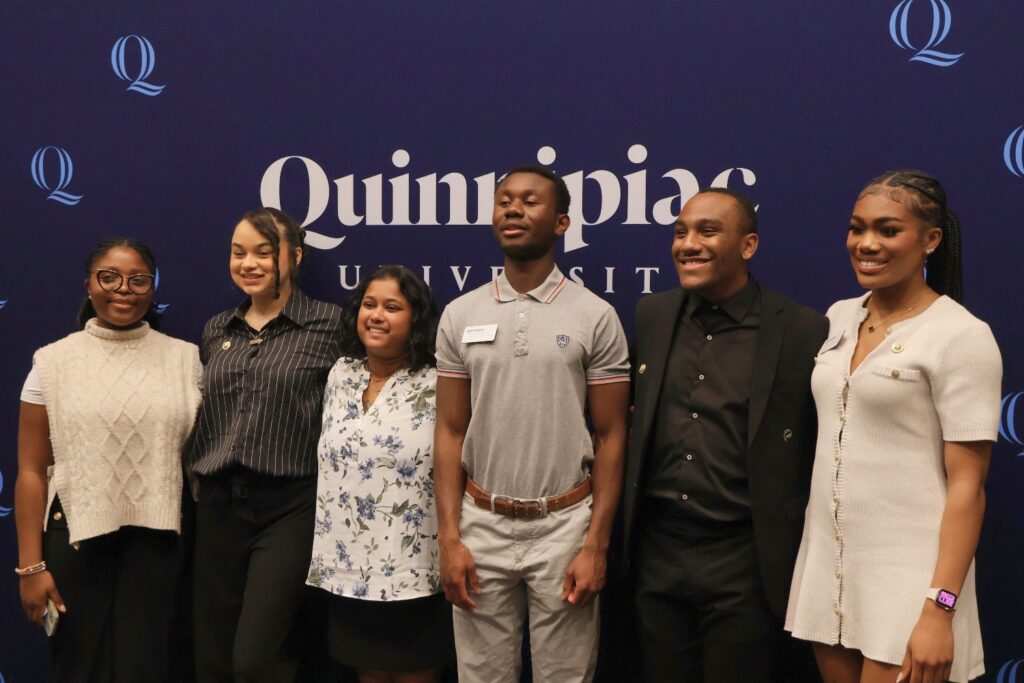
For Arun, this responsibility is shaped by her identity as an immigrant, and a 28-year-old veteran. She arrived at Quinnipiac with significant “outside experience” from a home she describes as “very cultural and colorful.” While she said the environment was not a culture shock, she noted the daily reality remains distinct.
“I don’t want to use a polarizing word, like isolating, but it is something like that,” Arun said regarding her experience. This outlier status is most evident in her STEM classes. “I’m probably one of two girls that I know in my classes. There’s such little representation of us that I can see another brown girl there, and she knows exactly who I am.”
This isolation has transitioned from social friction into direct confrontation. Arun observed that the national debate regarding diversity initiatives now influences classroom interactions. She recalled a conversation with a fellow student and veteran who argued that “white men are the most persecuted group in America right now.”
Arun said the interaction “legitimately happened” and left her unsettled. However, it also provided a clear sense of purpose. “It just keeps cementing that we need to do important work as a BIPOC caucus,” she said.
While Arun’s experience highlights the isolation of the classroom, Joseph “J.J.” Saunders, a sophomore film major, navigates a “majority mindset” that extends into the very architecture of campus life. Although Saunders grew up in similar environments, he described the prevailing atmosphere at Quinnipiac as a barrier that frequently triggers a sense of displacement.
“It definitely can create a sense of imposter syndrome,” Saunders said.
To counter this isolation, Saunders sought structural avenues for advocacy, joining the Student Government Association (SGA) and the BIPOC Caucus. He noted that the caucus provided a vital communal refuge during periods when he felt he was “flying solo” within the university’s social scene. For Saunders, this involvement represents a rejection of social conformity in favor of authentic representation.
However, this commitment to authenticity often meets direct hostility in public spaces. Saunders recalled an encounter the day after the 2024 election involving a student wearing a MAGA hat who targeted him with a dehumanizing gesture.
“I was walking and one of the girls with a MAGA hat, she barked at me,” Saunders said. The incident left him in a state of disbelief for weeks, highlighting the volatile nature of the campus climate for those outside the majority.
Ultimately, Saunders views his advocacy as a defense of his earned being in an era of heightened federal scrutiny. He argued that current political rhetoric weaponizes the “DEI” acronym to undermine the intellectual legitimacy and achievements of students of color.
“I’m here to prove, yes, I’m a BIPOC student, but I’m just as worthy as you,” Saunders said. “I was not handed this position; I worked for this position. I’m going to show you exactly why I got it.”
The consequences of erasure
Saunders’ insistence that he was not “handed” his position is a direct response to a national narrative that treats identity-based support as a shortcut rather than a necessity. His experience on the quad serves as the local face of a federal movement to pretend that structural disparities do not exist. In Washington, this movement has transitioned from rhetoric into a silent redaction of identity from official records.
During a recent House hearing, U.S. Rep. Summer Lee, D-Pa., challenged Health and Human Services Secretary Robert F. Kennedy Jr. on the tangible impact of these mandates. Lee highlighted a directive requiring agencies to remove nearly 200 words and phrases from funding applications, including the word “Black.”
“Your agency told programs to remove a list of nearly 200 words and phrases from funding applications, including the word ‘Black,'” Lee stated. “Do you have any idea how we could solve the Black maternal mortality crisis if we can’t say ‘Black’?”
Saunders’ insistence that he was not “handed” his position is a defense against a growing national narrative that views identity-based support as a shortcut rather than a necessity. His experience on the quad is the local face of a federal movement to pretend that structural disparities do not exist. In Washington, this movement has transitioned from rhetoric into a silent redaction of identity from official records.
During a recent House hearing, U.S. Rep. Summer Lee (D-Pa.) challenged Health and Human Services Secretary Robert F. Kennedy Jr. on the tangible impact of these anti-DEI mandates. Lee highlighted a directive requiring agencies to remove nearly 200 words and phrases from funding applications—including the word “Black.”
Lee’s questioning strikes at the heart of the crisis facing institutions like Quinnipiac. When political rhetoric demonizes the language used to identify marginalized communities, it effectively cripples the ability to serve them. The first step toward solving a systemic failure is the bravery to name it. By stripping away the vocabulary of the vulnerable, the administration renders their specific crises invisible. Structural inequality cannot be dismantled in silence.
Beyond the narrative
At Quinnipiac, student leaders like Arun and Saunders are refusing to be silenced by this administrative erasure. Their work serves as a localized rebuttal to a national trend that views their identities as a liability rather than a reality. They prove that an isolating atmosphere cannot be mitigated if it cannot be named, and achievement cannot be celebrated if the barriers to that attainment are ignored.
The Office of Inclusive Excellence does not exist to serve a political agenda; it exists because the friction of inequality is a data-driven reality that requires a dedicated response. The goal of higher education is not to avoid the conflict inherent in a diverse society, but to build the institutional infrastructure to survive it.
This effort to bridge gaps in the student experience is exactly what is at risk when the vocabulary of inclusion is dismantled. Stripping away the politics reveals a simple, human reality: You cannot fix what you are forbidden from describing.
“The political climate and what we’re facing in the world and DEI offices around the world being dismantled, right? But again, knowing that our work is not just for marginalized groups,” Grant said. “Our work is for everybody, no matter what.”