

Is sending teenagers to long-term facilities the “solution” to their perceived problems? A look at one family’s experience in the system.
Edited on August 14, 2026 to reflect reinstatement of Haley’s TikTok account.
*Some names have been changed to protect identities
Wilderness therapy in Utah sounded like summer camp to Eric*. He said they framed it as if the adolescents in the program sang around campfires and slept in cabins.
“I thought it was gonna be kind of like sunshine and rainbows,” he said. “I honestly thought it was gonna be a kind of fun experience, originally, because that’s how they framed it up.”
However, Eric, now 19, said that picture was far from reality. Daily multi-mile hikes with heavy backpacks, thin mats to sleep on the solid ground and limited food and water. How did Eric get there, though?
Doctors diagnosed Eric with attention-deficit/hyperactivity disorder (ADHD) at a young age and he began therapy. His parents divorced in 2012, when Eric was 5 years old, and his mom Haley remarried to his stepfather three years later. His parents both remained in Maryland, but lived in different school districts.
Haley, who uses the alias “Mrs. H” on social media to protect her son’s identity, noted Eric struggled in a typical classroom. The COVID-19 pandemic forced his middle school to close during his first year – when Eric was 13.
“[It] was very, very difficult for him – as it was for millions of children,” Haley said. “Also, his father and I had…tumultuous divorce custody issues. That impacted him and, to add icing on [an] already terrible cake, our house burned down during COVID…That was a lot.”
Eric said his friend group in middle school split ways shortly before the pandemic began, increasing the amount of isolation he felt during that time. While he made some friends online, he said that it was not the same as having friends to be with in person.
When school opened back up the following year, Eric continued struggling. He expressed these feelings to his therapist, who relayed that to his parents. Eric admitted he also started doing drugs, skipping school and failing classes.
Beginning Treatments
His father brought up treatment programs that fall. He reportedly told Haley that he connected with an educational consultant and she recommended Eric go to a wilderness program. Eric was unaware his father was researching wilderness programs at that time.
“I don’t know…how he found [the educational consultant], but that was the first time he ever mentioned sending our son away,” Haley said. “It went against every instinct I have as a parent. If your child is struggling, I can’t imagine anything worse for them than sending them away. It just didn’t even make sense to me.”
Haley said her and Eric’s father had equal parental rights in the original divorce agreement. However, this agreement also included a tie-breaking stipulation. This sets in stone someone to make education or health decisions if the divorced parents can not come to an agreement. In this case, Eric’s father had the tie-breaking power.
In early 2022, Haley agreed to a different kind of mental health program called a partial hospitalization program (PHP) through Newport Academy. PHPs are a level of care in between inpatient treatments, like hospitalizations, and outpatient treatments, like individual therapy.
According to the American Academy of Child and Adolescent Psychiatry (AACAP), adolescent PHPs are typically five days per week for at least 20 total hours throughout each week. AACAP also notes these programs typically overlap with normal school hours.
PHPs usually involve medication management, group therapy, school support and more. In addition to these, Haley said Newport Academy also randomly tested clients for drugs and alcohol. Eric said he discovered his father had been researching wilderness therapy programs around early February of that year.
“[Eric] went during the day and he came home at night and on the weekends…To me, [it] was just elevated therapy,” Haley said. “There was nothing about it that seemed bad and he loved his therapist…He was enjoying going and, at that point, there was nothing worrisome.”
However, Eric broke one rule: no outside contact. In some programs, that rule means clients can not contact each other outside of program hours. However, according to Haley, at Newport Academy this meant Eric could not talk to his former classmates either. The program conducted random phone checks to ensure clients followed this rule.
“When you really think about it, it’s completely setting these kids up to fail…because, at that age, socialization and friends are everything,” Haley said. “You’re in this program with these other kids who are now your support system, who are now kind of the only kids that get you because you’ve left school – you’ve left your peer group.”
Eric said he started dating someone within the group and Newport Academy found out. They had connected through social media outside of program hours. Haley and Eric reportedly agreed that he would follow the rules and she would take his phone away. However, roughly two weeks before finishing the program, Eric broke the rule again.
“[That rule is] kind of a recipe for disaster for kids that age because, at that age, socialization and friends are everything…You’re in this program with these other kids who are now your support system, who are now kind of the only kids that get you because you’ve left school – you’ve left your peer group. You’re embarrassed, frankly.”
Haley
Newport Academy reportedly told Haley that her son needed a “higher level of care” than PHP and suggested a 30-day residential treatment in March 2022. National Alliance on Mental Illness (NAMI) notes residential treatment can aid children with severe symptoms who require higher levels of observation and structure than outpatient treatments, like PHPs, provide. Haley disagreed with the assessment.
“I remember having a conversation with his therapist who explained [it] to me,” Haley said. “I said, ‘For what? He talked on the phone…He’s sober, he’s doing the work, he’s in the program…There’s no possible way that I’m agreeing to that.’”
Due to the tie-breaking stipulation, Haley did not have a say in the end. According to her, the educational consultant coordinated with Newport Academy and recommended Evoke Therapy Program’s Wilderness Therapy Program in Utah. Evoke closed in late 2024 “due to unforeseen circumstances beyond [Evoke’s] control” according to their closure announcement from August 2024.
“[Eric’s father] was being very candid with [Eric] about it and kind of dangling it over his head,” Haley said. “So my son and I would talk about this openly, like…‘Dad’s going to send you to wilderness and I don’t know how to stop it.’”
Eric already knew his father wanted to send him to a wilderness program. Yet, according to Haley, Newport Academy did not want to tell Eric about it beforehand. They set his discharge date for later that month and reportedly told Haley to not tell Eric about Evoke.
Newport Academy also allegedly told Haley they wanted a transport company to take Eric from the discharge meeting to Evoke. They claimed that he would be a “flight risk” if he knew about the plan, saying Eric might run away.
“I was like, ‘No f***ing way am I doing that. No – if he’s going to go to wilderness, he’s going to know he’s going to wilderness,’” Haley said. “So I sat down with [Eric] and I explained to him…that we were going to have to fly out to Utah and that he was going to go to wilderness.”
Haley, Eric and his stepfather flew across the country together a few days later. None of them wanted to go. None of them agreed to this. However, Eric’s father had invoked his tie-breaking power. They had no choice and he made sure they followed through.
“I didn’t even know his father showed up and was on the same plane as us,” Haley said. “[He] didn’t even talk to us, but got on the plane to make sure that I really took [Eric].”
Haley created a code word for Eric before leaving him in Utah. It was a way for Eric to tell her if Evoke was “horrible and abusive” without alerting anyone else. However, Haley did not know if she would hear from Eric after dropping him off. She did not even know for certain how long he would be gone.
“I told him, ‘Don’t use the code word if it just sucks, like if it’s like summer camp and you want to come home,’” Haley said. “That’s kind of what we thought [it would be]. He’s like, ‘I can do it, Mom…how bad can it be? We’ll be outside, we’ll be hiking. It’s like summer camp, right?’”
Eric agreed that Evoke misled him and Haley about the true nature of the program. They thought it would be short-term; a few weeks long, maybe a month at most.
“I thought it was [going to be] me and some people, you know, sitting around a campfire, cooking s’mores, kumbaya, you know?” Eric said. “Sleeping in cabins and whatever, being able to bring my stuff up…we didn’t really know.”
Evoke had an online portal where parents could view letters from and photographs of their children in the Wilderness Therapy Program. Once a week, the program also had clients write a word or short phrase on a piece of notebook paper along with their initials. The program would take a photo of the paper and upload it to the portal. Eric participated a few days after his arrival and wrote down the code word.
“Most of the phrases were things like ‘I miss home,’ ‘Get me out of here,’ ‘I’m starving,’” Haley recalled.
Haley said the program also involved structured letters between clients and their parents. Evoke gave Eric a topic for each letter. Haley would receive a similar assignment and write a letter on the same topic. She said Evoke also sent photos of Eric reading her letters in Utah.
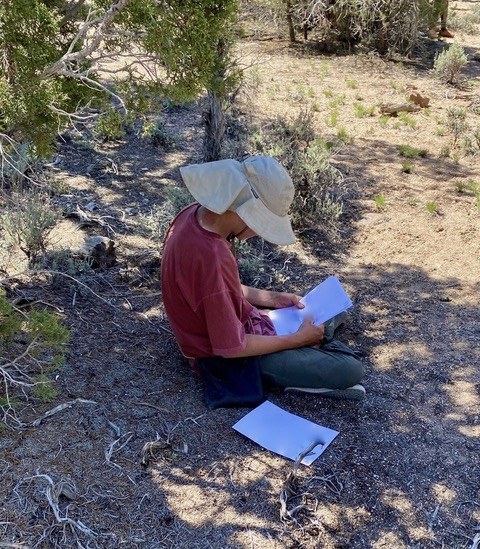
Eric claimed Evoke provided “minimal” food and water to clients during their stay, adding that at one time their water rations ran out for an entire day. He also claimed they had to use the same pot for cooking and “showers.”
“Kids were getting heat exhaustion, throwing up, passing out. People were trying to kill themselves…I mean, it was just not good,” Eric said. “Whatever you’re picturing, it was worse, you know?…We got one little pot of water to pour on ourselves as a shower, like, once a week. Most people didn’t even do it.”
After a few weeks, Evoke suggested that Eric undergo neurological testing. A therapist indicated to Haley that it was not a requirement. She called the testing psychiatrist to ask him a question.
“‘How many kids – that you do this testing for – do you send home?’”
“‘Almost none,’” he reportedly told her.
After that conversation, Haley told Eric to refuse the tests. The educational consultant reportedly was upset about this and said no other child has refused the testing before, according to Haley.
Visiting the Wilderness
Evoke invited Haley, Eric’s stepfather and other parents to visit as part of their Wilderness Therapy Program in June 2022, over a month into Eric’s stay. Eric’s father also visited at a different time. The program told parents what to bring and had them check in at the main office. This is also where parents dropped off their children at the start of the program.
Staff provided each parent with a bag of food before departing the building. Everyone then entered their individual cars and followed a staff member deep into the desert. Nearly two hours down empty dirt roads.
The cars eventually stopped and pulled into nearby vegetation. Staff took each parent’s personal items – phones, watches, medications. Haley reported she could only keep the clothes she brought and the food Evoke provided.
After searching every bag, staff led the parents down a dirt path in the desert heat. The air was hot and dry. The group eventually turned a corner and saw 10 boys huddled under a tree. One burst from the pack toward the parents. Eric knew she was there. He ran straight to Haley and hugged her.
“I’m looking around as I’m hugging [Eric] and trying to just be so present in this moment of embracing him,” Haley said. “I’m looking around [asking myself] ‘What is happening? This is sick. Why are these boys out here?’”
The desert surrounded them. No tents or cabins in sight. Shoes and other items littered the dirt – the only evidence humans stayed here.
The parents spent 30 hours out in the desert. Each child had to go around and introduce themselves. This included why they were at Evoke, how long they had been there and a fun fact about themselves.
“It was so demoralizing to hear them have to explain to a total stranger why they deserve to be there,” Haley said. “It was just a narrative that had been put on them…They didn’t deserve to be there.”
Evoke separated food into different categories. There was personal food and group food. Staff would provide clients with personal food on a regular basis. If a client ran out of personal food early, they could not have more.
Eric told Haley he ran out of personal food two days prior. She offered him food from her own bag, but he told her to put it away. Eric said he would get in trouble if he took her food, but added he did have some. He claimed the amount of food Evoke gave each parent for their visit was the equivalent of an entire week’s worth of food for a client.
Eric later showed Haley and his stepfather how to make a fire from scratch. If clients do not learn this skill, Haley said, they can not have hot food nor advance in the program.
There are no bathrooms in the middle of the desert. Instead, the program gives the boys a bucket. According to both Eric and Haley, clients had to say their name every three seconds while using this bucket. Eric claimed the clients had to clean the bucket themselves and bring it with them wherever the group went.
Everyone slept under the stars. Though it sounds peaceful at first, it was anything but. The temperature dropped dramatically and the ground was solid rock. Bugs covered everyone and caused bites so severe that Eric’s stepfather sought medical care upon returning home.
The next day, Haley argued with the therapist and threatened to take Eric home. However, if Haley did that, then she would lose all custody over him. After a long, difficult discussion, she and Eric’s stepfather left him in Utah.
“I didn’t take him home,” Haley said. “I felt like the worst person in the world. It was terrible.”
Eric was sad to see them leave, but he understood the situation. It was out of their control.
“It was good to see them…I’m grateful for them to be able to come out there,” Eric said. “But part of me was just they didn’t get to see that, because it was pretty bad.”
Leaving the Wilderness
Even though Newport Academy only recommended a 30-day program, Eric stayed at Evoke for over 75 days. Haley says their situation was unusual, though. Instead of sending him to a different facility, Evoke sent Eric home.
Eric’s therapist at Evoke noted the conflict between Haley and Eric’s father “contributed significantly to his anxiety and poor sense of self” in an email explaining this decision to the parents. However, he also noted that Eric made significant progress since starting at Evoke.
“Given his openness to treatment and his willingness to engage in his work, I am recommending that [Eric] return home following his treatment at Evoke,” the therapist wrote. “I believe his profile is such that he can handle addressing these clinical areas of concern while home.”
The educational consultant seemed skeptical of this decision in her email response. She noted the conflict between Eric’s parents was “more extreme than we have seen in other cases” and wished the therapist had discussed his discharge plan with her before making a decision. She added that she “just can’t imagine [Eric] being able to live peacefully at either parent’s home.”
Eric agreed that his parents created a “very hostile environment” with their arguments. He said he tried to distance himself, but it was still stressful for him.
Evoke did not send Eric home with zero aftercare, though. They recommended he attend an intensive outpatient program (IOP). IOPs are a step between PHPs and weekly outpatient therapy. AACAP says IOPs usually meet 2-4 days per week for a total of 9-19 hours throughout the week. These programs typically operate after school hours or allow for part-time attendance.
Eric returned home in July 2022, almost a month after Haley visited him in Utah. She said they could not stop hugging each other. However, things had changed.
After returning home, Eric said he continued to eat the same kinds of food Evoke provided him. He added he would also go on hiking trails with a large, heavy backpack.
“I felt very socially inept getting out of it,” Eric said. “It was, you know, definitely an isolating experience.”
He would get overstimulated in crowded rooms and have to leave. He said it took time to adjust to the “real world” and the transition to home was not easy.
“Nobody understands that these poor kids are so much worse off when they get out of these places than they were before they went in,” Haley said. “They make you feel like you can’t trust your own instincts as a parent…they create an actual rift between parents and their children and it feels purposefully designed.”
“They make you feel like you can’t trust your own instincts as a parent…they create an actual rift between parents and their children and it feels purposefully designed….We were always, and still are, so close and have such a trusting relationship with one another that I wouldn’t allow that.”
Haley
Late in the fall, Eric broke one of the IOP rules and Eric admitted he was also not participating in the program. Once again, Haley heard that her son needed a “higher level of care.” It did not make sense to her.
Haley tried working with Eric’s father. She tried to see if Eric could return to Newport Academy since he liked the therapist there. However, his father reportedly would not budge on sending him and filed legal paperwork.
“The whole time I’m in the background saying…to my ex-husband, ‘Why are we sending him away? Why can’t we keep him here and get him the support he needs?’” Haley said. “But, every proposed solution from his father involved sending him away.”
A three-day trial ensued in November. Eric’s father and his team presented arguments as to why the court should allow him to enroll Eric into residential treatment. A court order from December states the judge allowed Eric’s father to use his tie-breaking authority to immediately enroll Eric into “a residential treatment center, as time is of the essence” after the trial.
The judge continued that neither parent could interfere with Eric’s admission and required both parents to attend individual therapy. This was meant to help “address their communication issues” and potentially lead to family therapy sessions.
Turnbridge
Eric’s father chose to send Eric to Turnbridge in Connecticut. Haley brought him there in December 2022. He begged for his father to let him stay home – it was almost Christmas. However, his pleas fell on deaf ears.
While dropping Eric off, Haley met with an admissions team member in the large main house on Turnbridge’s Woodbury campus. Haley claimed that though the front rooms where parents enter are nice, the rest of the building is “run down.”
“The only thing that was okay with that place – literally the only thing – was that I was allowed to hear from him every day,” Haley said. “It’s amazing what we’ll tolerate, you know? Like me talking to my child 10 minutes a day shouldn’t feel like a gift, but it did at the time.”

When she spoke to the admissions team, they claimed Eric would have access to a music room and be able to burn CDs. However, Haley and Eric both alleged the music room did not even exist. They also told her that they would work with Eric’s local county so he could keep up with the school curriculum. However, Haley claimed it took over a month for Turnbridge to complete that process. The team never told her the length of Eric’s stay.
Turnbridge reportedly told Haley she could visit once a week for a two-hour period. However, she lived roughly 300 miles away. She wanted to visit Eric as often as possible, but it was not feasible from Maryland.
Instead of giving up, Haley uprooted her life. She and Eric’s stepfather booked an Airbnb in Rhode Island and moved in while Eric attended Turnbridge. Haley already worked from home running her own business, easing that transition. She drove two and half hours from that Airbnb to Turnbridge once a week to see Eric.
Turnbridge was not easy for him. Eric just wanted to go home. Haley claimed his therapist, who she says no longer works at Turnbridge, insulted and belittled him.
“[Eric was] just trying to get through it so he can get back home,” Haley said. “Immediately [his therapist told] him…‘You’re never going home. I don’t send kids like you back home.’”
Already struggling with anxiety, Eric felt defeated. Haley claimed the therapist also lied to them both and called Eric a “genetic trash bag.” Eric confirmed this and said he witnessed the therapist also call other clients “human trash bags.” The therapist also reportedly stopped conducting family therapy calls because they were “too stressful,” according to Haley.
“She was just not a great person,” Eric said. “She would always kind of badmouth my mom and say a bunch of stuff that, you know, a therapist in a ‘professional’ setting really shouldn’t say.”
Eric added he eventually changed therapists during his stay. He claimed he became a lead therapist’s only direct client after refusing to work with his original therapist.
At some point during Eric’s stay, a different therapist told Haley that her son was suspected of flirting with another boy. While Haley did not care about her son’s sexuality, she recognized it as a tactic to drive a wedge between Eric and her.
“It was another way of them trying to get you to think, ‘Maybe you don’t know your child as well as you think you do. Maybe your child has issues that only we can deal with because you really don’t know them,’” Haley said. “Looking back, I felt there were repeated situations that encouraged that kind of doubt.”
Eric told Haley his mental health was the worst it had ever been while inside Turnbridge. He begged for her to take him out. However, they both knew the legal battle that came with that decision.
During a visit in late December, just a few weeks into his stay, Haley noticed something on Eric’s finger. Another client gave him a “stick and poke” tattoo with a pen. Eric said the tattoo has since completely faded.
“[Turnbridge staff] talked about [the residential] like it was this happy, joyful place, and it was so depressing and so sad,” Haley said. “There was one room [for a common space]…and [the clients] were always just sitting on the couch in there in front of the TV – just staring at the TV.”
Eric claimed there was a group therapy tradition the clients called “S**t Talk Wednesdays.” He said a therapist would have the clients anonymously write insults about each other on paper and place them into a bucket. Clients then picked a different piece of paper and reportedly had to repeat the written insults to the indicated person.
“We pass the bucket around and call out everybody basically just sh*t talk everybody. I mean, the name was fairly accurate…a lot of fights broke out. I mean, I’m sure you can imagine that that group did not go well.
Eric
Turnbridge also wanted Eric to go through neuropsychological testing. Once again, he refused to participate. Haley claims she later learned that was the reason Turnbridge decided that Eric, again, needed a “higher level of care” in February 2023.
Eric is unsure why Turnbridge decided that. He admitted he began refusing to participate in therapy, causing the change in therapists, and was “definitely a little belligerent in their eyes.”
Eric was at Turnbridge nearly 90 days at this point. The average stay for Turnbridge’s Woodbury campus was just over 45 days according to a 2025 annual report the facility provided, up from just under 43 days the year prior.
Crossroads
Eric’s father and the educational consultant already found his next placement: Crossroads Academy. This is a 9-month, long-term residential program in Utah. However, Crossroads would only take Eric from a wilderness program – from Evoke.
Haley alleged that Eric’s father, Evoke’s owner and Crossroads’ owner came up with a plan. Crossroads had an open spot starting March 1. Until then, Evoke would let Eric spend roughly three weeks in their Wilderness Therapy Program so he would be eligible for admission into Crossroads.
“They were sending me to wilderness…to kind of like, you know, shake me up or whatever.,” Eric said. “So I was ready for Crossroads. It’s ridiculous.”
No one informed Haley about this plan. She said only learned when a Turnbridge clinical team member called her from a personal phone number in February 2023.
“She said, ‘I’m on my cell phone. I’ve got [Eric] with me. His dad is here to take him to Utah and he wants to say goodbye to you,’” Haley recounted. “She went out on a limb. She didn’t have to do that…She did me a solid because otherwise I would have not even known.”
She still cries about that moment to this day. At the time, Haley did not know what to do. She knew court was the only way to stop Eric’s father, but that would take months. He already took Eric; there was no stopping him. So, she made a social media post on TikTok about the situation.
Her video amassed over 25,000 views, 1,600 likes and 100 comments as of May 26. Haley temporarily disabled her TikTok account between then and publication for an unknown reason. On Aug. 13, Haley reinstated her account.
In the video, Haley discussed Eric’s father taking him to wilderness. She said Eric would return to Evoke within the next two days and emphasized that it was not her choice. She also described Eric as being “trapped in the TTI.”
AP News describes the “troubled teen industry” (TTI) as a “sprawling network of loosely regulated, for-profit residential treatment centers, wilderness programs and boarding schools.”
At the time, Haley just wanted some possible answers. She did not know what might come of her post. TikTok introduced her to the world of advocacy. Some former clients, who themselves and Haley refer to as “survivors,” reached out and told her their stories.
“At that time, I still didn’t know that the TTI really existed, but once I got on TikTok all these survivors came out and started talking to me and I found this community,” Haley said. “I came out…talking about how bad these places are and believing the kids, and that’s not a role that parents typically take.”
Haley posted what motivated her at the time. Sometimes she discussed her experience visiting Eric in Utah. Other times she discussed manipulative program tactics. However, she quickly realized the issue was more than just her situation.
“[At first] I was just this desperate mom not knowing what the hell was happening and then I quickly realized there are thousands of kids who this has happened to,” Haley said. “So my goal was…to raise awareness so that parents would hear that what your kids are telling you is true – that what happened to them out there is true – and to stop sending your kids to these places.”
Haley said there are online social media groups that encourage parents to send their children to wilderness programs. Some parents in these groups reportedly encourage other parents to use transport companies, like Newport Academy suggested to Haley, and to listen to educational consultants.
“There’s a whole movement out there of parents who believe in this crap,” Haley said. “I was like, ‘Well, I’m only one person, but I’m going to come out and say that: Don’t believe in it, please.’”
Despite online support, Haley could not stop her son’s transfer. Eric started at Evoke’s Wilderness Therapy Program – for the second time – a couple days after his father removed him from Turnbridge.
Haley still had access to the online portal from Eric’s previous stay. Just like before, Evoke sent photos throughout his time. She also had a weekly call with his therapist, where she bluntly told him that she only participated to gain updates on her son. Haley said the therapist understood her feelings. She claims he also may have thought Eric “didn’t fit the criteria” of most clients sent to these programs. She thinks this may be why the therapist sent him home after his first stay instead of another program.
Eric stayed at Evoke for just over three weeks before transferring to Crossroads Academy, a long-term residential program for teenage boys. His father returned to Utah and took him from Santa Clara to Ogden, a nearly five-hour car drive, in early March. The program’s website says the academy is nine months long, but Eric and Haley claimed the program said it could be up to 12 months.
Crossroads did not allow visits for the first couple of months. Eventually, Haley was able to make a handful of trips to see Eric at Crossroads Academy throughout his stay. She said he also called her every Sunday.
Crossroads also allowed Eric to visit home in July 2023, three months into his stay. Eric said he refused to return to Utah once he got back to Maryland. Haley helped him get to an attorney’s office where he retained counsel to fight his father’s decision.
Eric and Haley still had to listen to the courts, though. If either violated a court ruling, she could lose custody. She said her own lawyer also became involved with the proceedings. Crossroads allowed them to extend the visit due to the court hearings, but Eric eventually had to return.
However, Haley and Eric said this was when things began to change. Eric told other clients at the academy about his lawyer. He said he also encouraged clients to report the program to hotlines posted on the walls. These hotlines were for clients to call and tell a third party if they end up in an “uncomfortable” situation in the facility, according to Eric.
“I was kind of getting everyone out of their brainwashed state, I guess…[Crossroads] really didn’t approve of that,” Eric said. “I was opening everyone’s minds up a little bit and [was] like, ‘Hey guys, are we really okay with this?’ And [other clients were] like, ‘No, no, we’re not.'”
Haley continued to make social media videos, which Eric reportedly told her that staff members saw and discussed them. She said staff members also started following her social media page.
Haley said it was only a “matter of time” before Crossroads discharged Eric at that point. In late September, 2023, nearly seven months into his stay, Crossroads sent Eric home.
“They were sick of me because I was out talking about it on social media and they didn’t want to deal with me,” Haley said. “Not because I’m so important, but because they didn’t want the scrutiny. They don’t want the noise.”
However, Eric’s father had a condition with his discharge: Eric had to attend boarding school. Haley said it felt designed to “punish” her and keep Eric away as long as possible. She and Eric got to pick between three options. Two were on the other side of the Mississippi, but one was located in Maryland.
They chose the latter. It was over an hour away, but it was close enough that Eric could visit on weekends. Eric hated boarding school, but they did not have a choice at the time. In late November, two months into his stay, Eric caught a viral infection.
Haley said he visited home while sick and refused to go back to boarding school. Eric said he told his father that he would have to go to court and force Eric to return. Haley and Eric claim his father never made another court filing to send him back.
Eric enrolled in the public school local to Haley and started as a junior. This was a new school – a new start.
“I was really proud of him. I mean, I know that was hard for him,” Haley said. “He went to a brand new school and he made incredible friends…He had this awesome friend group and he had a great couple years.”
Haley posted dozens of times since that first video. These range from updates on her and Eric’s situation to “exposing” the TTI. She also connected with anti-TTI advocates online to increase her own involvement.
Advocacy and Oversight
Dani Gusto, 38, was in multiple TTI facilities for multiple years in the early 2000s. Spring Ridge Academy, one of those facilities, faced a lawsuit that went to a jury trial in 2024. Gusto decided to attend with some of her former peers. One of them helped her with travel costs.
“Honestly, we thought it would be fun to see the people who had tormented us,” Gusto said. “Just see them on the stand and see them have to answer for themselves and not be in control of a situation.”
The jury awarded the plaintiff $2.5 million. Gusto said watching the trial was an “incredibly validating” experience, as people were upset and crying. She said it was the first time she saw “regular” people react to her and her peers’ experiences.
After the trial, Gusto and the friend who helped her travel to the trial decided to create an organization to help and educate others. Kids Over Profits is an advocacy nonprofit organization that works to educate the public about the TTI. This includes both historical context and present-day events, such as lawsuits and legislation. The organization also sometimes provides direct support and resource connections to struggling families or survivors.
“[I get] people asking me, ‘Can you use the people you know and the resources that you have to help me find this information?’” Gusto said. “Whatever it is, if we can’t help, we’ll try to help. If we don’t know the answer, we’ll try to figure it out.”
Gusto said other organizations advocating against the TTI already exist, like Unsilenced and Breaking Code Silence. However, she noted they seemed more focused on advocacy. While she thinks that is incredibly important, Gusto also wanted to put as much information together as possible.
“We’re not doing the best job getting all this information out there, so that any random person can just be like, ‘Hmm, I’m bored today, I want to go [down] a rabbit hole, let’s learn about this,’ and then just find everything that they need to find,” Gusto said. “I think that [advocacy and education are] kind of complementary things that need to happen together.”
Kids Over Profits hosts a multitude of information about various facilities on their website. Gusto said sometimes the information comes from survivors or whistleblowers, but much of the information comes from program websites.
“There are lots and lots and lots of things on their own websites that I can just get that way,” Gusto said. “I think the big thing is that a lot of these people don’t really seem to realize that they’re doing something wrong, so they just tell on themselves constantly. They make it pretty easy to find a lot of the information if you know where to look.”

Kids Over Profits also pulls facility inspection reports from different states and uploads new ones to the website on a monthly basis. The Department of Children and Families (DCF) completes these inspections in Connecticut and posts them on their “Licensed Facilities” website. If DCF found a violation in their inspection, Kids Over Profits marks that inspection with orange coloration.
Not every program listed on the Kids Over Profits website is a residential facility or wilderness program. Gusto also includes youth crisis shelters and similar facilities in the listings.
“[I include those facilities] because I think they need a little extra eyes on them, not necessarily because there’s anything wrong with them,” Gusto said. “That’s one way to keep track of it. Not that [the inspections] catch everything, but [it is] one way to kind of keep an eye on things.”
Since creating Kids Over Profits, Gusto has researched hundreds – if not thousands – of facilities. At first, she was unsure how to separate the “good” facilities from the “bad” ones. However, after researching, she said there is not a single one she would be comfortable sending her child to.
“It just seemed like it was just a matter of how much information was available. You know, the further you dig…the more you find about any facility, it doesn’t matter which one it is,” Gusto said. “That was very concerning to me, including the ones…that are licensed, they’re accredited…It seems legitimate from the outside.”
Some programs, like Newport Academy, boast about partnerships with organizations like The Trevor Project, the National Alliance on Mental Illness, the National Eating Disorders Association and more. However, Gusto says these hold little meaning.
“I think it’s an indication that that facility is very invested in PR, and it doesn’t really mean a lot else,” Gusto said.
The United States Government Accountability Office (GAO) noted in a 2022 report that the Department of Health and Human Services (DHHS) did not consistently share information regarding abuse in facilities between different states. Kathy Larin, director with the GAO’s Education, Workforce, and Income Security team, said much of the responsibility is at the state level.
“Out of state [placements are] particularly challenging because, you know, part of the oversight role is just checking in on a child regularly,” Larin said. “It becomes challenging for the social worker to maintain connections with a child and to really get a sense of how they’re doing [when placed out of state]…There really is no mechanism to kind of force states to work together or share information.”
The report recommended DHHS create a system to help facilitate sharing that information. The GAO website says DHHS implemented their recommendations through new trainings and documents.
Gusto said that TTI practices have changed since her enrollment in the early 2000s. Children are not necessarily facing physical abuse like tackling or restraining at every facility. However, she says survivors report still feeling “traumatized” to her.
“We hear from survivors all the time who are like ‘I don’t understand, because Newport Academy…didn’t tackle and restrain us, they didn’t do this, they didn’t do that, but I feel traumatized. I’m having nightmares, I can’t get over it,’” Gusto said. “So we’re having to kind of face the fact that what happened to me in the TTI isn’t necessarily what’s happening to teenagers now, but it still matters.”
She said survivors also reported staff playing favorites and facilitating bullying. Survivors also claimed Newport Academy did not provide proper therapy. Newport Academy declined interviews despite multiple emails.
Larin and Gusto agree that children treated at home or in a “family-like setting” have better outcomes than those sent away. Larin emphasized that children who keep close connection to their families have better outcomes.
“Whenever it’s possible, it’s best for kids to be at home…Residential treatment is not a logical next step for most situations. So I think I would love it if people understood that there’s more options,” Gusto said. “A lot of people don’t consider kinship care a real option because it might involve admitting, like, ‘Hey, maybe there’s something about my home that’s not great for my kid, but another person’s house might be okay’…You have to not take it so personally. Sometimes kids thrive [in] different places, and that just is what it is.”
Gusto says one way to help is to keep an eye on the community and be kinder to struggling children. If a child seems to disappear, the community should investigate and come together to support the child.
“I think that we’ve gotten so individualistic in this idea that everything’s private, let’s deal with it in our house, in our family,” Gusto said. “[People are] not really thinking about the fact that kids live in the whole world, and if a kid needs extra support, they’re gonna need it everywhere.”

Inside and Outside
Jack Britton is the vice president of clinical services for Turnbridge, a mental health treatment program in Connecticut. Turnbridge has multiple outpatient and extended care options, along with two adolescent residential treatment locations. They offer services for both children and adults.
The first residential location opened in Woodbury in 2020 and the second in Killingworth in 2022. Turnbridge’s annual report from 2025 reported there were 65 beds across both locations as of mid-September that year. Britton said Turnbridge is creating more beds for the Killingworth location.
Britton claimed part of the reason Turnbridge acquired a second location is that Woodbury has “not been as kind” to the facility. He reported that a neighbor once called the facility and said he would “get” any child that stepped on his property. Britton added that neighbor has since “tempered down his grumpiness,” but they warned clients to not run away in that direction.
Multiple people living near the Woodbury location, who all wished to remain anonymous due to their proximity, said the community is unhappy with Turnbridge. One reported the town attempted to prevent its construction, but someone from Turnbridge presented local ordinances to counter the prevention.
“It was not this guy’s first rodeo,” he said. “I just hope the kids in there are okay.”
Britton claimed part of the reason Woodbury does not like Turnbridge is due to Newport Academy’s residential locations in Bethlehem. Multiple people who live near the Bethlehem locations, who also wished to remain anonymous due to their proximity, reported that children run away from the facility and onto their properties fairly often.
Britton said Turnbridge tries to be a “good neighbor” through all of their locations. He takes feedback from the community and helps implement it into Turnbridge. One way, he said, is reminding employees to follow speed limits as they exit highways. He added that Turnbridge also invited their neighbors in Killingworth to summer “Rock and Roast” celebrations for employees and their families.
Britton also said Turnbridge tries to limit the amount of town resources they use. If the facility determines a client needs an emergency evaluation, they may drive a company car to the hospital instead of calling an ambulance. Turnbridge checks in with the client, parents and medical team before making that decision. He added this also helps prevent re-traumatizing clients.
“We did not then use…the town’s resource of an ambulance. We also did right by the kid because it’s re-traumatizing to put them in an ambulance every single time. We did right by our other kids because for them to see the ambulance can also re-traumatize (sic.),” Britton said. “If [the client does not] have a plan or an intent, but they have a lot of suicidal ideation and they’re feeling really overwhelmed, they’re pretty safe to ride in a car.”
Before speaking with HQNN, Britton had not heard of the TTI. He said a Turnbridge staff member was the first to introduce him to the term earlier this year. He took issue with using the term “troubled” to describe children with mental health issues.
“This world – which I think embodies everybody who provides treatment to teenagers…has a lot of bad apples, tough experiences,” Britton said. “‘Troubled teen’ is f*****g stupid. I would never use that term and if it’s being used by the people who are mad [about the industry], that just weirds me out…That’s a term that like harks back to like, oh my god, just behavioral struggles and things that like probably I was called out for as a teenager. I was guilty as a teenager…People have mental health difficulties. They need help.”

Boarding School USA is a website that hosts information about various therapeutic, boarding and military schools. The website targets parents with “troubled teens,” as the term is plastered across their website. Boarding Schools USA also has a phone number for parents or guardians looking for placement help. The website states that the schools pay for their “assistance,” not parents or guardians.
Britton is not the only one who takes issue with calling teenagers “troubled.” Eric also takes issue with the term “troubled teen industry” itself.
“I think [it] is slightly misleading because not everyone is ‘troubled,’” Eric said.

Back in Maryland, Eric was not magically “better” after coming home. Haley reported he still struggles with his anxiety and self-worth to this day.
“He doesn’t really want people to know that this is part of his background because it’s hard to talk about,” Haley said. “It’s hard to explain.”
Though Eric enrolled in public school as a junior in late 2023, he was unable to graduate in June 2025 as a senior. Haley claimed the credits from the various programs did not meet the academic criteria for their local county. This meant Eric would have to return in the fall to complete those missing credits so he could graduate.
However, there was an issue. Haley planned to move to New England permanently after Eric turned 18 and graduated high school. She had already started the moving process and could not stop it, though she tried.
“When you make plans, God laughs, if you believe in that,” Haley said. “[Eric] didn’t have enough credits because the credits that they supposedly earn in these programs don’t transfer. So last summer when all of his friends graduated, he didn’t.”
At first, Eric wanted to earn his GED diploma. He moved to New England with Haley and his stepfather. However, he decided to enroll in the local high school as a senior and completed his required credits in late January. Eric, now 19, will walk across the graduation stage in June.
While Eric was at Crossroads, the program allowed Haley and his stepfather to take Eric on a road trip. They visited Bozeman, Montana and MSU’s campus during that trip. Haley said that Eric stood on the campus and told her “‘One day, I am going to go here.’” They felt it was an impossible dream at the time.
“He decided to take a chance [after completing his credits] and apply to a handful of colleges,” Haley said. “He didn’t think he would pull it off, but…he was accepted into what he considered his ‘first choice of colleges, Montana State [University].’”
However, Eric did not want to live in a dorm after going through forced program placements and boarding school. Haley said he could not separate those experiences from potential dorm life. Instead of giving up, though, they accommodated.
Eric and Haley visited other colleges that do not require first-year students to live in a dorm setting. He managed to find a school in Arizona he loved and immediately applied. Eric will be joining the class of 2030 as a first-year business student this fall.
“He loves the mountains out West,” Haley said. “Which is kind of an ironic, crazy twist.”
Haley has continued her advocacy work since Eric’s return home and is still active on social media today. She also works in the marketing industry for an agency in New England.
“I’m still continuing with some of my advocacy work. I work alongside of a number of survivors and their advocacy teams,” Haley said. “We’re just taking it day by day.”
Eric is excited to start college in the fall and hopes to start his own business one day. He also said he still maintains positive relationships with both of his parents and tries to remain “optimistic” about his past experiences.
“Did it make me stronger? I guess, but it was just not the right way,” Eric said. “I mean, you know, those places should not be allowed to operate.”
One reply on “Troubled teens or a troubled industry?”
Wow. This article is amazing. When you told me you didnt want to just tell people my story, that you wanted to show people my story and take them through it to make them feel like they were there with me while it was happening, I gotta say, that you did an excellent job doing this for Eric and his mother Haley. I’m extremely impressed with the depth of this article, its truly amazing and I really hope to work with you again in the future and help support you in your future endeavors. Thank you so much for publishing this, I appreciate it so so much. ❤️