
If you’re an American and had any dial on these past Winter Olympic Games, then you saw what was going on with our hockey teams. According to the Seton Hall Sports Poll, twice as many people were geared up to watch the Olympics in Milan than in Beijing.
Ice hockey was the sport with the biggest bump in popularity, not to mention the huge surge it saw in the wake of the hit TV show, “Heated Rivalry.” The United States’ performance in the games sparked a ton of conversation, and the fact that both their men’s and women’s team won gold brought an abundance of national pride.
Connor Hellebuyck’s performance in net in the gold medal match was nothing short of jaw-dropping. Jack Hughes proved he could be one of the best hockey players in the world if he puts his mind to it. Megan Keller’s overtime winner in their gold medal game proved the women could win with just as much of a flair for the dramatic.
The hype around the men’s team was obviously raucous, and for good reason. This was the first Winter Olympics in 12 years where NHL players could get in on the action, and with so much star power lining the rinks it made sense as to why they were so popular. In addition to the fact that they hadn’t won since the 1980 Winter Olympics’ Miracle on Ice team, it was the culmination of a perfect storm.
However on the women’s side, they had plenty to be excited about too. The PWHL is currently in its third year of operation, shattering attendance records and building a thriving community around the women’s game. The names are becoming more recognizable by the day, and on top of that, this program is an international titan.
Since the women’s hockey tournament began in 1998, the US and Canada have met in every final except 2006. Canada has five gold medals to the United States’ three. All in all, they are certainly the more successful program.
It begs the question, why do they feel like they’re getting disrespected? The answer is multifaceted. First, after the men’s team won their gold, FBI Director Kash Patel joined the team in the post-game celebrations in their locker room. Patel got President Donald Trump on the phone to congratulate the team, but he went a bit off script.
“I must tell you, we’re going to have to bring the women’s team,” Trump said. “You do know that. I do believe I’d probably would be impeached [if the women’s team wasn’t invited].”
It got a laugh from the room, and everyone moved on. But the backlash on social media was heavy and instant. Captain Hilary Knight thought the joke was distasteful, and was overshadowing the monumental success of her team. Kelly Pannek, an American national player with the PWHL’s Minnesota Frost, expressed her frustration and disappointment, but ultimately wasn’t surprised.
Professor and Director of University of Rhode Island’s Sports Communications program, Molly Yanity, expressed a similar sentiment. On top of being highly knowledgeable on both men’s and women’s sports, working for the WNBA and as a writer on the NFL, Yanity is also just a fan of women’s hockey on the whole. The incident soured her significantly.
“You’ve got [Patel] doing his Make-A-Wish kid act in the locker room being highly inappropriate,” Yanity said. “And then there’s the phone call from Trump. Donald Trump will always take the opportunity to shit on someone, as opposed to lift anybody up. And at this moment, it’s doing that to the women’s team.”
Some men’s players stepped to the women’s defense, though. The Bruins’ Jeremy Swayman said they probably should’ve reacted differently. Hughes added that he wasn’t surprised by all the criticism, but they still have an immense respect for the women’s team.
Quinnipiac University’s Professor of Sociology and Gender Studies, Lauren Sardi, was keeping tabs on the matter with her classes, as well.
“It just felt super hypocritical of the current administration, because they’re really launching all these sorts of attacks on, transgender folks,” Sardi said. “They’re hyper focused on, in their words, protecting biological women from biological men in their sport and saying that they care so much about protecting women’s sports. I feel like what happened was that they so very clearly showed that they do not give a shit about actual women’s sports.”
It feels especially insulting since the 2020s have been the beginning of women’s sports as a whole seeing a true mainstream limelight. Between the successes of the WNBA fueled by the Caitlin Clark and Angel Reese rivalry, and the NWSL setting a new record for their television ratings, the PWHL has been riding that momentum.
This situation is equally applicable to most colleges, including Quinnipiac. The men’s hockey team has seen its fair share of triumphs including 11 NCAA Tournament berths and their coveted national title win in 2023. But the women’s side is nothing to scoff at either, collecting four NCAA Tournament berths and most recently, a win at the ECAC Tournament, a feat that legendary men’s coach Rand Pecknold has seen only once in his 30-plus year tenure.
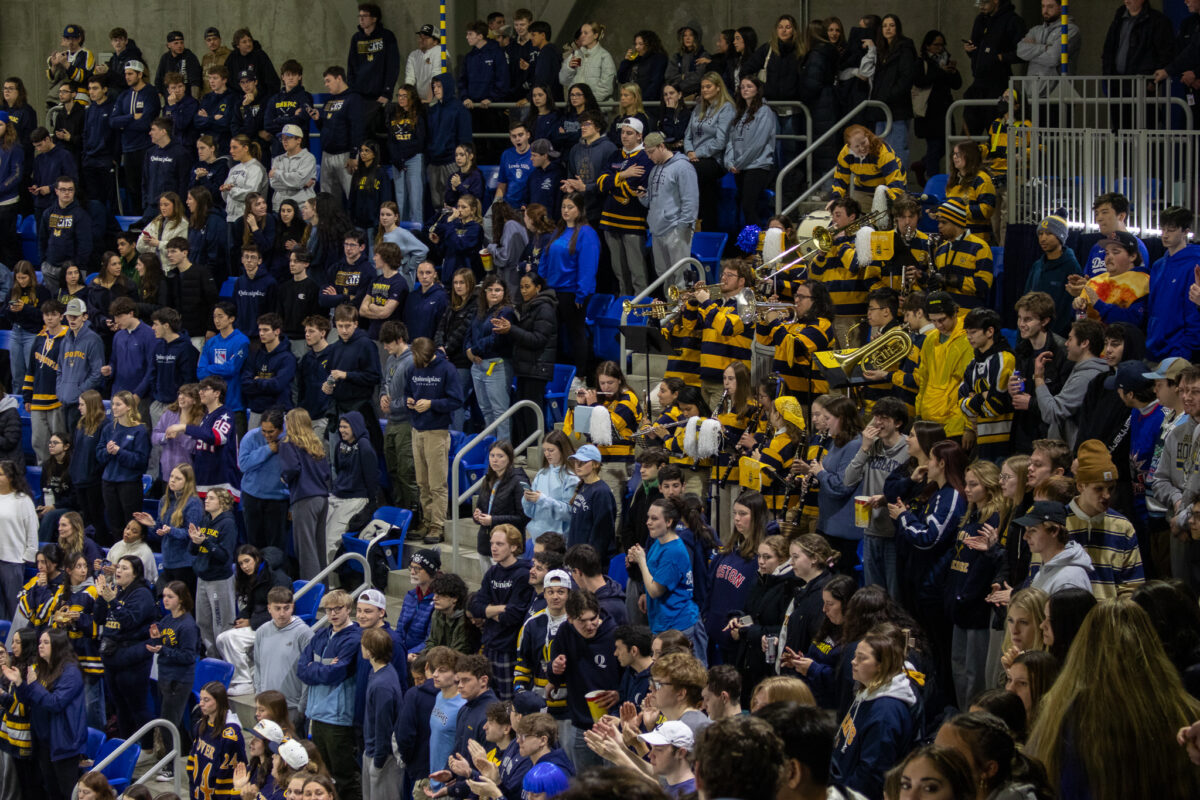
Despite these similarities, the Quinnipiac community simply doesn’t show up for their women like they do the men. According to US College Hockey Online’s attendance statistics, the Quinnipiac men’s hockey team ranked top 30 (28) in average attendance in 2025-26, and boasted a very respectable capacity percentage of 93. While the women are technically higher on their list at 23, but put up an embarrassing capacity percentage of 17.
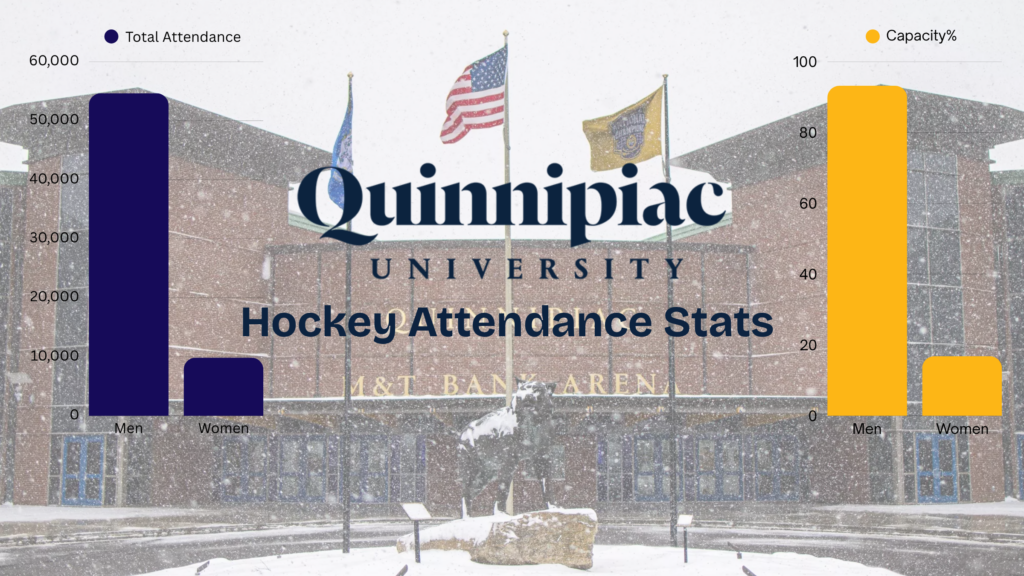
The problem is clear with just a quick glance at each table. In the top 50 schools for highest attendance at men’s hockey, only one program has a capacity percentage less than 50. For the top 50 women’s programs, only three schools post a capacity percentage above 50.
The reason for this dip feels simple on the surface, that men’s hockey is just the more popular sport, so of course more people will show up for it. However, when programs like Quinnipiac’s women don’t have access to prime time playing slots like the men, or receive an equal acclaim from the community for their achievements, there’s no wonder these numbers suffer. Yanity has seen this as a routine occurrence at Quinnipiac in particular.
“I see the Minnesota Frost, a three-time, PWHL champion, and Kendall Cooper, defender from Quinnipiac, is their first round pick, number six in the entire PWHL draft,” Yanity said. “If that had been a male player, it’d be everywhere, and that, to me, is disgusting. I just can’t even fathom that.”
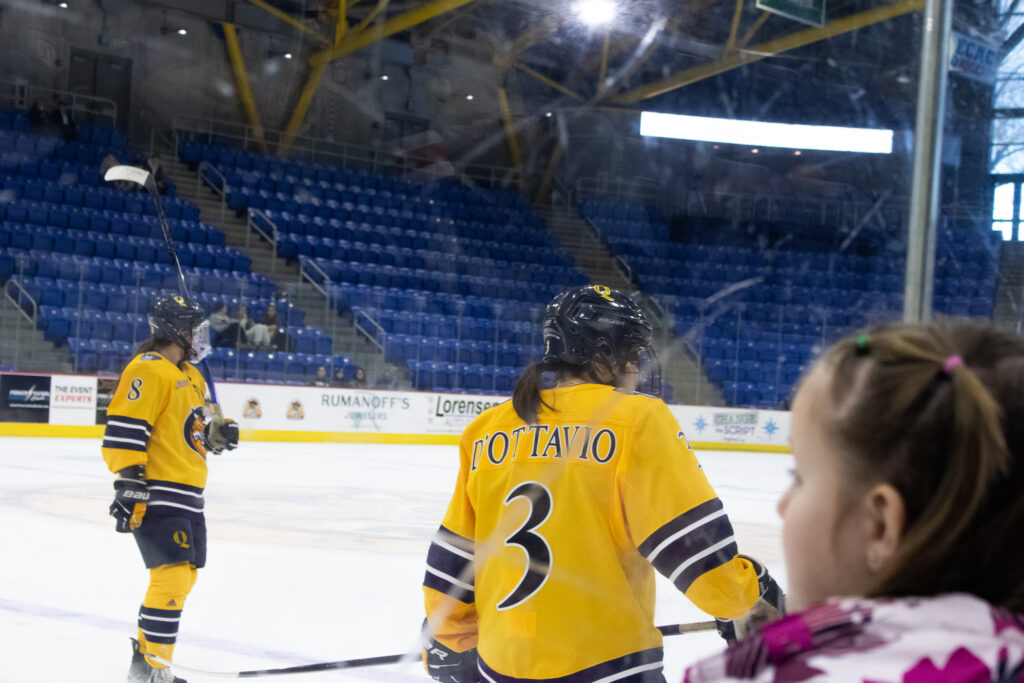
So how can Quinnipiac begin to truly embrace the tidal wave of women’s sports, and start to ride it toward more success instead of being washed away by it? Their Assistant Athletic Director, Marketing & Fan Engagement, Nick Simeone has taken on the challenge of finding new unique ways to get more butts in seats.
“I know that one thing that I think will be helpful going forward, is like trying to get community engagement with younger fans as well, to try to create lifelong Quinnipiac fans from a young age,” Simeone said. “This is actually something that the women’s hockey team approached me with when I took over.”
That aspect of community engagement is the real key. If fans don’t have an emotional or personal connection to the team they’re rooting for, why would they care to leave their house to get to a game?
One of those crucial community pillars is Quinnipiac’s pep band, one of few fully volunteer programs in the country. They attend every single men’s and women’s hockey game in any given year, barring rare specific time conflicts. Graduate student and Pep Band Director Becca Steeves has seen how much the teams care for each other firsthand.
“They do both have games each year where this year they wore the other team’s jerseys,” Steeves said. “That was really, really cool, very cute. And something that I loved is that the men’s team wears the jerseys backwards sometimes, so you see the [women’s] players names and numbers, which I think says a lot about their respect.”
While pep band doesn’t often engage in club level sports, they made an exception for the new women’s club hockey team. Junior Entry-Level Master’s Physician Assistant Katie Potter (below right) helped forge the club in her freshman year, and in just two quick years, they made semifinals at their national tournament.
Potter came to Quinnipiac an avid fan of both hockey and the environment, but the itch to play was starting to become too much to bear. She tried club lacrosse, but it wasn’t that satisfying click that she was looking for. After she and three fellow Quinnipiac students worked to get the club off the ground, it was difficult for her not to recognize how much of a force the men’s club hockey team brought to the fold.
“[Men’s club hockey] always had this empire and could get people every single year,” Potter said. “They have like 80 kids try out every year for their team. It’s absurd, the amount of people. They do like three day tryouts, and they have to cut kids every single time, so it’s very competitive. So in then, in contrast, no one has even seemed to have thought of forming a women’s club ice hockey team, at least maybe it was up in the air when we created the club sports here.”
On the other hand, President of Men’s Club Hockey, senior 3+1 finance major Brandon Cuccaro found the inclusion of his club on campus to be a crucial one.
“I have played hockey ever since I was six years old and have been skating since three. Hockey was a large part of why I chose QU,” Cuccaro said. “I wanted to continue playing hockey post high school so having the club team option was huge for me. It’s something that helps you make friends on campus, stay in shape.”
The fact that the club team has been around since 2012-13 means it took well over a decade for Quinnipiac to finally see their women’s team in action. Despite the team’s eventual addition a decade later alongside a women’s club basketball team, it remains clear that Quinnipiac and its community aren’t ready to consume or push their sports in a truly equal way.
You can only get there through baby steps, by nurturing your community and building for families. You need to showcase your athletes as active community members. And you need to uplift the women’s unique flair.
“Full stop, the game is played differently,” said Sardi. “If you’re watching a women’s game, it’s going to look different in terms of the strategy, in terms of the technicality, in terms of the types of moves that they’re going to do, right? And so I think part of that is also when you don’t grow up watching that or playing it yourself, then you don’t even know what you’re looking for.”