
Disclaimer: This story discusses the topic of suicide
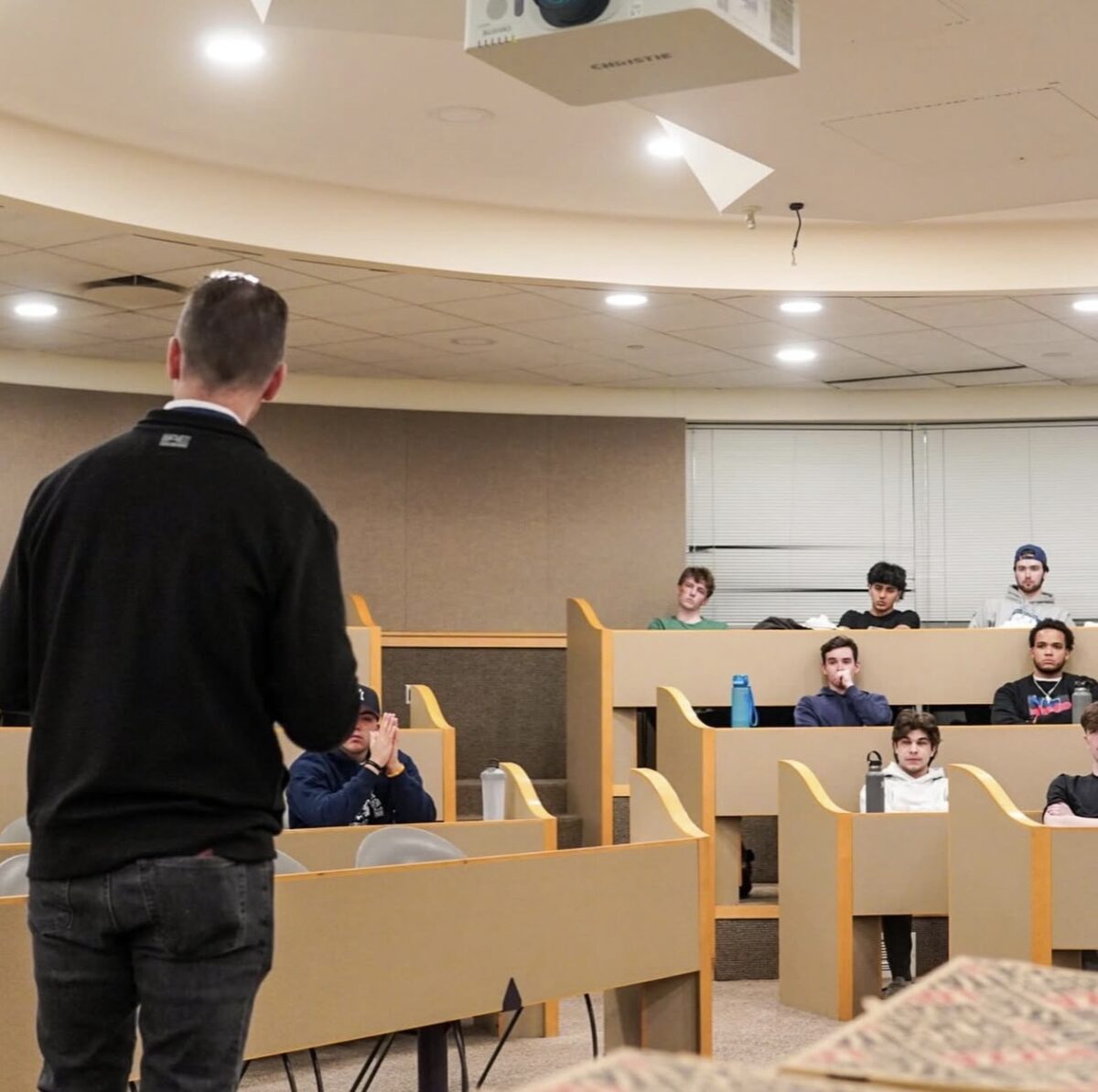
It’s lunchtime on a Thursday in mid-February at Quinnipiac University in Hamden, Connecticut. Most students are busy hustling to class, bundled up to withstand the frigid Connecticut winter temperatures. But inside an empty classroom on the Mount Carmel campus, people are gathering for an occasion with a deeper meaning than just a simple meeting.
They are students, staff, faculty, peers, strangers even, ready to enjoy a pie of pizza. Now take a slice of this pizza for example; the crust, a foundation just like the organization bringing these strangers together in the first place. The cheese and sauce, a staple of conversation like that of what occurs in these gatherings. The toppings, some savory and some difficult to swallow, a perfect resemblance of the personal vulnerability that is shared and for lack of a better word, eaten, by individuals who took a chance and showed up. While you may have never heard of a gathering like this, The Pizza Project at Quinnipiac University has been cultivating conversation and offering pizza to those who are willing to share a slice and share a story.
While The Pizza Project has blossomed in Hamden thanks to the foundation built by Quinnipiac junior Riley Renke, its origins lie four hours west in Lancaster, Pennsylvania at Franklin & Marshall college with Riley’s older sister, Braden. The organization was founded just two weeks after the passing of Braden and Riley’s father, Steve, who sadly died by suicide in 2018.
“My goal was to create something that could help connect every student of any background with resources and help to break the stigma surrounding mental health, by normalizing asking for help,” Braden said. Before its formation into a non-profit, the organization began as a simple Instagram account, run by Braden, a freshman at the time, who took to posting mental health resources and quotes while simultaneously spending her own money made from an on-campus job to buy pizza from local Lancaster pizza spots to offer to students.
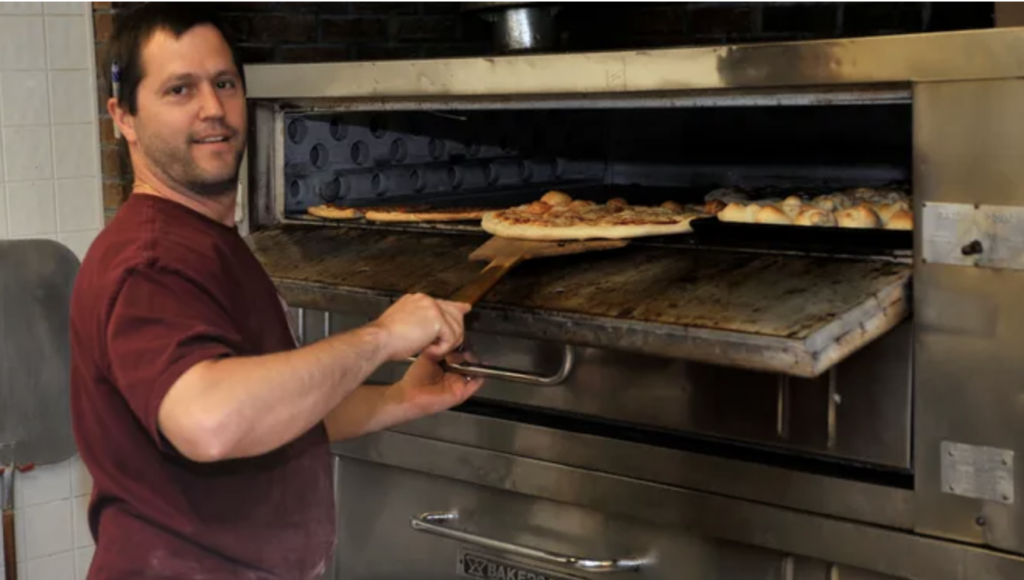
For Braden, the idea of using pizza as a force for good was simple. “[The Pizza Project] only purchased local pizza as a way to support small businesses like my dad’s pizzeria, Demarest Pizzeria, which he owned and ran for over 25 years,” she said.
Quickly, The Pizza Project became a staple of Franklin & Marshall College, partnering with a vast number of campus clubs and organizations and even other entities like the Benjamin Rush Foundation, an organization focused on strengthening medical relationships between doctor and patient.
While supporting local small businesses and her university community was important, Braden made sure that The Pizza Project was connecting and supporting mental health on a larger scale, by raising money for The America Foundation for Suicide Prevention, FEMA, and Mental Health America, where Braden interned during her academic career.
In the growth of The Pizza Project, the organization made the jump from a venture focused on awareness to a full-fledged 501(c)(3) non-profit. Braden says it cannot be understated how impressive this jump was for the Pizza Project. Being recognized as a charitable non-profit by the government takes loads of energy and time, showing how big of an impact the organization was making at the university.
When Braden left Franklin & Marshall to continue her academic studies in graduate school at George Washington University, The Pizza Project did not skip a beat. Her strong standing with the GWU community and connections through Mental Health America helped her carry out the message of The Pizza Project seamlessly.
“[Mental Health America] was very diverse, and I learned a lot from people of all walks of life, which I feel strengthened my ability to support people through The Pizza Project since our goal was to never turn anyone away that sought out mental health support,” said Braden. Her impact on both university and local communities was immense shedding light on struggles that many in our society face every day.
As time moved, so did Braden as she graduated from George Washington University and became an active-duty psychiatric nurse in the Navy. And while The Pizza Project did not lose its impact, it found itself ready for a new direction.
“I am proud I was able to create something so meaningful in my dad’s memory.”
-Braden Renke
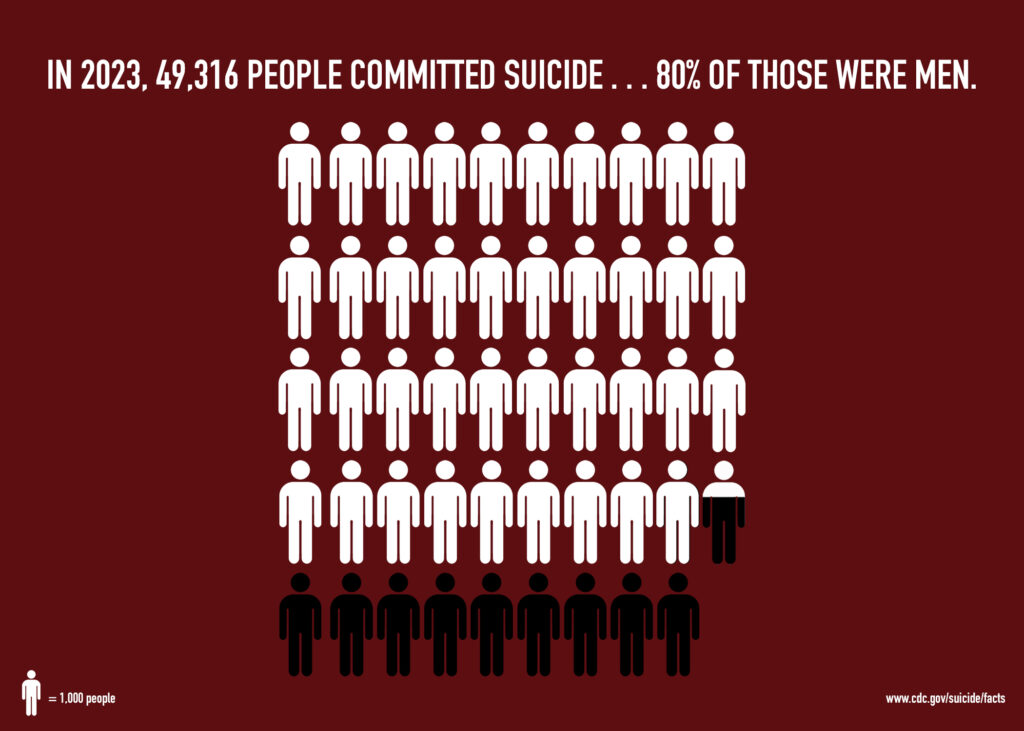
Integrating and opening discussion about mental health is a challenging feat for an organization like the one Braden worked so hard to create. The data on suicide and mental health trends in the United States sheds light on why organizations like The Pizza Project are so important. Suicide rates in the country increased 37% from 2000 to 2022, with a suicide death occurring roughly every 11 minutes in the United States according to the Centers for Disease Control and Prevention.
And the data goes deeper than just suicide rates. According to the National Institutes of Health, roughly one in every five adults lives with a mental illness, with higher rates in those ages 18-24 (36.2% in 2022) than that of adults ages 25-49 (29.4% in 2022). But when reading in between the lines there is a subset demographic that faces mental health struggles more than any other, that being men.
The CDC reports that roughly one in every 10 men deal with depression and anxiety in their lifetime, but less than half will seek or receive support or mental health care. And as mentioned previously, these rates are especially volatile in young adults, specifically ages 18-24, which may be better represented by the title, “the college years.”
One of Quinnipiac University’s licensed counselors, Christine Chew, believes mental health struggles in men come from social constructs. “I think a lot of times men are sort of socialized into more action-oriented things, rather than sort of expressing emotions or talking about emotions… in our society, men being angry or getting into a fight, or men having too much to drink, is sort of ‘boys will be boys,’ as opposed to, hey, what’s going on with this guy that he’s engaging in these behaviors, or he’s doing these things,” she said.
Chew, her colleagues and countless other counseling professionals in universities, are noticing what commonly falls under a blind eye; mental health struggles in men are a very prevalent problem. And what both researchers and counseling professionals are noting is that the struggle faces layers of difficulty. That being both the social constructs that bind individuals and the stigmas around seeking professional and peer support. “I think that another piece of your generation is there’s a missing social connectedness that may be internet driven…not only is it sort of an access point or an opening to the idea of professional help, but it also may be sort of curative, in and of itself, to have a supportive group of peers where you can have real conversations,” said Chew.
Quinnipiac’s counseling and mental health services are of high-quality by any university or college standard. It has been recognized as a partner campus with the JED Foundation who provide mental health resources to universities nationwide. But the awareness of mental health struggles in men goes further into the echelons of the university than professional services. Quinnipiac’s Chief Experience Officer, Tom Ellett, is an avid supporter of mental health initiatives at the university and beyond. Ellett is a licensed life coach outside of his university duties and is keen on supporting those around him. “One of the things I constantly try to do, is connect people from different walks of life here and at other places I’ve been and I think that’s important to do,” Ellett said.
Now fast-forward to 2024, where Braden’s younger brother Riley’s journey with The Pizza Project began. Riley’s testament followed the same as his sister’s: bring awareness and support to those on campus while breaking down stigmas in the form of conversation and pizza.
“Randomly last year it came to me. I was like, I should bring the pizza project here and you know, it was this whole thing that gives me a purpose,” said Riley. After some time building awareness of The Pizza Project’s on campus and beginning to follow in the footsteps of his sister, Riley began hosting events on campus beyond just giving out free pizza. In the first year of its existence at Quinnipiac University, the organization hosted a “Spike Away Stigma” spike ball tournament as well as introducing their “Pizza for 8” conversational series, both of which brought strangers together from all walks of life on campus in the name of awareness.
“At Pizza by 8 there were a lot of people from different backgrounds that I never talked to before, so that experience, being able to talk with people you wouldn’t normally communicate with on a regular basis was really eye opening,” said Ben Busillo, a junior at Quinnipiac University who is a regular attendee of Pizza Project events.
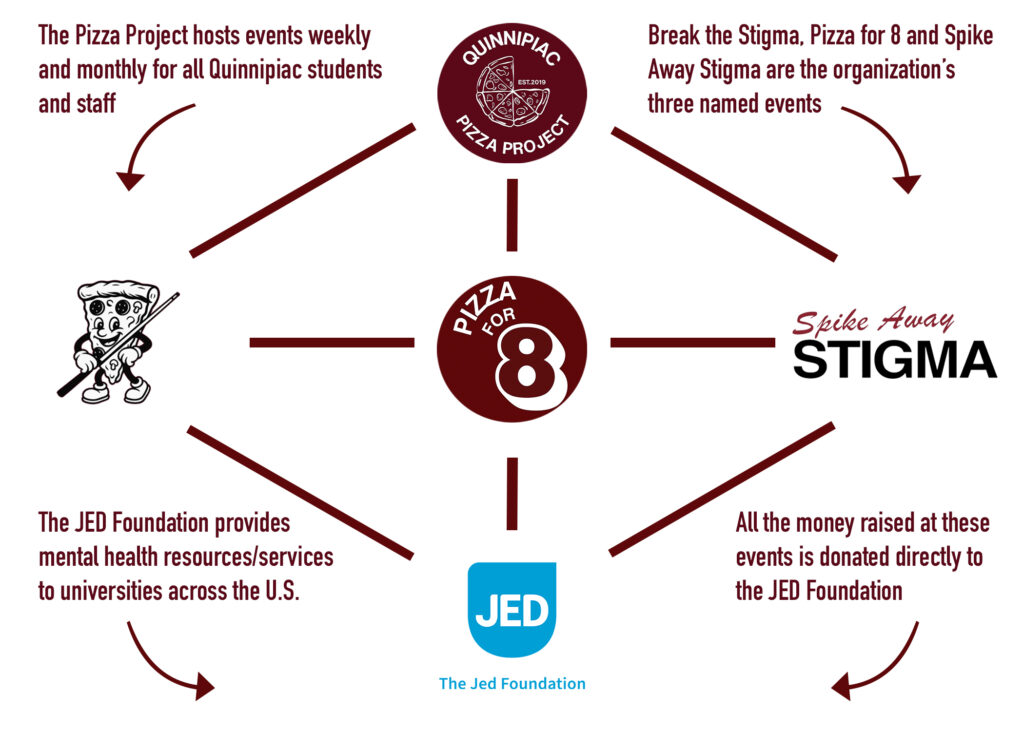
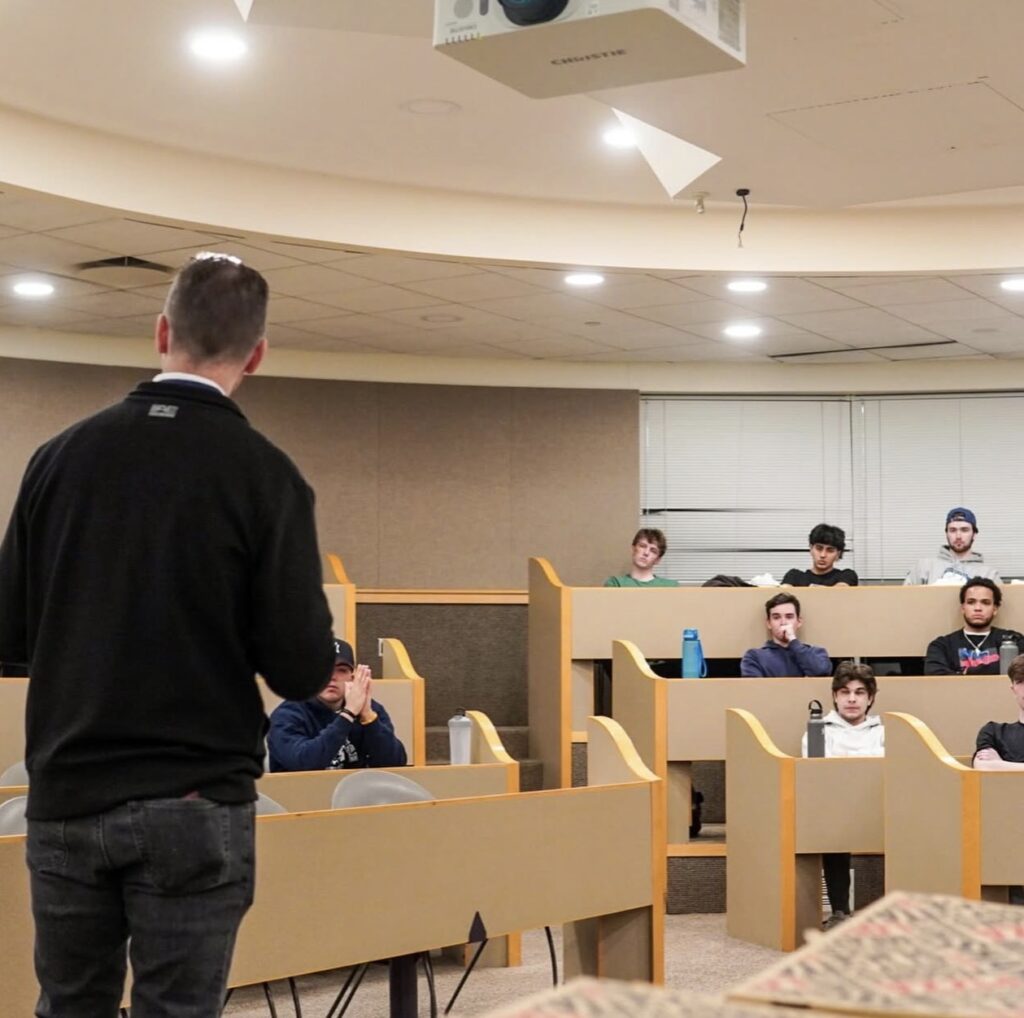
Even as The Pizza Project has spread around campus the sentiment of what the organization aims to do has remained. Riley’s drive to spread awareness caught the attention of many at Quinnipiac and helped The Pizza Project to thrive in its events and fundraisers. One of those eyes that noticed the organization’s potential and positive impact was Ellett, who was the honored guest speaker of one of the first general meetings. “I think it’s a privilege whenever you’re invited to speak to students on any particular topic,” said Ellett. “I took it seriously, and I had to kind of think about which particular life experiences I may open up the audience to think about.”
Hear more from Tom Ellett’s perspective on growing and learning from mental health struggles
Riley, who has a close connection with Ellett was blown away by his oration and understood the value of what it brought to The Pizza Project. “The room was almost completely full. And what I loved so much about this meeting was every single person in that room, man, woman, everyone, was completely locked in on every single word Tom was saying. It was incredibly powerful.” That among many other testaments from students and staff rang out as The Pizza Project continued its mission.
“The Pizza Project has given me a sense of clarity and purpose, and I wouldn’t trade it for the world.”
-Riley Renke
Recently, The Pizza Project has continued to be a thriving organization on campus in hopes to grow onto other campuses and reach more people to spread the awareness of men’s mental health struggles and break down stigmas. Riley, and his newly elected executive board, have kept up with their note-worthy events, with the recent Spike Away Stigma tournament concluding and monthly Pizza by 8 events bringing in all new people from around the community.
The expansion of the organization’s executive leaders offered an opportunity for those who share Riley’s passion to become more involved. “I realized that an organization like this is limitless,” said Jesse Steinvurzel, the now president of The Pizza Project. “The idea that I could be a real contributing officer to the operations and the events that we hold, it just felt like an opportunity I couldn’t pass up.”
Hear more from Jesse about some things Riley and The Pizza Project taught him about mental health
As the organization heads into the future with individuals like Riley and Jesse at the helm, there is strong belief that the Pizza Project’s impact will span farther than the confines of the Mount Carmel campus. “We had a collective goal that we wanted to branch out to other schools…we’ve broken down one barrier, and it has opened our horizons incredibly,” said Jesse. And from Riley, there is a reminder that The Pizza Project will always be a place for support for everyone. “I really hope that when people think of our organization, they just think that it’s normal for me to have a mental health problem, because everybody does…people really can be able to learn and help from others,” he said.
Hear more from Riley about how pizza can facilitate conversation
So, the next time you walk by a room filled with people and a box of pizza, consider the limitless potential of what some cheese, bread, a cardboard box, and a fruitful conversation can do to help support those who are facing struggles that cannot be seen.
Quinnipiac offers students mental health services and support seven days a week via in-person or virtual appointment, and free of cost. Students can book appointments or talk to a specialist online https://www.qu.edu/student-life/health-and-wellness/counseling-and-mental-health-services/ or by phone (203) 407-4020. For immediate 24/7 support, dial or text 988 for the National Suicide and Crisis Lifeline
One reply on “More than a slice”
A powerful testimony to the resilience of children who grow up to embody a legacy born out of incredible pain and the desire for clarity. Having known Steve, it is no surprise to me that his children would create and embrace a project as simple and as powerful as the pizza project. I also deeply appreciate the Language that has been used consistently and respectfully throughout this article. Death by suicide etc. It is dignified and human. I miss Steve and he also created this massive container for healing regardless of circumstance. Love on your peeps ❤️🙏🏽❤️and thank you to the entire Renke Family