
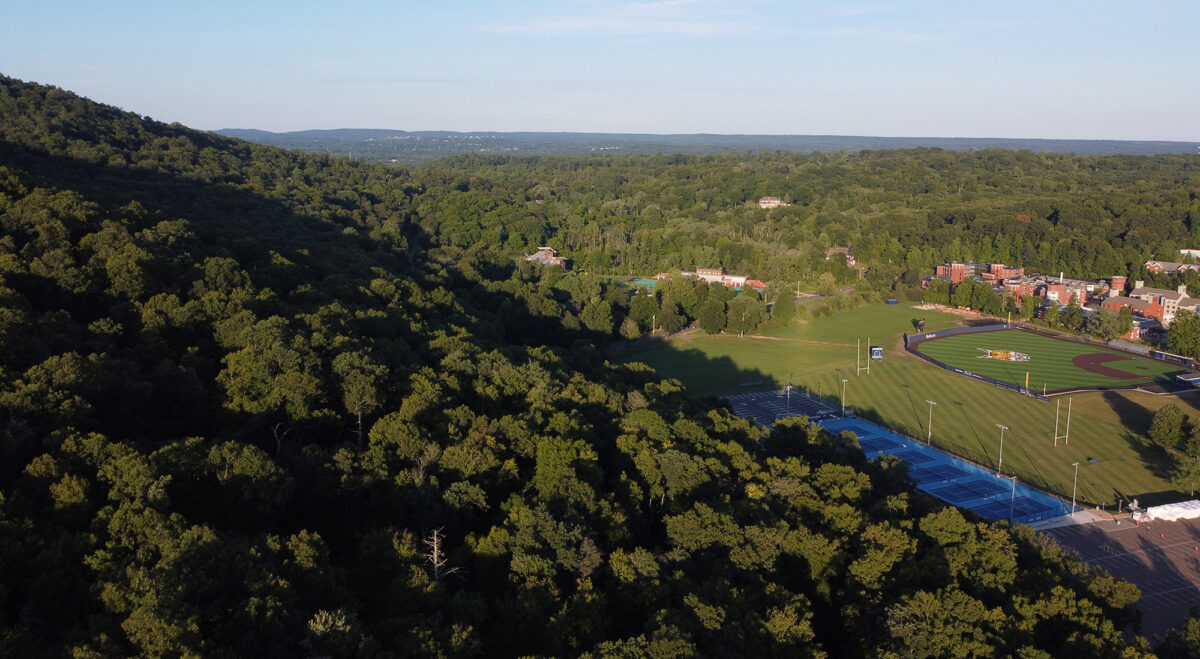
Not all giants are sleeping, or even giants for that matter. At the foot of Sleeping Giant State Park, quiet predators move through a landscape of 32 miles of winding trails, dense forest and open land.
The quiet is deceptive. Early in the morning, flashes of tawny fur dart before vanishing into the brush of the Sleeping Giant. By dusk, coyotes start to call from the tree lines, their howls echoing off the Giant into the nearby neighborhoods. After dark, black bears emerge from the forest, wandering the edges of backyards and neighborhoods. Many people never see them, moving through the same landscape as the hikers who pass through the park every day.
Once hunted almost to elimination from Connecticut, these predators are returning to a landscape that they once dominated.
A century or more ago, this coexistence was not possible.
For generations, Connecticut residents viewed its predators as threats to their livelihood that needed to be eliminated. Mountain lions and wolves were pushed out of the state, bobcats were hunted under a state-sanctioned bounty and black bears were also pushed out of the forests. Today, those forests are home to a new set of predators as conservation policies, recovering forests and changing landscapes have made coexistence possible.
That transformation and coexistence is most visible in and around Sleeping Giant State Park, where the edge of the Giant’s forest merges into neighborhoods, farms, and Quinnipiac University. The new set of predators, bobcats, coyotes and bears, now move through the same landscape as people, adapting to a new set of boundaries of coexistence in Hamden.
This is something that lifelong residents are witnessing firsthand. Park naturalist and Sleeping Giant State Park board member Gail Cameron is one of those residents who is witnessing the flourishing of bobcats.
“Honestly, as a kid, we didn’t see the wildlife we see now,” she said. “Now, it’s really exciting. They’re thriving here.”
The Department of Energy and Environmental Protection (DEEP) Wildlife Division, records show how widespread bobcat sightings have become across Connecticut. In 2016, hunters reported 2,690 bobcat sightings across 161 towns. In the following year, the number increased to 3,249 across 151 towns. More recent data indicates that bobcats live in all eight Connecticut counties, but are most heavily in northwestern Connecticut.
DEEP’s numbers are not an exact count of Connecticut’s bobcat population, but it is a snapshot of how frequently and widely the predators are being seen. DEEP began its official statewide bobcat project in 2017, using public sightings, vehicle kill reports and GPS tracking to better understand their distribution and abundance.
Cameron has volunteered for the DEEP, studied alongside them and gone into the field to gain first hand experience handling and tracking bobcats.
“They’re stealth hunters,” she said. “You may catch a glimpse of them running off, but they have very good camouflage so they can just blend into the landscape.”
While these predators are learning and building the coexistence with people, there is a distinction between the behavior of the three.
“Bears will come into yards for trash and for birdfeeders but coyotes are quite bold. They’re not as fearsome of people,” she said.
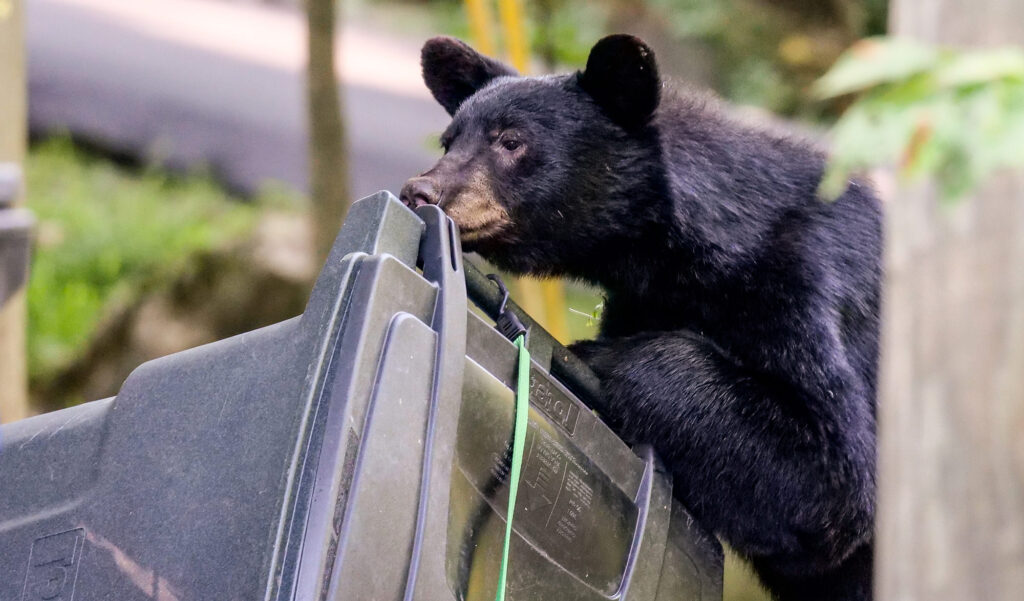
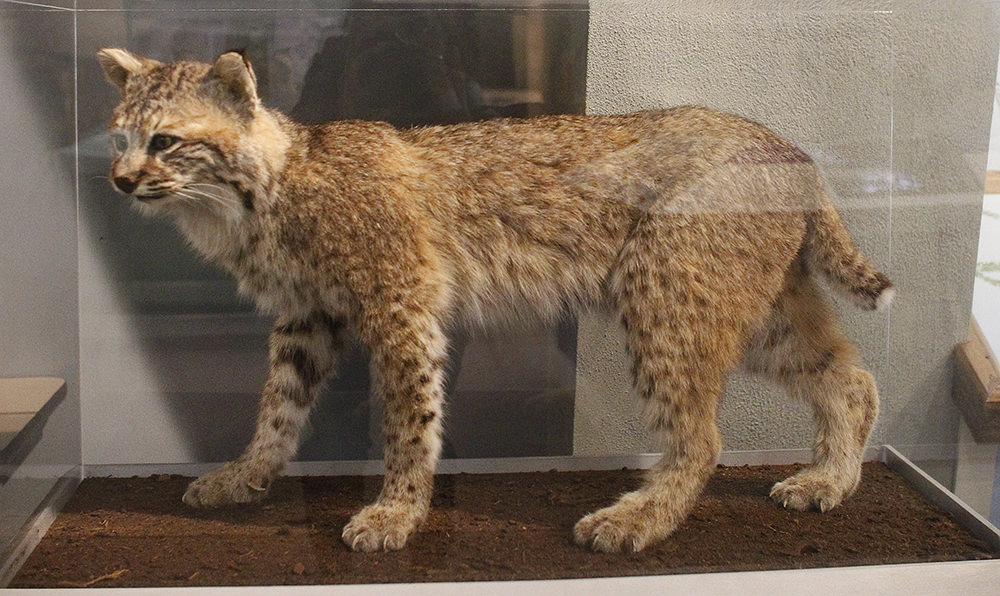
Jason Hawley, DEEP’s Supervising Wildlife Specialist, studies Connecticut’s wildlife and has observed these predators’ behaviors firsthand. He explained that bobcats are similar to bears, in that they may be seen in backyards passing through and scoping out the area, but they don’t have a desire to interact with humans. That’s the common denominator between the three. People are bound to see them in their yards, all having different reasons to be there and different behaviors, but they generally don’t have any inclination to interact with people.
All around Sleeping Giant State Park’s trails there are signs stating “Be Bear Aware,” giving guidance on hiking safely and what to do if one walks onto the trail. Out of all the predators, there are only signs about bears, not bobcats or coyotes. There are a few reasons for that, but while black bears are generally docile and don’t interact with humans, caution is still needed when in their habitat.
“Bears have learned to associate people with food, that’s why you have to be a little more careful,” Cameron said.
But even if there aren’t signs about bobcats or coyotes, that doesn’t make them any less dangerous. Hikers are guests to the Giant. The Giant belongs to the predators and creatures that live within it, and so there is common knowledge to not go around and provoke what is living there.
“We can’t post signs about everything. But if there were an issue, it would be different and with bobcats, there really isn’t,” Cameron said.
Cameron described an unspoken wildlife etiquette that comes with sharing the landscape of Sleeping Giant: Give wildlife space, even if it wanders into the backyard. The rules aren’t written for bobcats, coyotes or bears, but they exist all the same; shaped by decades of conservation, education and a developing attitude from the human population.
From bounties to conservation
Connecticut’s relationship with predators is forever evolving and adapting to the state’s landscape, culture and laws. The balance between predators and people is very much different than it was 50 to 100 years ago.
“Connecticut has kind of a very negative past, with our relationship with predators,” Hawley said. Back in the 1600s when European settlers were arriving in Connecticut, the apex predators at the time were mountain lions, wolves and sometimes bears. Hawley said these animals were seen as more than competition; they were seen as threats to European settlers’ livestock and children.
“The larger predators tend to take the brunt of that,” Hawley said. “Wolves, mountain lions, and bears were pretty much fully extirpated from Connecticut by the mid 1800’s.”
As Connecticut industrialized, agriculture declined and abandoned farmland began returning to forest. That landscape change combined with later conservation protections, gave wildlife more habitat to recover. Because of the Industrial Revolution, many residents moved away from agriculture and this gave the landscape an opportunity to regrow and work on getting back to what it was. Alongside the Revolution, the Endangered Species Act was enacted in 1973, meaning that a lot of animals, including the predators, received official protection.
But while they became protected, it doesn’t erase all the damage that had already been done.
“What had happened was populations of wolves and mountain lions had been pushed so far back,” Hawley said. “I mean, essentially gone from the east coast. There’s really no chance of recovery for those two species which would be our traditional apex predators.”
From 1935 until 1971, Connecticut had a state sanctioned bounty on bobcats, meaning the government paid residents cash for hunting them according to DEEP’s bobcat fact sheet. Similar to the 1600s with mountain lions and wolves, bobcats were seen as pests and threats to livestock, but their pelts were also considered valuable. For 36 years, bobcats could legally be hunted for a bounty, placing a sustained pressure on the species across the state. When the legal protection to these predators passed, the forests and their habitats started to grow back and flourish. With mountain lions and wolves gone from Connecticut, it gave bobcats the opportunity to come in and take their place as a top predator.
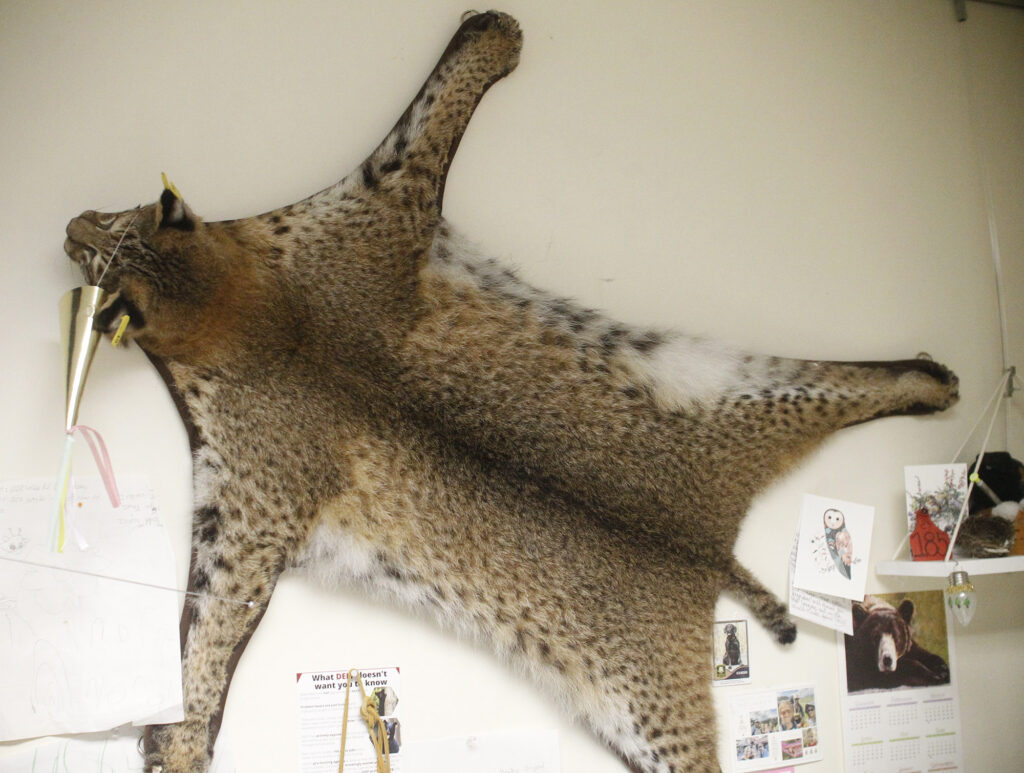
“We don’t know if bobcats were fully extirpated from Connecticut. We think there was a small remnant population in the northwest part of the state,” Hawley said.
Since gaining legal protection, bobcats have recolonized most of the state according to Hawley. DEEP estimates that the bobcat population is roughly around 3,000 to 4,000 throughout the whole state, Cameron said.
“They’re a pretty adaptable animal. We kind of saw the same process with bears,” Hawley said.
When mountain lions and wolves disappeared from Connecticut, Hawley explained that bears followed a different path. While they were not in Connecticut, Hawley said, a population persisted in Western Massachusetts and that’s where the state’s current bear population came from. According to Hawley, it was a range expansion on their part from Western Mass down into northwestern Connecticut and it has continued to expand from there. But the biggest difference between bears and other predators is that they are not fully considered to be a true apex predator.
“A bear’s diet is about 80% vegetarian meaning they aren’t going to be considered an apex predator but they certainly have the ability to,” Hawley said.
Black bears can reach five to six feet long and the males can weigh up to 550 pounds where the females go to 300 pounds. While they are big in size and have the ability to kill and can kill pretty easily, they are docile animals. Bears, alongside bobcats, are a protected species as well. They have no hunting or trapping season.
And so, while they are protected and thriving, there are a multitude of reasons as to why they are being noticed more by people.
Hamden resident Sarah Mulhall remembers one black bear in particular: Gourdy, a name she and her partner gave him after he consistently raided their porch for pumpkins.
“We would always buy two pumpkins, they would flank our front door. He would always just take both of them and devour them,”
For Mulhall, Gourdy was more than a passing sighting. His presence became familiar and made what might have once been a rare encounter into an ordinary part of life at home.
Why predators are returning
Legal protections gave Connecticut’s predators a second chance at living and thriving in the landscape, but protection alone could not guarantee their return. Connecticut ended its bobcat bounty in 1971 and classified the species as a protected furbear the next year. Similar protections over time limited the killing of other predators as attitudes towards wildlife evolved. But conservation laws could not rebuild the ecosystems those predators depended on. Their recovery relies on mainly three components: water, cover and prey. And with Connecticut’s changing landscape, especially around Sleeping Giant, there is an abundance of those components.
Jason Hawley, the DEEP wildlife expert, thinks of it from the perspective of the predator.
“When people ask me, ‘why am I seeing more bobcats?’ My answer is well, it’s always those three things,” he said. “If you have that, then a bobcat’s gonna be there.”
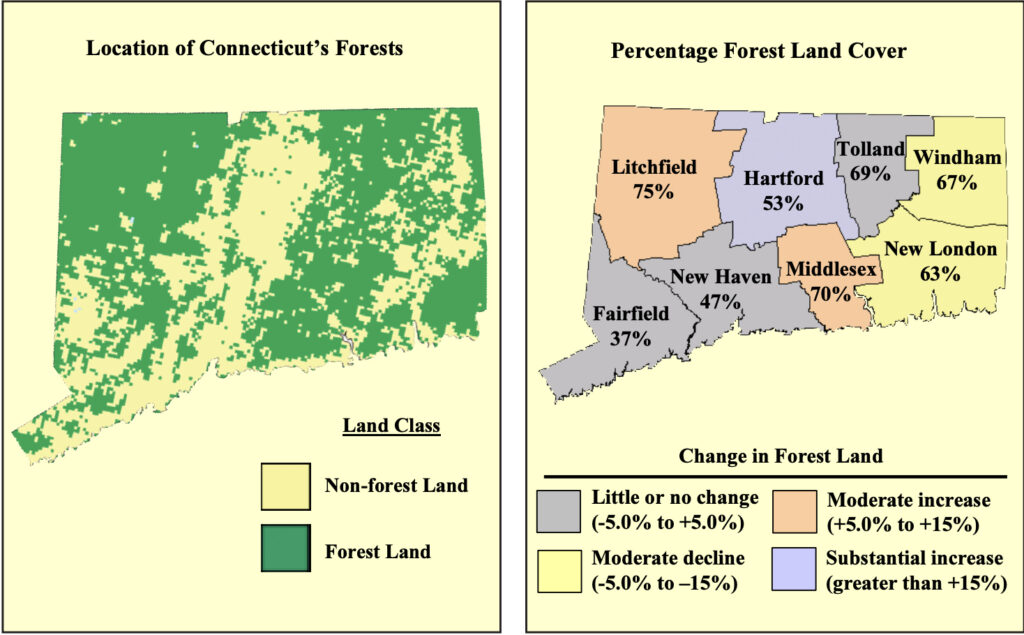
Connecticut’s history offers another explanation as to why these predators are flourishing. According to the Connecticut Council on Environmental Quality’s (CEQ) 2025 annual report, forests cover about 58% of the state’s land, based on the most recent 2024 forest inventory. That is more than twice the roughly 25% of the state that was forested in 1825, according to DEEP. Widespread agriculture and timber harvesting during the 1800’s stripped most of the state’s forests, reducing habitats for bobcats and other wildlife. As forests returned, so did the habitats that predators depended on.
Climate change is another factor that may be contributing to the increased presence of some predators year round.
“The warmer winters are creating a domino effect for bobcats,” said Oswald Schmitz, the Oastler Professor of Population and Community Ecology at Yale University.
The state’s average temperature has increased by 2.2 degrees in the past 125 years, according to a DEEP report.
“With warmer winters, the prey base that these bobcats eat survive better,” Schmitz said.
A similar sequence can be observed with coyotes, as their diet also included small mammals that become more active during milder winters. With less snow covering land and warmer temperatures, small rodents are more active in the winter, providing better hunting conditions. Schmitz said that predators, such as bobcats, thrive when ecosystems are more stable which warmer winters are providing. While the climate is changing, so is the behavior of the predators.
Hawley said that these predators are becoming more bold with their actions but out of curiosity.
“Think of it from a bobcat’s perspective, if everywhere you go you’re smelling a person, you’re hearing a person, you’re seeing a person and there are no negative consequences,” he said.
They are going to become more bold with their actions and behavior. The same applies towards bears. Hawley said that many interactions between bears and humans, generally nothing bad happens to either party.
“In fact, usually something really good happens to you because there tends to be food around people,” Hawley said. A bear or predator could not live or thrive in a state where it is always running away from something.
This is where the act of habituation comes into play. There generally tends to be a higher concentration of food near human development as many people have yards with some hedges separating their yard from others and that provides good cover for these predators.
“They may even have a bird feeder out, and the squirrels are all coming out near their yard,” Hawley said. This is creating opportunities for these stealth hunters to get a meal or even more.
“So, from a bobcat’s perspective, it’s everything you need right there,” Hawley said.
And so every time they hunt or wander through the yard, nothing bad is happening to them and sometimes there is a positive outcome from it all, a meal.
“They are becoming more comfortable around people because people are everywhere and people tend to live where the food is,” he said.
Despite adapting around humans and learning a level of coexistence, Connecticut’s predators are still, at heart, wild animals. Sleeping Giant State Park remains one of their habitats in the state, its miles of uninterrupted forest continues to provide the main three things to key survival; cover, prey and water. But predators don’t recognize park boundaries, to them they don’t know when the Giant’s edges starts or stops. A bear, bobcat or coyote wandering from cover to cover isn’t aware that one cover may be someone’s backyard, to them the landscape is never ending. And that is because the landscape surrounding Sleeping Giant has changed. Rather than ending at the edge of the forest, it blends into neighborhoods, farms and Quinnipiac University, creating what Schmitz described as “woodburbs.”
The making of ‘woodburbs‘
Forests don’t just stop where Sleeping Giant trails end. Around Sleeping Giant, wooded ridgelines fade into subdivisions, hiking trails blend into sidewalks and Quinnipiac University sits next to both. To people, these are distinctly separate places. To a bobcat, coyote or bear, they are simply different parts of the same landscape. The boundaries that humans see mean much less than the availability of prey, cover and water. If those components exist, the predators will continue to move through the landscape, regardless of what we may consider “park lines” or someone’s property.
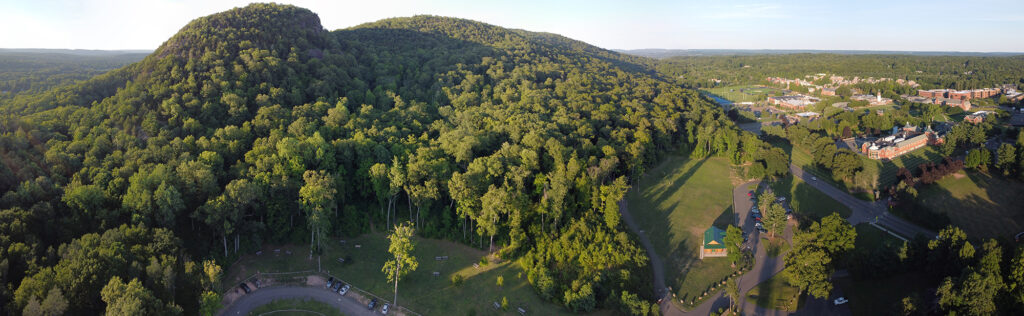
These “woodburbs,” as Schmitz described, is where suburban development and natural habitats overlap instead of existing outside of one another. This patchwork of forests, farms, backyards and wooded areas have created ideal conditions for many of Connecticut’s predators. Connecticut residents are developing and building more into heavily forested areas and woodlands, inserting themselves into a habitat that used to belong to four-legged species.
“Bobcats’ prey like the edge habitats,” said Schmitz. “So when we create these woodburbs, we are building more of these edge habitats, making them conducive for bobcats to thrive in rural areas.”
These zones, where two different ecosystems meet, are ideal for species that thrive in exposure but also vegetation that provides a protective cover.
Leah Hilton sees this firsthand on Nadeau Farm, not far from Sleeping Giant. Her farm sits where the dense forest is blending into the open landscape of development and farmland. Bobcats, coyotes and bears regularly move throughout her farmland but very rarely in a threatening manner. A majority of the time, these predators are crossing through people’s yard because it is on the way to the next heavily forested area. But these sightings and interactions Hilton has had is nothing new for her.
“They come from everywhere,” Hilton said. “They live in these woods all around our property.”
But while she is used to these interactions, she still takes precautions. She drives around Nadeau Farms with her multiple large guard dogs at her side, ready to warn off any predators that may come their way. Along with the guard dogs, she also has an electric fence that protects her livestock, but she has found that having the dogs proves to be a better defense as they have the primal instinct to mark their territory.
Schmitz said that this is part of the process of coexistence developing and that’s not because predators become more relaxed, but because predators and people are learning the boundaries of sharing the same landscape. Sleeping Giant has become more than just a state park. It has become a focal point of a larger landscape where a multiple of landscapes overlap, creating a shared ecosystem by all.
One of the bigger woodburbs next to Sleeping Giant is Quinnipiac University (QU) and with the landscape there being very intimately shared between predators and people, there are bound to be interactions. QU Public Safety Chief Othoneil Reyes has worked at Quinnipiac for four and a half years and throughout those years he has never heard of a bobcat attacking on campus. But it is always better to be safe than sorry and to educate students on what to do during an interaction.
“Anything we feel could be a threat to the community we put out for situational awareness,” Reyes said.
The public safety department will send out multiple notices to students and faculty whenever a bobcat, bear or coyote is spotted on or near campus. There are always three notices: a text, an email and a phone call and it always says where on Quinnipiac’s three campuses it was. Sometimes, very rarely, the sightings are passed through Hamden Animal Control or DEEP, but Hamden Animal Control clarified that bobcat sightings aren’t handled at the town level.
The constant alerts that Quinnipiac students receive are one of the clearest examples of how the rise of woodburbs have reshaped everyday life in Hamden. These predators are moving from forests to developed areas. They move every day between the Giant’s forests and trails, the neighborhoods, the campus and farms because in their eyes, all those places are connected and lead to another habitat.
The landscape has changed more than the predators have, they simply are adapting. Connecticut’s recovering forests, suburban growth and wildlife protection laws have created a new kind of landscape and habitat where people and predators live amongst themselves. As more residents move into the edges of Sleeping Giant, the coexistence is no longer a goal, it is a reality. Living alongside Sleeping Giant, means accepting an unspoken agreement of coexistence with the predators that call it home.
Living with predators/managing coexistence
For many, living in an area where there are forests and lots of wildlife, it is expected to come across a predator but that doesn’t always dismantle the surprise when one is actually seen.
“I was upstairs in the bedroom, I walked by the window and then it dawned on me that I just saw something,” Sarah Mulhall, a resident of Hamden for almost a decade explained. “There’s just a bear in our backyard, just standing there wandering around, just making his way around.”
Mulhall lives with her significant other, Coulson Hageman, as well as their mastiff dog, Achilles. While living in Hamden, they have had a few interactions with predators coming into their yard, specifically coyotes and now a black bear. Living with a 125-pound dog, they don’t really worry about predators coming too close to them or posing a threat.
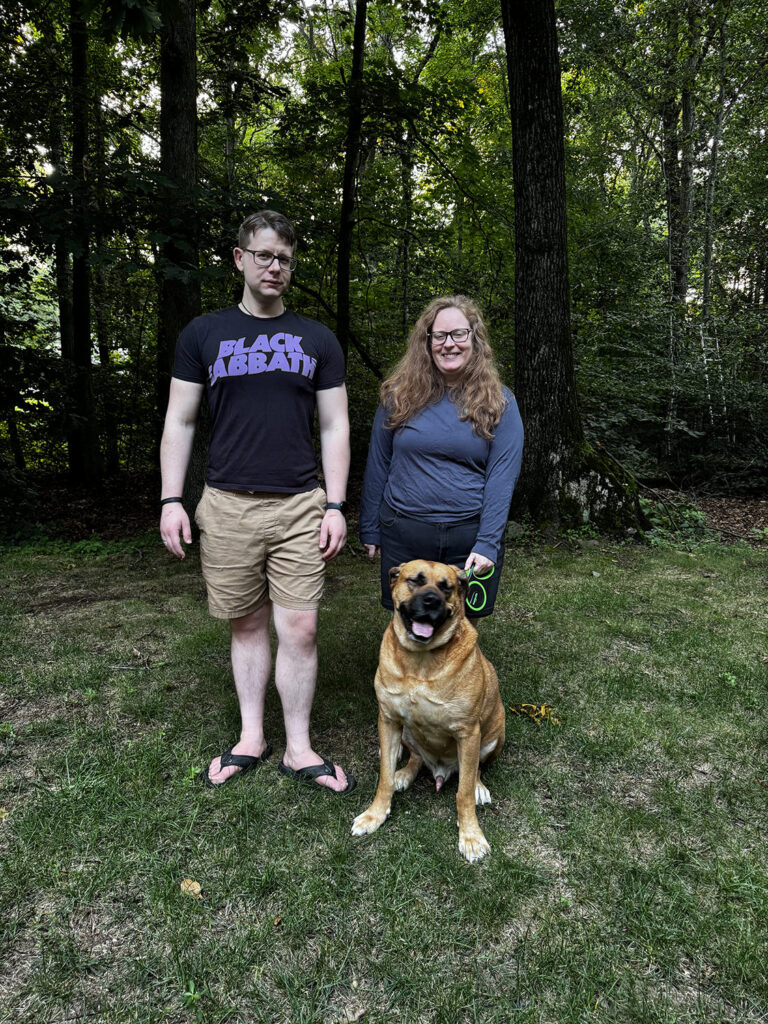
“Achilles was taking his pre-bedtime nap on the couch but then we heard this noise outside, about 50 feet away from the door,” Hageman said. “They sounded so close.”
Mulhall and Hageman stood on the deck for several minutes, listening and then they heard Achilles get up from the couch and walk over.
“He gets in front of us, his ears are pointed forward and then he lets out a single ‘woof’ not a bark, not a growl, a ‘woof,’” Hageman said.
The couple have had Achilles for just over a year, but they have never seen him react to predators in their yard. Immediately after Achilles sent what seems to have been a warning signal, the yipping stopped and didn’t start again.
The biggest difference between these three main predators is how they interact with backyards. While a bear may go after a bird feeder itself, a bobcat is going to stalk what is under it.
“The squirrels are all coming out, their yard is a perfect cottontail habitat, they may have some pet food, and the possums and raccoons are coming to that, so from a bobcat’s perspective, it’s everything you need,” Hawley said.
So, while bears are going after the trash and the seed, bobcats and even coyotes are attracted to the prey that gathers because of it. To a predator, a backyard isn’t just a yard, it’s part of the food chain.
Anyone who lives around Sleeping Giant and in Hamden sees these predators in backyards even if it isn’t theirs. Ring communities are filled with people posting sightings of bears, coyotes and bobcats roaming around their yard, getting into their trash or even just crossing the road. These posts, often shared through Ring’s neighborhood platform, are to make people in the area aware of what’s around, what is potentially dangerous, and how they have interacted with them. But, while many think seeing these predators in their yard are cute, there is a negative aspect.
“We don’t want bears to be comfortable around people’s houses,” Hawley said. “There is an old saying ‘if you care, scare the bear,’ because that’s what’s best for the bear.”
The more comfortable bears are in someone’s vicinity, the more potential there is for harm to either party. Hawley and DEEP recommend finding a way to scare the bear out of the yard, to make it a negative experience so they don’t come back, as that is the best for the bear. But, when hiking on trails in forests it’s something completely different.
“We recommend people make some noise, wave their arms, so the bear is aware of them because if you scare the bear, it might provoke it,” he said.
For hikers, the most important thing is to make their presence known. Bears require the most attention and caution because they are the most conditioned to food around people, whereas bobcats and coyotes are usually just passing through.
The return of predators does not mean that the work is finished. Coexistence depends just as much on human behavior, if not more, as it does on wildlife behavior. Every bird feeder, trash can and every person who approaches wildlife for any reason teaches the predators something about living around people. As people learn how to reduce negative interactions, they are also rethinking what it means to live alongside predators.
“There’s this perception that nature is red, tooth and claw and it isn’t.” Schmitz said. The conceptions that these predators are aggressive and will attack if seen are being debunked with every harmless interaction being made. Much of coexistence breaks down to respecting wildlife as it is, wildlife. Giving predators their space to move throughout the landscape without proactively encouraging them to stay. Around Sleeping Giant, that shared understanding has become just as important as the forests that support them.
The future of sharing the Giant
As the sun starts to set over Sleeping Giant State Park, the trails begin to empty. Families return to their cars, runners finish their last mile, headlights start to fade as they drive away and the forest grows quiet again. But for the predators that live in the Giant, their night is just beginning. Bobcats move silently throughout the trees, coyotes emerge from the ridgeline and black bears move along the trails looking for food.
For the people living around the park, those boundaries can be harder to see. A bobcat can cross from the forest into a backyard, a bear can move from the woods into a neighborhood in search of food. Coyotes can pass through residential streets before disappearing back into the trees.
But to the animals, the boundary between the park and the neighborhoods surrounding it does not exist in the same way. Hawley said the reason is simple.
“They’re not there because they like the name Sleeping Giant. They’re not there because they like the people in that neighborhood,” he said. “They’re there because that area has what they need to survive.”
2 replies on “From fear to coexistence: Hamden’s changing relationship with predators”
Wow, very insightful piece! Beautifully written and well constructed!! <3
Beautifully written, Ksenia! This article gave me wonderful insight about my community and neighborhood around Quinnipiac University. I’ll be sure to keep an eye out for bears, coyotes, and bobcats in my yard.