How the Quinnipiac men’s soccer team recruits from all over the world
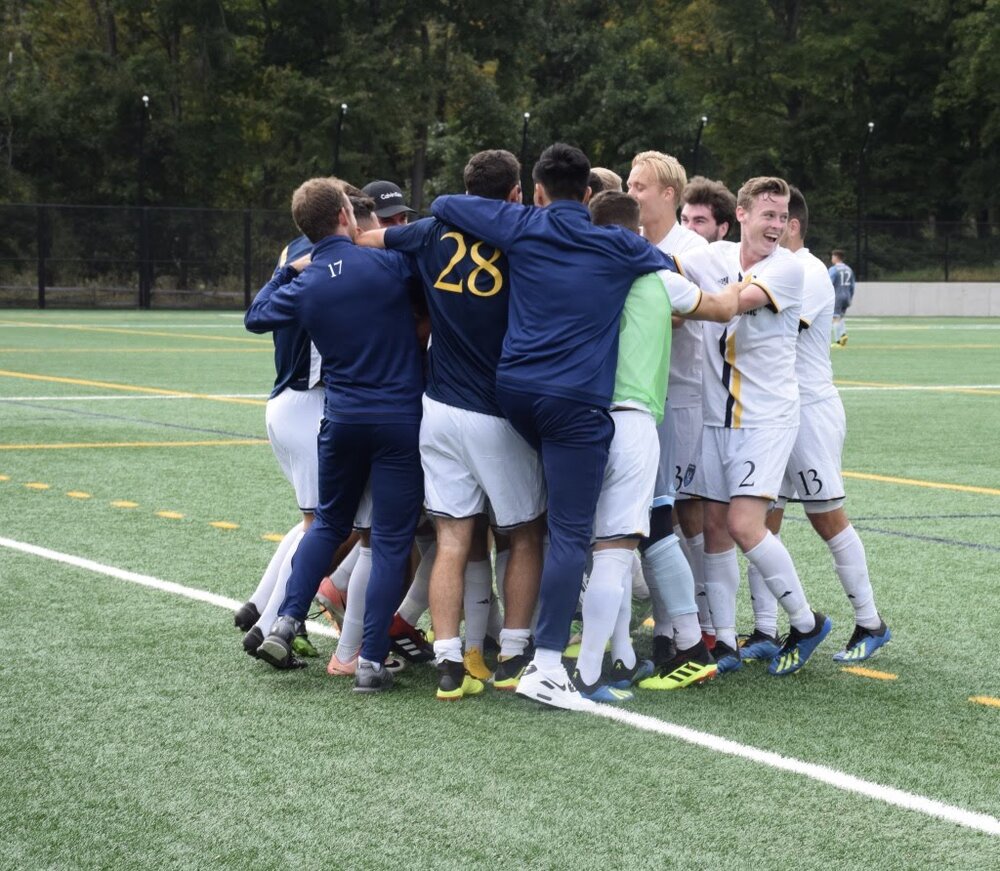
The Quinnipiac men’s soccer team celebrates a goal from last season. The Bobcats made it all the way to the MAAC finals in 2018, before losing 1-0 to Rider.
The United States was built by people who came from other countries for new opportunities.
The same can be said for some of the Quinnipiac men’s soccer team.
Take senior defender Conor McCoy for example. He hails from Forkhill, Ireland, and the opportunity to go to school and play soccer at the same time was too good to pass up.
“The whole dream of football and study, I think that was the real selling point,” McCoy said. “Both coaches sold it really well, and this school is really great. I really wanted to get a degree out of it as well. I didn’t want to just finish playing football and whatever age and not have any future opportunities.”
McCoy is one of 13 international players on the Quinnipiac men’s soccer team who has made his way to Hamden.
The team has the most international representation of any sports team at Quinnipiac. There are 27 players on the roster, with 13 from outside the United States, representing nine different countries.
Men’s soccer also has the highest percentage of international players at just under 50%. The next highest is the women’s soccer team having 36% of the team from outside the U.S.
How they recruit these players is an overt strategy with Quinnipiac head coach Eric Da Costa at the helm.
“It’s a really complicated process,” Da Costa said. “The first thing that we’re looking for is that first impression. What we get on video from a player, usually it’s some type of highlight reel. You’re really just focused on the technical ability of the player. Then we start to do some digging. We need full matches and we have a couple different scouting software that we use that have a pretty in-depth database globally.”
After the first step is taken, Da Costa said it’s about finding out who the player is as a person. It becomes less about the soccer player and more about the international student trying to come to a new country. When he gets the chance, Da Costa will travel to different countries to meet with his prospective recruits personally.
According to Da Costa, that’s not always the case. Due to budgetary restrictions, there is only so much international travel that Da Costa and his staff can do. So they rely on technology to keep their relationships with these players growing.
“We do a lot of Skype; we do a lot of Whatsapp and Facetime,” Da Costa said. “Just trying to get that face time with these guys and figuring out who they are, what they’re about, what makes them tick and does that fit into what we do here. It’s really important that we bring the right character into this program.”
Da Costa is also looking for players that want to not only be a part of a collegiate soccer program, but want to be a part of his program.
“I want someone who wants to be at Quinnipiac, not because it’s an opportunity to play soccer or there’s a potential scholarship, or it’s an opportunity to come to the United States,” Da Costa said. “That means nothing to me. I want someone who wants to be at Quinnipiac University for all the right reasons. They want to play for me, they want to be a part of this program. They want to help continue to grow and help us continue to win.”
That same “want” that Da Costa looks for in his players, is also reciprocated the other way. Junior midfielder Simon Hillinger, a native of Ditzingen, Germany, felt that as much as he wanted to come to the United States, Quinnipiac wanted him as well.
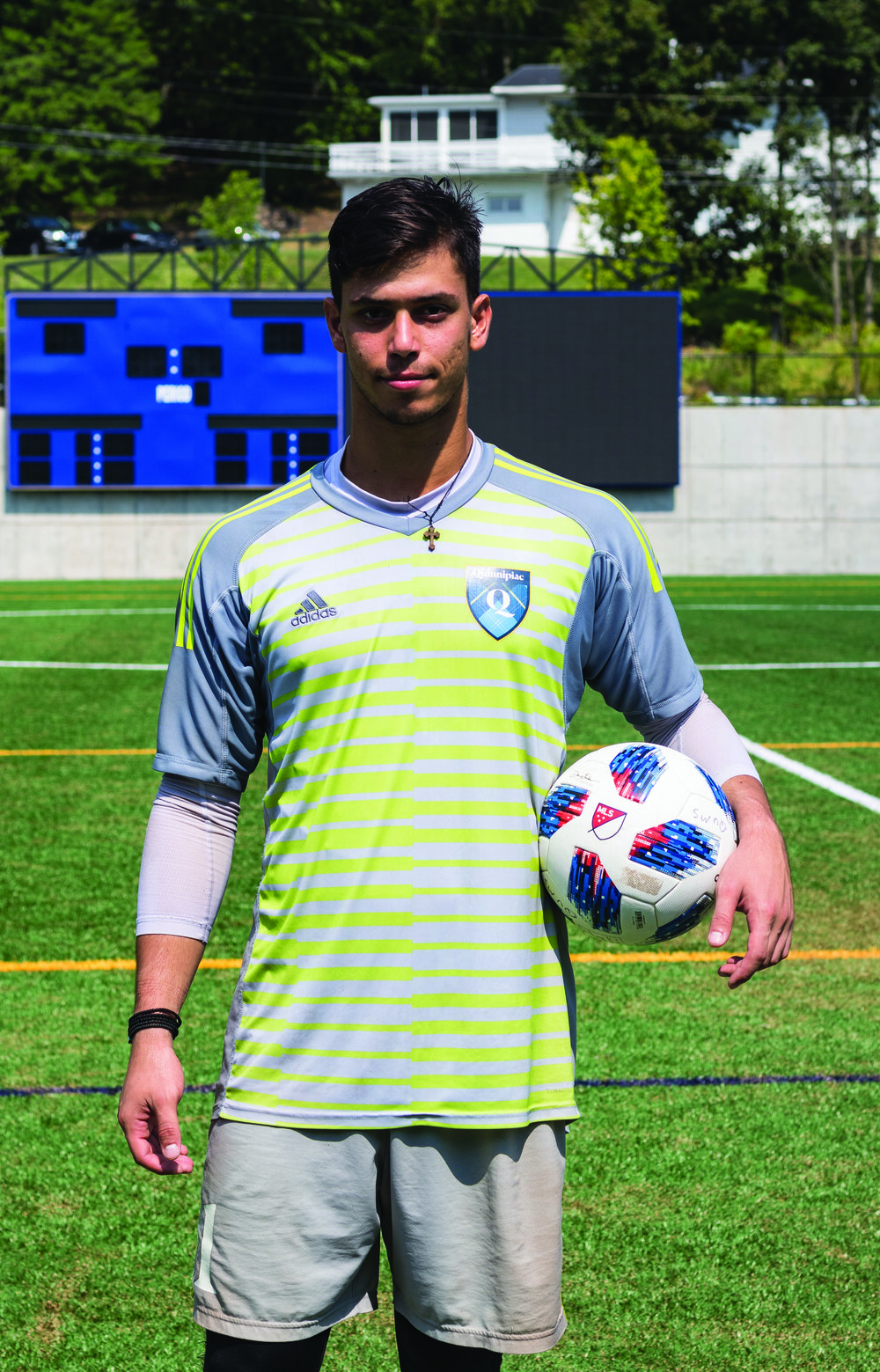
“I saw that coach had big dreams for the team and big goals, so I was really just like ‘Why not? I want to be a part of this family and this team.’”
-Chrysostomos Iakovidis
“I really felt like the coaches wanted me here,” Hillinger said. “Compared to other coaches I talked to, I always felt like the second choice. But with [Quinnipiac assistant coach Graciano] Brito and Da Costa I felt right away that they really wanted me and really wanted me in their program.”
Hillinger isn’t the only one that feels that way. Senior goaltender Chrysostomos Iakovidis comes from Thessaloniki, Greece, and he also credits Da Costa in why he eventually chose coming to the U.S. to play soccer.
“Coach was really close to me from the first time (we met),” Iakovidis said. “He seemed like he really wanted me to get with the team and be a part of it. …I saw that coach had big dreams for the team and big goals, so I was really just like ‘Why not? I want to be a part of this family and this team.’”
Why they cross the Atlantic
For the players, there is a multitude of other reasons they come to the United States. And that changes from person to person.
In the case of senior defender Jeppe Haehre, it was his older brother, Daniel Haehre, who influenced his decision. Daniel made the choice to come to the U.S. and play soccer in 2011. Coming from Baerums Verk, Norway, the elder Haehre attended Virginia Commonwealth University before transferring to Hawaii Pacific University for his final three years.
“I kind of knew about the whole college experience from [my brother] so I kind of looked into it early,” Haehre said. “Then I reached out to Da Costa and Brito, and they told me a bunch of stuff about Quinnipiac. The people, the diversity that was here, that really pulled me into wanting to come here.”
Haehre first attended a showcase in Sweden, joining other prospective Europeans who wanted to come to the United States for soccer. From there, Da Costa and his staff watched Haehre’s video highlights from the showcase, reaching out to him afterward. It wasn’t long after that Haehre decided Hamden would be his home for the next four years.
“I was really ready for it because my brother did it,” Haehre said. “He always came home and told a bunch of stories about the cool experiences, so I was very open to a new culture and embracing that.”
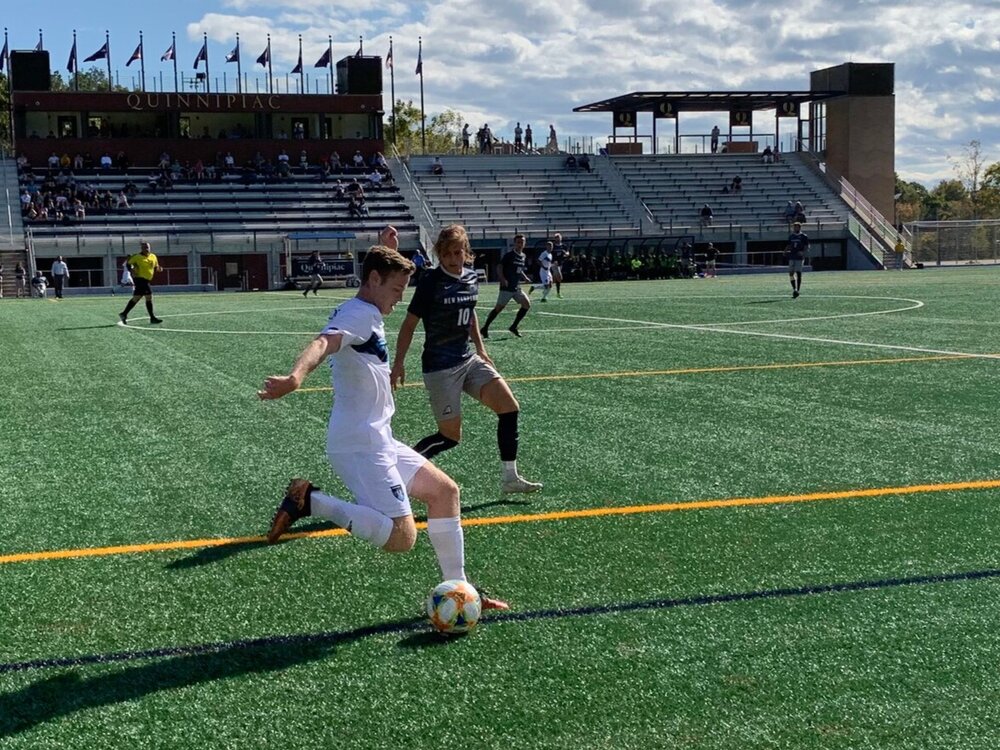
Quinnipiac sophomore defender Jordon Bennett kicks the ball up the field. Bennett comes from Central Coast, Australia. He is the only non-European international player on the team.
For others, such as freshman defender Henry Weigand, coming to the United States provided an opportunity for additional development. Weigand was playing in the U19 Bundesliga North/North-East league, which is considered to be the highest division in German youth soccer. However, when scouts approached him, they felt he wasn’t quite ready for the next level in Germany.
“A scouting agency came to me and said that they thought I had the potential to play at the high, college level,” Weigand said. “But they didn’t think I could go to next division in Germany. I had to develop a little bit more, and I know that I will be [eventually be] a professional in Germany. So I took the other option [for college].”
Unlike in the United States, it’s not common for people to go to college. Most will go straight into the workforce and never even give a thought about higher education.
“In this country, you raise your kids and they’re going to college,” Da Costa said. “A lot of other countries aren’t like that … at the end of the day, an international kid and their family want to go to a place where they’re cared about. They want to go to a place where they know they can study and play at a high level, which they can’t do in most of their own countries.”
Complications in the process
With that said, it’s not always smooth sailing for these players to come play. They might have the destination, but they now have to get to the U.S., which includes applying for and receiving a visa. Raya Al Wasti, the secretary for Multicultural and Global Initiatives at Quinnipiac, explained how the process can differ depending on where the player is form.
“We have countries that are really easy to get their visas here, but sometimes it’s harder because of political issues in the country,” Al Wasti said.
Weigand was one of the players that experienced some difficulties in getting his visa. After going through all the paperwork, the visa eventually did arrive, but later than expected. As a result, it threw off Weigand’s entire move to the U.S.
“I had a little issue with my visa, so it came three days late,” Weigand said. “I had to cancel my first flight and at that point I really wanted to go [to the U.S.] because when you are focusing on one point to leave and then you have to move it to a second point, it was like I was wasting time in Germany.”
From within U.S. borders
As for the 14 Americans on the team, eight of them are coming from the Nutmeg state. Some are from the local area of Hamden, such as sophomore midfielder Ivan Ramos, and North Haven, such as sophomore midfielder Alex Holle.
“We have a really good pool of talent in Connecticut,” Da Costa said. “Myself and my staff being involved in the local club [soccer] scene, we’re able to identify them early. If the kid’s not leaving the state, then why is he not coming to Quinnipiac? We think that if you’re not going to Yale, then Quinnipiac should be high up on your radar because we feel like we can offer everything else any other Division I institute in Connecticut can offer.”
If you’ve followed the team recently, the name Eamon Whelan is constantly being brought up. The reigning MAAC Offensive Player of the Year and the Preseason MAAC Player of the Year isn’t from across the ocean. In fact, he’s just about an hour away, coming from New Fairfield, Connecticut. But having these players come from all over provides Whelan with something that he wouldn’t have been able to get at home.
“I grew up in a very suburban area where there’s not that much diversity,” Whelan said. “So being able to come [to Hamden] and play and be around kids from all around the globe, it’s been a big eye opener. I think on the field I’ve grown, but socially as well.”
Looking at other student athletes near the area, Glastonbury, Wallingford and Farmington are a few more of the areas that the players come from. Having this close distance to the campus allows for the international players to have a warm welcome when being a Bobcat.
For example, Holle and his family treats some of the international players to Thanksgiving, a tradition most have never heard of, but get that exposure to when in the U.S.
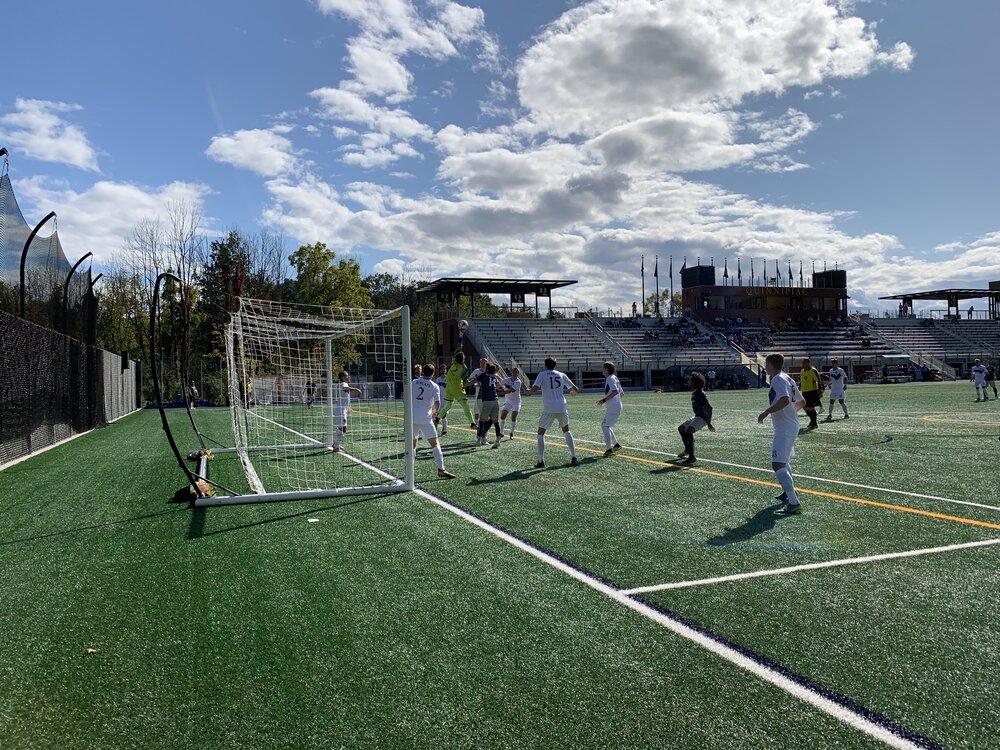
Quinnipiac goaltender Jared Mazzola reaches up to tip a shot away. The Bobcats currently own a 4-4-3 overall record, while they are 2-2-1 in the MAAC.
“The Connecticut guys are massive for us just because those families are here,” Da Costa said. “Again, we recruit good people, so they come from good families. These families open up their doors and their hearts for these guys and they become almost surrogate parents which is really cool to see.”
Regardless of whether a player is from Spain or Norway, Connecticut or New York, at the end of the day, they all are here for a reason – to be a Quinnipiac Bobcat on the men’s soccer team.
“When you come here, it’s not about you,” Da Costa said. “It’s about us, it’s about the program, so we spend a lot of time figuring out ‘Do they have that type of mentality?’”
He continues, “We’ve spent a long time building a culture that we’re all really proud of. I always say culture is people, so the people in our program make our culture. We obviously know what we want to be but these guys have to carry that out. So we try and make that we get the right person to come in and fit in what we do.”