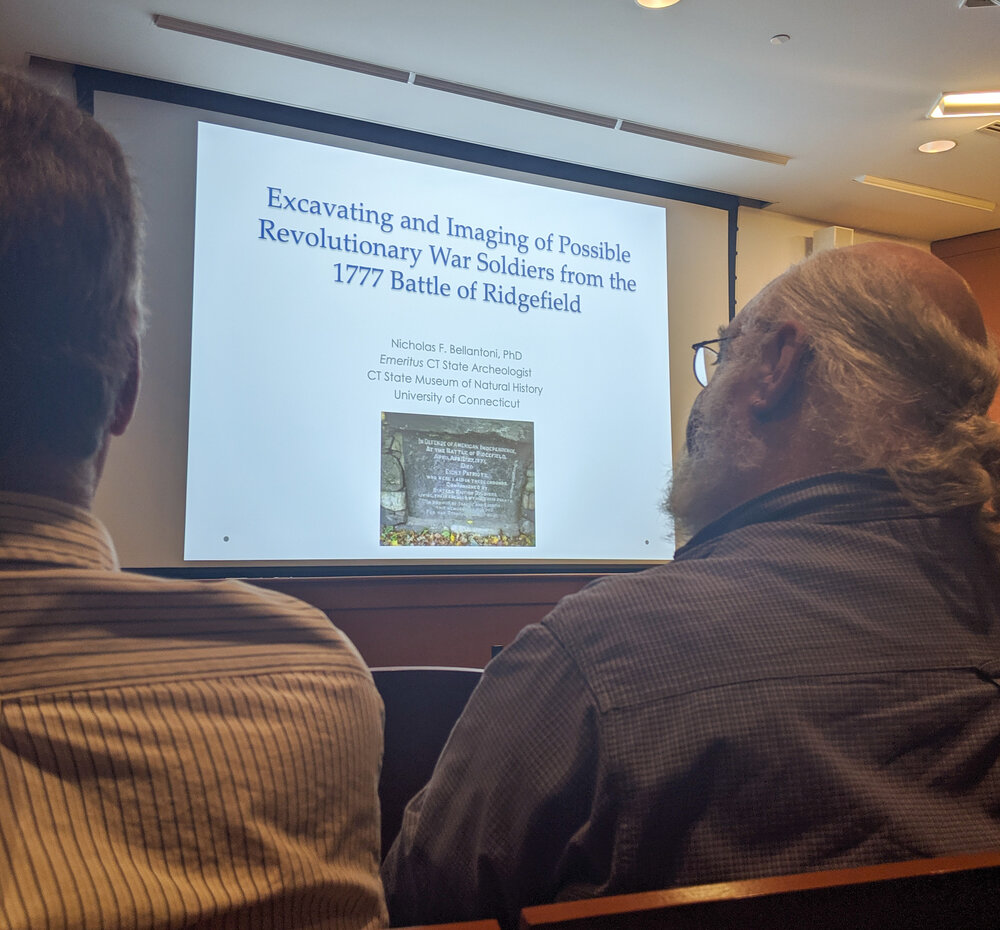
Audience members watch on as archaeologist Nick Bellatoni presents his findings. Courtesy: Garrett Amill
Connecticut state archaeologist Nick Bellantoni believes the human remains found in Ridgefield, Connecticut last fall are likely the remains of Revolutionary War soldiers. At a presentation given in Quinnipiac University’s Center for Medicine, Nursing and Health Sciences on Monday, Bellantoni discussed the remains, which were discovered in a cellar.
“The thing I should preface right off the bat is I don’t have a lot of conclusions to give you,” Bellantoni said. “It’s probably going to take a good year to get a handle on what we have.”
However, if the remains are from soldiers, this is considered a major find. The remains were found in situ, or in place, meaning they hadn’t been disturbed prior to the archaeological research. According to Bellatoni, this is very rare.
“It will put revolutionary Connecticut on the map,” he said.
The discovery began as a police case. On Nov. 25, 2019, construction workers were renovating a basement in Ridgefield, Connecticut when they found some bones underground. The workers called the police, who then called the medical examiner’s forensic anthropologist. Once the anthropologist discovered just how old the bones were, the state archaeologist was brought in.
“The law in the state of Connecticut is that whenever bones are 50 years old or more, the state archaeologist is notified,” Bellantoni said.
Bellantoni knew there had been a Revolutionary War battle in Ridgefield with some dead from both sides of the conflict buried in the town. He’d looked for remains in the past, but never found anything.
Bellatoni hoped the finding was Revolutionary War soldiers, but he didn’t have the highest hopes at first. Farming families often buried their dead near their homes, so the bones could be linked back to that.
However, when he got to the site, Bellantoni found soldiers were most likely buried there. He said the remains were from strong men between the ages of 25 and 35.
Then came the most important piece of evidence.
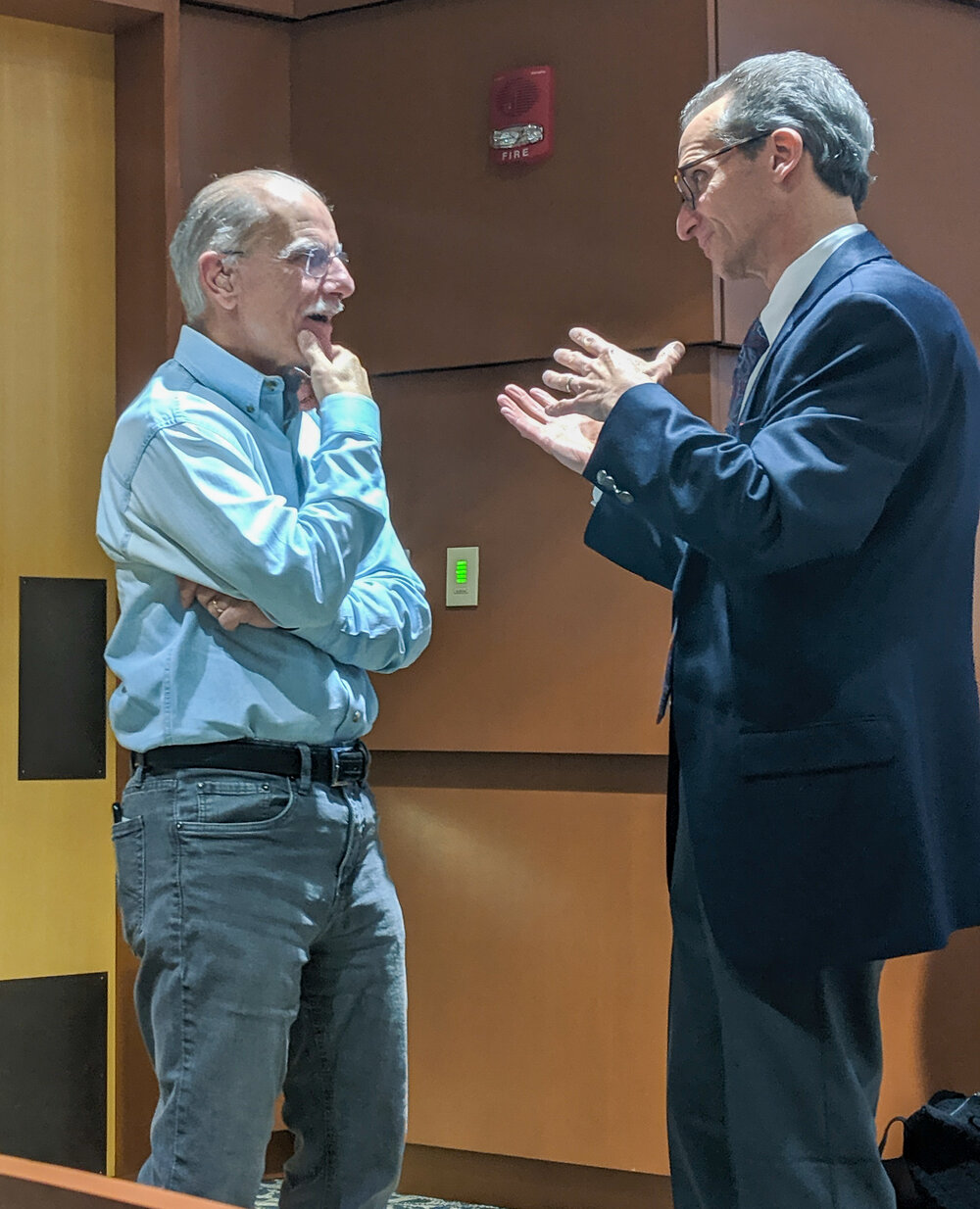
Nick Bellantoni and Eddy Rosenblatt conversing before the presentation. The two studied the same remains, and came to similar conclusions. Courtesy: Garret Amill
“We started to find buttons,” Bellantoni said. “These buttons were a strong indication that the remains weren’t from farmers..In the colonial period, clothing was expensive. You didn’t bury someone with something so valuable that could be passed down to brothers and sisters.”
However, Bellatoni still had his doubts.
“One of the things we have not found yet in the field is trauma,” he said. “If the remains are from soldiers, they would have been killed by some sort of trauma.”
Dr. Eddy Rosenblatt, a radiology consultant for Quinnipiac University, validated that nothing found on the bones can be considered trauma.
“We can come up with all kinds of exciting speculation that this guy took a headshot and that’s why he’s buried,” Rosenblatt said. “However, more likely it has to do with the burial.”
Still, Bellantoni believes the remains are from Revolutionary War soldiers.
“I’m still calling it a hypothesis, but really I’m struggling to come up with another explanation for three healthy guys together on a battlefield,” he said.
Bellantoni also mentioned Quinnipiac’s effort in this investigation.
“Quinnipiac has been so helpful with the diagnostic imaging of those remains,” he said. “This is only the latest of a number of collaborations we’ve had. The collaboration has been so marvelous.”
Bellantoni and his team will continue to analyze the remains. The bones were not allowed to be photographed at the presentation.