
Exactly a year ago, in Ellesburg, Washington, Macey Dunn and Reagan Perez had their lives upended.
The Central Washington University rugby team they played for had been eliminated by university administration without any notice.
They both transferred to Quinnipiac for a fresh start. Two weeks ago, gathered with their teammates in a conference room in the Recreation and Wellness Center, they listened to Athletic Director Greg Amodio deliver familiar news: Quinnipiac, like Central Washington, was cutting its rugby team.
“I’m still trying to find the words,” Dunn, a junior, said. “This school promised me more. Promised me that it wouldn’t be like that, just for them to do it all again, literally a year later.”
In an April 14 press release, the university announced that “following a comprehensive review of varsity participation, conference affiliation, department resources, and gender equity considerations,” Quinnipiac will add a men’s indoor and outdoor distance program and transition women’s rugby from Division I level to a club sport.
However, following said announcement, the university has been met with pushback and outrage from the team and the current and former student body, due to the lack of communication and transparency on the situation.
“These decisions are never easy, but they are essential to ensuring that Quinnipiac Athletics remains equitable, competitive, and sustainable for the long term,” Amodio wrote in the press release.
The announcement further states that “the initiative aligns institutional resources with long-term competitive priorities, fiscal sustainability, and the University’s ongoing commitment to Title IX compliance.”
Women’s rugby came to Quinnipiac following a Title IX lawsuit in 2011. Since then, the team has won three NIRA national championships — in 2015, 2016 and 2017.
When the news first dropped
That Tuesday, April 14, the women’s rugby team received an email from Sarah Fraser, deputy director of athletics and senior woman administrator, at 10:40 a.m., informing them about a meeting scheduled for 11 a.m., giving the team only 20 minute notice.
According to freshman Emily Hartman, the coaches got an email informing them about a separate meeting, confusing the team as to why they were separated.
When the team got in the conference room, Hartman recalled Fraser and Amodio entering together with Amodio holding an envelope.
“He just sits down and reads ‘Dear QU rugby,’” Hartman said. “And (Dunn and Perez) they immediately get up because they knew what he was about to read to us.”
Hartman continued that what Amodio read out loud to the team was almost the same press release that the student body received just an hour later. The team also wasn’t informed about the establishment of the men’s outdoor and indoor distance teams, but rather found out from social media afterwards.
Some of the team members were not even present as the short notice meant they couldn’t ask to skip class, per NCAA rules.
“It was like immediate sobs for everyone,” Hartman said. “I’ve never been in a room where so many people were trying to catch their breath because our lives just got turned upside down. And while we were getting read the script, our coaches were getting the same script read to them.”
Quinnipiac women’s rugby rosters 27 players with only four seniors. That’s 23 players that were presented the choice to accept losing their Division I athletes status or scramble to find a new placement at a different program.
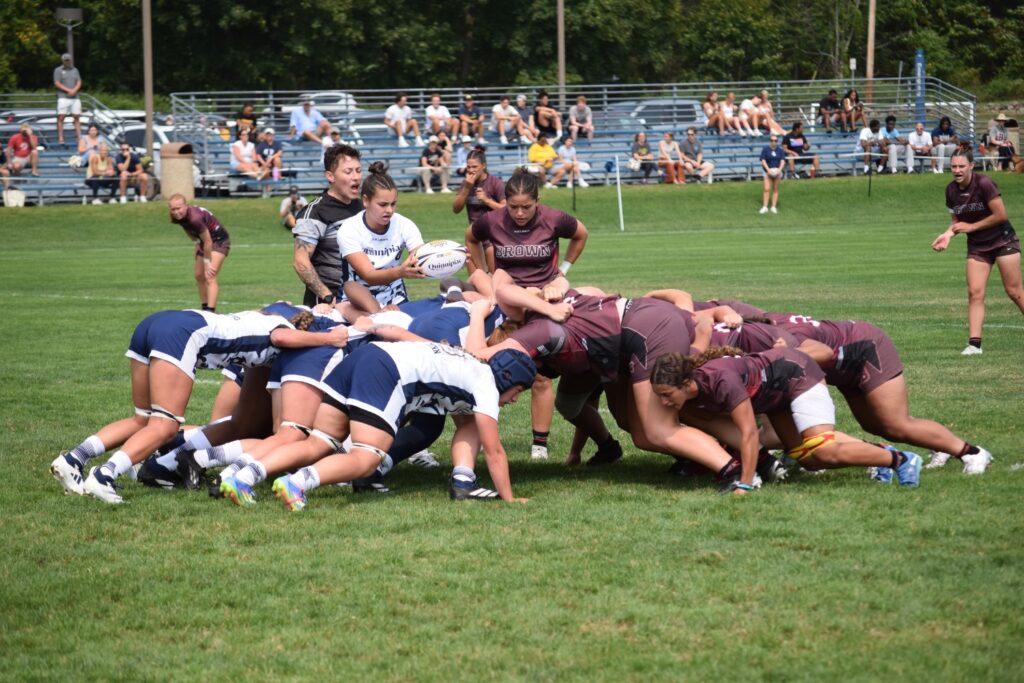
“I immediately thought about the hard work I put in it my whole life,” Hartman said. “My parents sacrificed so much to get me to this point. To have 14 years of my life just taken away in three minutes was like a heartbreak.”
Hartman continued that after that meeting, the team went back to their field, “spread out, crying and calling our parents.”
The news quickly reached other universities with rugby programs, as well.
“I was kind of confused,” Navy women’s rugby head coach Murph McCarthy said. “I was in Hamden playing a tournament on Sunday and they played well that day. So to see them make a decision to downgrade the team, it’s confusing and it doesn’t really make sense because they’ve had a lot of success. It doesn’t really add up for anybody that I’ve talked to.”
A few minutes after the news reached the wider Quinnipiac community, a former player and an Olympic Bronze medalist Ilona Maher ‘18 posted on her Instagram a screenshot of the press release with the words “Shame on you @quinnipiacu, @quathletics.”
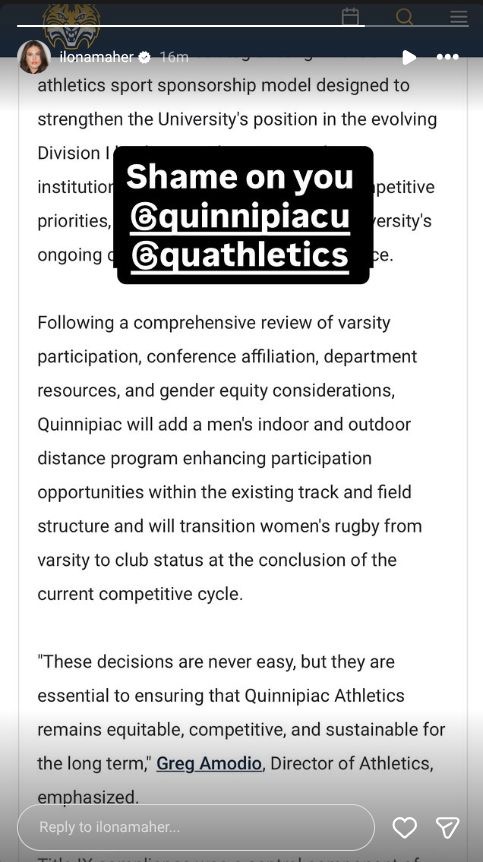
“It feels great to have what is probably one of the most well known Quinnipiac alumna publicize this issue,” Hartman said. “And it shows what greatness comes from Quinnipiac rugby.”
Maher wasn’t the only one to immediately respond, as a petition was created mere minutes after the announcement.
The petition
Former Assistant Coach and player Colleen Doherty started a Change.org petition a little after the announcement. The petition quickly gained traction and at the time of publication, sits at 28,280 signatures.
“We call on Quinnipiac University, their President Marie Hardin and Athletic Director Greg Amodio to reverse its decision and reinstate women’s rugby,” the petition states. “This should not just be a legal obligation but it is a commitment to fairness, opportunity, and the continued advancement of women in athletics.”
A couple days later, former Quinnipiac women’s rugby captain Libby Moser ‘22 helped create a Linktr.ee hub with resources for current student athletes, alums and concerned individuals.
The hub contains links to the petition, links to file a Title IX complaint as well as a pdf of Letter of Reinstatement for Quinnipiac Rugby signed by 50 Quinnipiac women’s rugby alumnae.
“It was really nice that everybody was agreeing with us that Quinnipiac was wrong,” Moser said. “People that I don’t talk to anymore that I graduated Quinnipiac with, reached out saying that they’d signed. People are really concerned.”
Despite the petition reaching more than double the signatures than Quinnipiac’s student body population, Moser said that the lack of response from the university is “disheartening.”
“I think the school should’ve responded by now,” Moser said. “I would just hope that the school knows this is a terrible look and the school should at least sit down for a conversation and understand the ramifications of their decisions.”
The petition has been supported by other rugby programs as well, with coaches speaking out in support of Quinnipiac’s team.
“To have other opposing colleges like Dartmouth, Harvard and Sacred Heart, all those girls signing our petition who are our competitors,” Hartman said. “It shows that getting rid of our varsity program doesn’t just affect Quinnipiac’s women’s rugby, it affects all the other teams in our conference.”
The silence and the impact
The press release stated that “Quinnipiac is committed to supporting affected student athletes through continued access to academic support, student athlete services and mental health counseling. Athletics will coordinate with Campus Recreation to ensure women’s rugby remains a well-resourced and organized club program and will work closely with students to ensure a smooth and respectful transition.”
Despite that, the athletics provided no additional communication, with the athletes or anyone else who reached out.
“I called every level of Quinnipiac administration,” Moser said. “The only response that I’ve received was an email from (Senior Associate Athletic Director) Billy Mecca and it was a copy pasted response that he sent to everyone who emailed him a concern, saying to just look back at the announcement.”
The only response the community has received, was an April 17 university-wide email from Chief Experience Officer Tom Ellet and Amodio, informing about three pieces of information about how they are “supporting the student-athletes affected by this decision.”
“Every rugby student’s athletic scholarship will be honored — including scholarship commitments made to incoming students,” Ellet and Amodio wrote. “Academic advising support for all team members will continue throughout their time at Quinnipiac; and athlete mental wellness and performance support for all team members will also continue throughout their time at Quinnipiac.”
Moser noted that that email only went out to the university community and the concerned alumni had to find out from friends who are still students.
The team is in a similar boat to Moser, getting no response despite the promises.
“We’ve contacted (Fraser) multiple times, contacted (Amodio), and they have not responded,” Hartman said. “His secretary will not pick up or return our calls and emails. I don’t feel any support from him. (Fraser) said to redirect all of our questions to the head of the club sports, even though they said we’re still Division I athletes until May 11.”
At Quinnipiac, the club sports fall under Campus Recreation.
“Campus Recreation is committed to work with Athletics and our Women’s Rugby athletes to smoothly transition the Women’s Rugby program to Club Sports status,” John Somers, associate director of recreation, wrote in a statement to HQNN.
He also clarified that despite there already being a men’s club rugby team, women’s rugby would be its standalone team, receiving “the same high quality of administrative support and athletic training care that all our Club Sports receive.”
Somers also wrote that Campus recreation and Athletics have been engaged in conversation about the transition since April 14.
“Our Campus Recreation leadership welcomes any conversation with current Women’s Rugby players about how to best support them as we help steward this program,” Somers wrote. “We recognize what a great tradition and history of success this program and these players have.”
Lorena Neptune, a sophomore international business and business analytics major and a close friend to the rugby team called the lack of communication with the team “outright disgusting and disrespectful.”
“You can change their lives with a snap of your fingers, but you can’t deal with the consequences of your actions,” Neptune said of the administration. “Some of (the players) have not been to class since. It really is their whole life and to have that turned upside down, to scramble to find some place to go in the fall, they’re very stressed. I don’t want to see my friends and members of our community leave so quickly.”
The Athletics Department has not responded to HQNN’s attempts for a statement.
Head coach Becky Carlson also has not responded to attempts for an interview and her only response to the situation was shared with NBC Connecticut the day the press release came out.
“We built something from scratch, won three national championships, brought the university an olympic medal,” she said. “Forward-thinking leaders see the power of women’s sport and support the space for it. Today, I’m afraid Quinnipiac is lacking those leaders and it is truly crushing.”
Title IX compliance
In the press release, the university’s athletics states that “Title IX compliance was a central component of the evaluation process and remains a guiding priority for Quinnipiac’s long-term athletics planning.”
The review has said to have assessed “participation opportunities by gender, roster management practices, proportionality relative to undergraduate enrollment, and the sustainability of providing equitable competitive and developmental support across all varsity programs.”
Women’s rugby was added as a direct result of the Biediger, et al. v. Quinnipiac University lawsuit, where Quinnipiac was found to be non compliant with Title IX regulations after it tried to get rid of its women’s volleyball team.
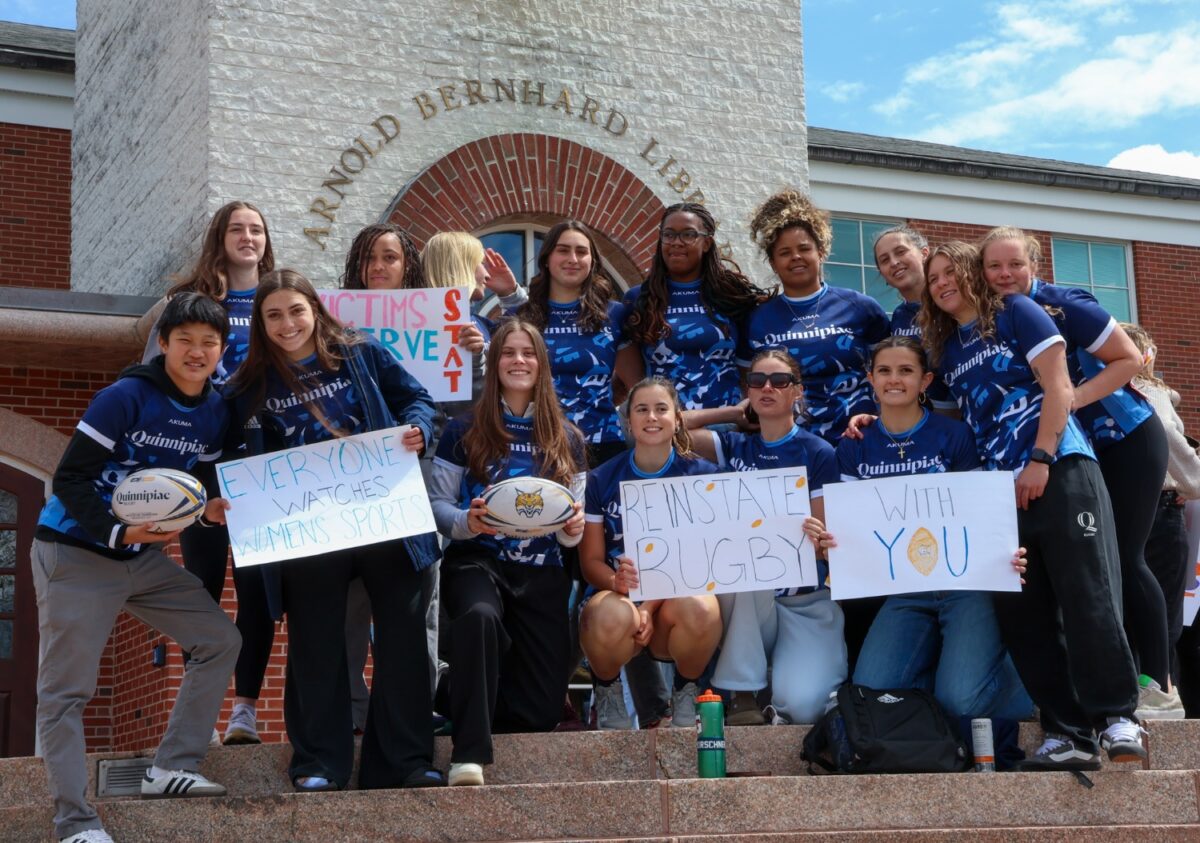
On Tuesday, April 21, the women’s rugby team joined QU stat, a new organization determined to hold the school accountable in Title IX issues, in a peaceful protest on the steps in front of the Arnold Bernhard Library.
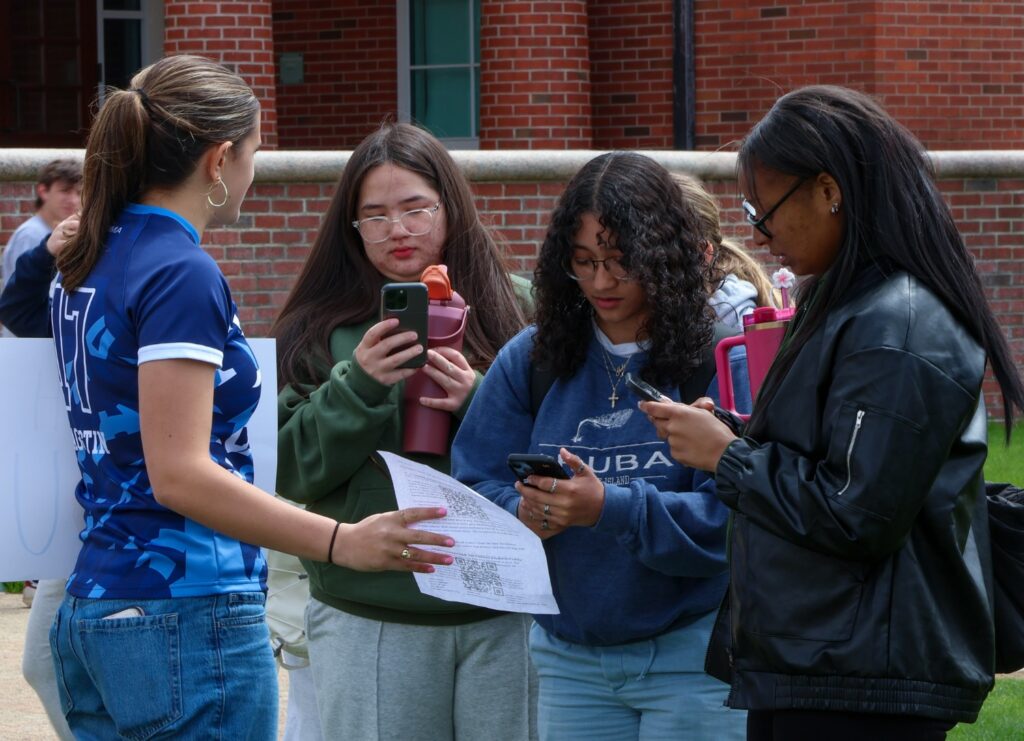
Quinnipiac President Marie Hardin attended for a little, addressing the team directly.
“I understand your deep, deep disappointment,” Hardin said. “You represented this university well, and you received news recently that you neither wanted nor expected. And I’m not trying to minimize that, but I want to say to each one of you, as students of this great institution, matter to us and as you navigate all of this and weigh what comes next, we are here to help you and we’re here to work with all of you.”
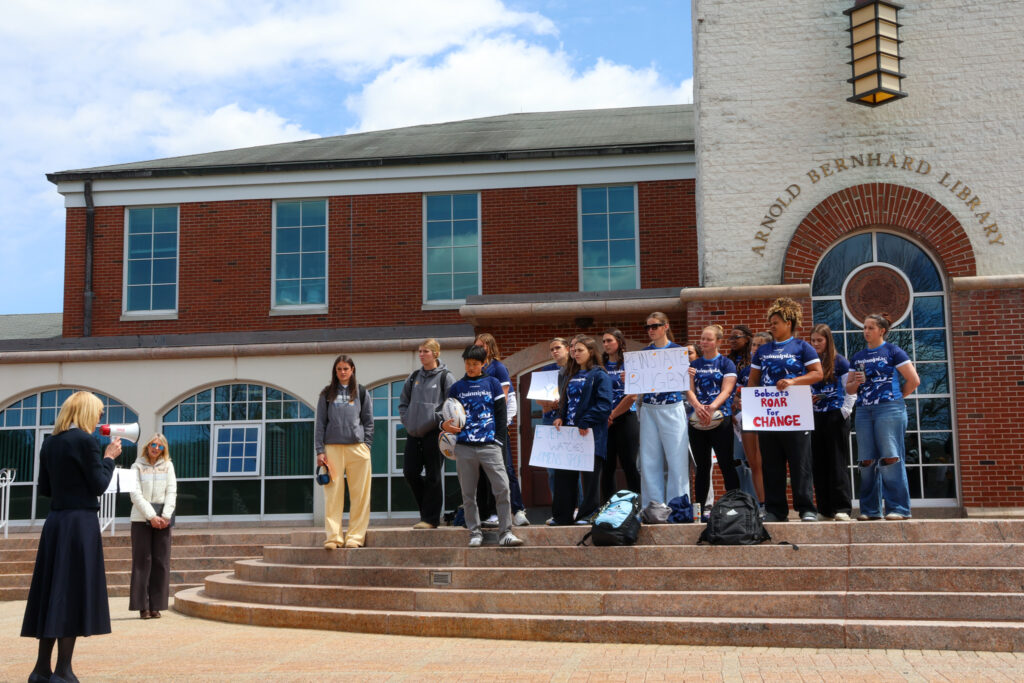
Hartman said that the team appreciated her presence.
Senior Lucy Lamborn had a message for the university following the protest.
“You cannot cut a women’s program, especially one intent on uplifting young women into a new and emerging sport,” Lamborn said. “Rugby is a fantastic community. We are just asking to be shown the respect that we deserve and to be reinstated as the Division I level and get answers, true answers.”
According to the NCAA, “Title IX requires that women and men be provided equitable opportunities to participate in sports. Title IX does not require institutions to offer identical sports but an equal opportunity to play,” which have to be “substantially proportionate to their respective rates of enrollment of full-time undergraduate students.”
In most schools, these rules ensure that women’s sports aren’t forgotten about. Quinnipiac seemed to have the opposite issue.
In the 2023-24 academic year, the university’s total undergraduate enrollment was 6,070 students — with 2,386 male and 3,684 female students. That translates into roughly 61% female student body compared to 39% male.
According to the Equity in Athletics Data Analysis records, that year there were 475 student-athletes at Quinnipiac.
The unduplicated number of female student athletes — as in not double counting indoor and outdoor track and field and cross-country athletes as they share rosters — was 300 (63%) versus 175 (37%) male student-athletes.
Duplicated numbers would make the women’s count rise to 366 (68%) while the men’s count remains unchanged at 175 (32%).
Those percentages show that the numbers were skewed towards women’s sports, not complying with Title IX in the sense of not providing enough opportunities for male athletes.
While adding the men’s outdoor and indoor distance program might not necessarily add to the male student-athlete count, or at least not enough to significantly impact the percentages, getting rid of the women’s rugby team crosses off 30 spots from the female numbers.
In numbers, this translates to hypothetical 260 unduplicated spots for female student-athletes making up 60% of the total count, while the unchanged 175 male student-athletes would make up the remaining 40% — adequately proportionate towards the school’s undergraduate enrollment.
Finances and conference
According to EADA, women’s rugby expenses in the 2023-24 academic year amounted to $934,801, neither the highest or lowest costing team at the university.
These expenses track all game-day expenses as well as additional, including things like field upkeep, jerseys, travel, scholarships and so on.
However, men’s cross country’s only cost $226,910.
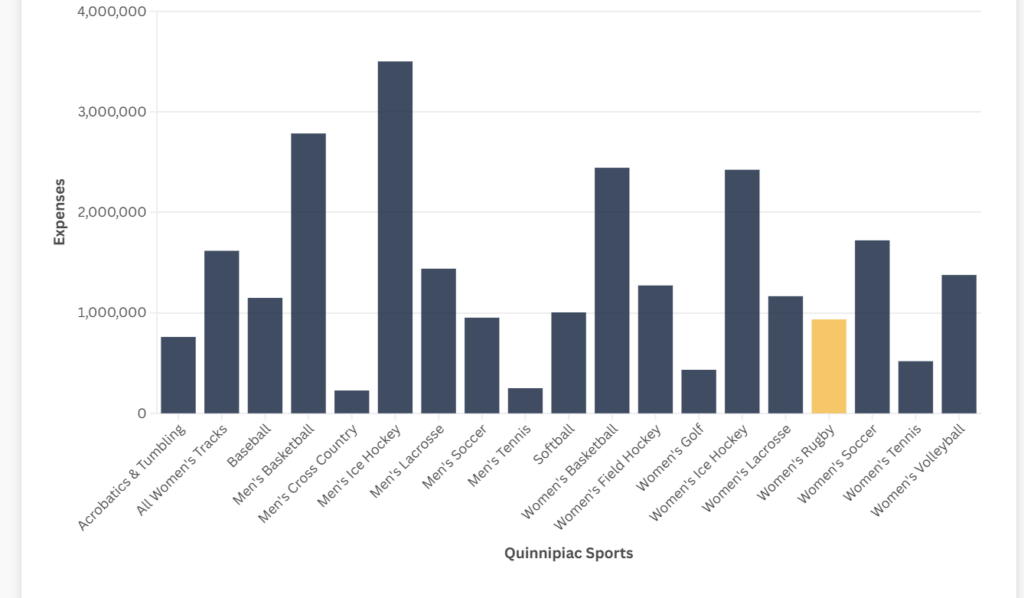
Adding a men’s outdoor and indoor distance program wouldn’t make that expense rise by that much. But this distinction would allow the cross-country athletes to participate in track meets and represent the university, something they were unable to do before.
Both cross-country and track and field are NCAA Championship sports. Rugby, on the other hand, is not.
While there is the push to make all NCAA sports championship sports eventually — such as acrobatics & tumbling becoming one come 2026-27 academic year — the chances for rugby to become one anytime soon are low.
The reason for that is the emergence of women’s flag football and its recent addition to the NCAA Emerging Sports for Women, supported by the NCAA President Charlie Baker.
Rugby competes in the NIRA and Quinnipiac is a three time national champion. While only varsity teams compete in the championship, there are only 24 universities across the U.S. with a rugby team, across all three Divisions.
Losing its varsity status means also losing its coaching staff, which leaves the future of the team’s game schedule unknown, even if the other teams are willing to still compete with Quinnipiac.
“I’d like to play everybody and of course, still got a decent team up there, and they got a place for us to play,” McCarthy said. “I’m game to put the girls on the bus and come up and get after it, for sure.”
The future
Following the petition, the rugby team with Lamborn in charge, has set up a Gofundme to “obtain legal insight into why the University chose to cancel our program.”
The team is aiming to raise $50,000 and currently is at $16,016 in donations at the time of publication.
Even if the team were to send this issue into court, it would take a while for it to be settled and the transfer portal for fall sports closes May 15. These student-athletes still have to make a difficult decision very fast with almost no prior notice.
“The last couple of days have not felt real at all,” Dunn said. “It’s just very emotional. It’s sad because obviously we want to get rugby reinstated but we also need to focus on what’s best for ourselves. But we’re also grieving, because this is the closest team I’ve ever been on and we don’t want to leave each other. We’re a family.”